oak wilt management

Oak Wilt Information Updated

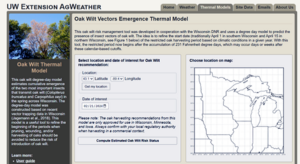
University of Wisconsin-Madison Extension online tool to help with oak wilt decisions.

A University of Wisconsin-Madison Extension online tool provides users localized information about the estimated emergence status of the two most important insects that transmit oak wilt in Wisconsin. / Graphic Credit: University of Wisconsin-Madison Extension

By Kyoko Scanlon, DNR Forest Pathologist, Fitchburg
Kyoko.Scanlon@wisconsin.gov

In 2025, oak wilt was detected for the first time in Hughes Township, Bayfield County, a northern Wisconsin location where oak wilt remains uncommon. There were no new county finds in 2025.

Based on the findings in 2025, the maps in the Oak Harvesting Guidelines To Reduce The Risk Of Introduction And Spread Of Oak Wilt (the oak wilt guidelines), oak wilt fact sheet and were updated. The maps in the oak wilt guidelines are good through the end of 2026.
Continue reading “Oak Wilt Information Updated”

Oak Wilt High Risk Period Quickly Approaches

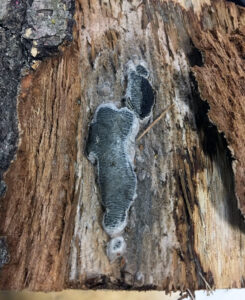
A closeup of a fungal pressure pad under the bark of an oak tree infected with oak wilt.

A fungal pressure pad formed on the outside of the sapwood underneath the bark of an infected tree. The pad will create cracks in the bark, where beetles can enter and visit the pad and become covered in spores. They will then leave and move on to infect new trees through open wounds. / Photo Credit: Wisconsin DNR

By Alex Hornung, DNR Forest Health Specialist, Plover
Alexandra.Hornung@wisconsin.gov or 715-340-3810

It is again that time of year to pause operating in oak stands or pruning oak trees during the high-risk period for oak wilt, which begins in April. The high-risk period begins April 1 in the South, April 15 in the North, and ends in both zones on July 15.

The high-risk period is determined by when the beetles that carry the fungus that causes oak wilt have emerged for the year and when they are carrying the highest number of fungal spores. When wounds are created by logging operations or other activities that expose sapwood, the beetles carry the fungus to the wounded tree, and the disease process begins.

Continue reading “Oak Wilt High Risk Period Quickly Approaches”

Oak Wilt Confirmed In Ashland County

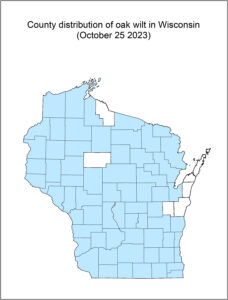
Map showing Wisconsin counties in which oak wilt has been detected.

With the addition of Ashland County, oak wilt has now been detected in 66 of Wisconsin’s 72 counties. / Map Credit: Wisconsin DNR.

By Paul Cigan, DNR Forest Health Specialist, Hayward
Paul.Cigan@wisconsin.gov or 715-416-4920

Oak wilt, a deadly disease of oaks, has been found for the first time in Ashland County.

The Wisconsin Department of Natural Resources (DNR) confirmed the find in wood samples from a red oak tree in the town of Gordon.

“There is always risk of oak wilt spread into new and relatively uninfested areas in northern Wisconsin, such as Ashland County, so it’s always best to practice oak wilt prevention wherever possible to significantly reduce that risk,” said Paul Cigan, a DNR forest health specialist based in Hayward.

Continue reading “Oak Wilt Confirmed In Ashland County”

Forest Health Team Offers Seven New Fact Sheets, Updates Website

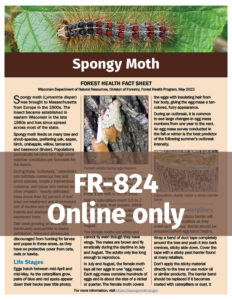
A preview of the new Wisconsin Department of Natural Resources Forest Health fact sheet on spongy moth.

A preview of the new Wisconsin Department of Natural Resources Forest Health fact sheet on spongy moth. Graphic Credit: Wisconsin DNR

By Art Kabelowsky, DNR Outreach/Communications Specialist, Fitchburg; Arthur.Kabelowsky@wisconsin.gov or 608-335-0167

The Wisconsin Department of Natural Resources’ (DNR) Forest Health team has debuted seven new fact sheets, providing information on various forest insects and diseases as well as tips on how to deal with their emergence on your property.

The new fact sheets provide details on spongy moth, oak wilt management, spruce budworm, jack pine budworm, tamarack insects (larch casebearer and eastern larch beetle), red pine pocket decline and mortality and a comparison of common spring defoliator caterpillars (forest tent caterpillar, eastern tent caterpillar and spongy moth).

Additionally, the Forest Health team has updated and/or refreshed the look of its 13 existing fact sheets.

Continue reading “Forest Health Team Offers Seven New Fact Sheets, Updates Website”