Statewide Forest Health

Look for next year’s gypsy moth infestations

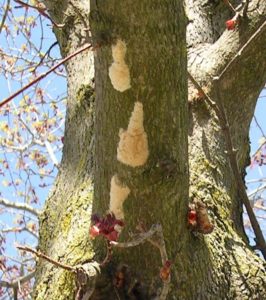
Gypsy moth egg mass.

Gypsy moth egg mass

Early fall is the best time for property owners to determine whether gypsy moths will be a problem next year. Gypsy moth egg masses are tan-colored and about the size of a nickel or quarter. Egg masses will not hatch until next spring, which means landowners have plenty of time to plan to minimize gypsy moth damage next summer. New egg masses produced this year feel hard, whereas those that are older are soft and appear faded. Most egg masses will be found on tree trunks and the undersides of branches, but they can also be found on buildings, firewood piles, vehicles and other outdoor objects. 

Continue reading “Look for next year’s gypsy moth infestations”

New video on buckthorn control available

Common buckthorns retain leaves late into the fall.

Common buckthorns retain leaves late into the fall.

The following article offers a glimpse of the good work that happens after DNR awards grants through its Weed Management Area – Private Forest Grant Program (WMA-PFGP).  Dick Ballou, the driving force of the Cedar Lake Buckthorn Project, takes us through his efforts to raise awareness of that forest scourge -common buckthorn- and control its spread.  The next application deadline for WMA-PGRP grants is April 1, 2018.  More information on applying for the grant can be found here.

Imagine the frustration of eagerly awaiting your opening day of deer hunting, having your stand in a perfect location and learning at daybreak that the woods around your stand are not as you expected? Several years ago, I prepared for bow hunting and found a perfect location for the deer stand, except for one small problem, a 20-foot tall tree full of leaves. Thinking the tree’s leaves would be gone by mid-October, I placed the stand nearby and went home. Returning in October, the “perfect” location was seriously compromised by the same tree – full of leaves – obstructing my view. Later, I learned the tree was invasive common buckthorn that currently threatens woodlots from New England to Wisconsin and beyond. This experience led me to start the Cedar Lake Buckthorn Project and create this video on buckthorn control. Continue reading “New video on buckthorn control available”

Wettest year ever in Wisconsin

It’s official. January through July 2017 was the wettest Wisconsin has experienced in the 123 years data has been collected. The average across the state was 25.25 inches, which is 7.14 inches above average according to the National Weather Service.

Areas of northeast, northcentral, west central and southeast Wisconsin have recorded the wettest January through July since measurements began.

Total precipitation percentiles for the United States from January through July 2017. Overall, and for multiple areas of Wisconsin, it has been the wettest January through July ever recorded. Figure from NOAA

Flood and other storm damage have occurred to forests and urban trees in many areas of Wisconsin. We suspect storm damage from May to July has led to a number of new oak wilt infestations in impacted areas. The wet weather has also led to abundant leaf and needle diseases such as anthracnose. Plentiful precipitation has similarly played a role in insect populations. Japanese beetle larvae thrive with consistent soil moisture and the consistent rain in recent years has resulted in large populations of this pest across the Midwest. In contrast, the wet, humid spring led to another year of high mortality rates for gypsy moth caterpillars from disease.

Written by Mike Hillstrom, forest health specialist, Fitchburg (Michael.Hillstrom@Wisconsin.gov), 608-513-7690.

Early fall color?

You may be noticing leaves of various hardwood trees already turning to fall color in lowland areas. These lowland areas are holding more water this year and it is affecting the trees. The trees in these areas are stressed from being in water too long, and this is causing the hardwoods leaves to turn color early. Some of the hardwoods are dying in these lowland areas, and most conifers in these areas are also dying due to too much water.

Hardwood leaves turning to fall color

Hardwood leaves turning to fall color

Written by: Todd Lanigan, forest health specialist, Eau Claire (Todd.Lanigan@wisconsin.gov) 715-839-1632

Ladybug larvae don’t look much like ladybugs

Ladybug adults and larvae are great predators of aphids and scales and help keep those pests in check.  Ladybug larvae don’t look much like ladybugs though, so you may not notice them, or you may wonder what the tiny monster is that’s munching on aphids.  Ladybug larvae come in a variety of colors and shapes.  Several people have described them as looking like a small dragon, or for those of you from Rhinelander, perhaps they look like a tiny Hodag.

I recently came across a critter that I would have never guessed was a ladybug larvae; it looked more like a mealybug to me.  It was on red pine, and there were no aphids on the red pine, so nothing triggered me to think “ladybug larvae.”  After snapping a few pics, I dismissed it as an oddity.  But of course oddities are just mysteries waiting to be solved.  Mike Hillstrom, my counterpart in Fitchburg, helped narrow this down to a ladybug larvae.  Ladybugs in the Hyperaspis genus have larvae that look like mealybugs, and those ladybugs (both larvae and adults) specialize in feeding on pine tortoise scale!  How fitting since I found it on red pine!

The following photos illustrate that ladybug larvae come in many shapes, sizes, and colors.

Ladybug larvae come in many shapes, sizes, and colors.Ladybug larvae come in many shapes, sizes, and colors.Ladybug larvae come in many shapes, sizes, and colors.

This ladybug larvae, in the genus Hyperaspis, looks like a mealybug and specializes in feeding on pine tortoise scale.

This ladybug larvae, in the genus Hyperaspis, looks like a mealybug and specializes in feeding on pine tortoise scale.

Written by: Linda Williams, forest health specialist, Woodruff, (Linda.Williams@wisconsin.gov), 715-356-5211 x232

New emerald ash borer finds in Wisconsin

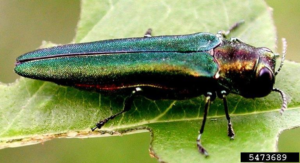
Much of Wisconsin has reached peak emergence of emerald ash borer adults.

EAB emergence map as of August 28, 2017. In the north the light green shows peak emergence, and olive is past peak emergence.

EAB emergence map as of August 28, 2017. In the north the light green shows peak emergence, and olive is past peak emergence.

EAB continues to be found in new areas. Wisconsin tracks EAB at the municipality or township level. Quarantine counties are shown in tan and infested areas are shown in green on the map below.

EAB quarantine map. Counties shaded in tan are quarantined for EAB, and include much of the southern half of Wisconsin, as well as other counties. Areas shaded in green are the townships and municipalities where EAB has actually been identified, and show that not all counties that are quarantined are fully infested.

EAB quarantine map. Counties shaded in tan are quarantined for EAB, green areas are townships and municipalities where EAB has actually been identified.

Click here for a larger version of the map: EABDetectionsQuarantines

New county quarantines:

  • none

New finds in counties already quarantined:

  • Columbia County – town of Caledonia and villages of Poynette and Rio
  • Crawford County – village of Soldiers Grove
  • Dodge County – towns of Herman and Theresa
  • Fond du Lac County – village of Campbellsport
  • Grant County – city of Boscobel
  • Green County – town of Sylvester
  • La Crosse County – city of West Salem
  • Manitowoc County – city of Manitowoc
  • Sheboygan County – village of Howards Grove, towns of Mosel, Rhine and Russell

Written by: Linda Williams, forest health specialist, Woodruff, (Linda.Williams@wisconsin.gov), 715-356-5211 x232.

Oak wilt vs. leaf diseases: Can you tell the difference?

Oak wilt symptoms are active right now, but so are several other oak leaf diseases.  Can you tell the difference?

Trees with oak wilt will suddenly start to drop their leaves in July and August.  These leaves will be either tan or a water-soaked greenish color away from the petiole (leaf stem).  Near the petiole there will often be an area that is still green, even though the leaf has fallen to the ground.  Symptoms typically start near the top of the tree and progress downwards.

Leaves dropped from a tree dying from oak wilt. Note the discoloration on the distal portions of the leaf, while the petiole area is still green.

Leaves dropped from a tree dying from oak wilt. Note the discoloration on the distal portions of the leaf, while the petiole area is still green.

Oak wilt leaves often drop from the top of the tree first.

Oak wilt leaves often drop from the top of the tree first.

Anthracnose is a fungal leaf disease that is quite common this year due to the wet weather that we’ve had.  Anthracnose is not fatal to the tree and the tree will hold these leaves throughout the season.  Irregular areas of the leaf will be dead, and if this infection occurred when the leaf was expanding the leaf will often end up misshapen or puckered.

Anthracnose causes irregular dead blotches on the leaf.

Anthracnose causes irregular dead blotches on the leaf.

Tubakia is another leaf disease that we will sometimes see.  Symptoms are typically worse in the lower canopy.  Leaves may drop from the tree but the pattern of mortality on the leaf will be different than what you see with oak wilt.

This oak is being affected by Tubakia, a fungal leaf disease. Symptoms are significantly worse in the lower canopy.

This oak is being affected by Tubakia, a fungal leaf disease. Symptoms are significantly worse in the lower canopy.

Written by: Linda Williams, forest health specialist, Woodruff, (Linda.Williams@wisconsin.gov), 715-356-5211 x232.

Dutch elm disease is prevalent this year

Dutch elm disease seems to be quite prevalent around the state this year, including the northwoods.  Symptoms, including whole tree yellowing and wilting have been occurring this summer, and will continue into this fall.  Dutch elm disease is an exotic fungal disease that is spread by the elm bark beetle and can spread underground through root grafts as well.  Since bark beetles are generally not attracted to smaller trees (sapling to small pole size) people often get their hopes up that their small elms have “escaped” and will survive and grow to maturity.  Unfortunately, as soon as the trees are large enough for the bark beetles to be interested in them the trees may become infected with Dutch elm disease.  The first symptom you will see is usually a single branch on which the leaves turn yellow and die.  The rest of the tree will die shortly after that.  Elm trees attempt to fight the fungus by walling off the portion of the tree where the fungus is located but this can lead the tree to self-induced water deprivation and death.  More info on Dutch elm disease, including useful pictures, can be found in the U.S. Forest Service document How To Identify and Manage Dutch Elm Disease.

Dutch elm disease is spread by elm bark beetles, which create artistic galleries under the bark of the tree.

Dutch elm disease is spread by elm bark beetles, which create artistic galleries under the bark of the tree.

Chemical injections can protect single trees, and some communities in North America still have large stately elms due to this strategy.  For new plantings, there are some disease resistant cultivars (those crossed with other elm species) and some disease “tolerant” cultivars of American elm which tolerate the disease without completely killing themselves.

Written by: Linda Williams, forest health specialist, Woodruff, (Linda.Williams@wisconsin.gov), 715-356-5211 x232.

Japanese Beetle Damage Extensive in 2017

Japanese beetles are abundant and causing extensive damage to many species of plants in 2017. Although many landowners in southern Wisconsin have experienced severe damage in the past, this is the first time many in central and northern Wisconsin have experienced an outbreak. The beetles are so common this year in part because populations have recovered after the droughts a few years ago. Many reports are also coming in from newly-invaded areas in northern Wisconsin.  Linda Williams noted heavy populations and significant defoliation to birch in the Minocqua/Woodruff area, and growing populations in the Rhinelander area.

Japanese beetles are pests both as larvae and adults. Larvae feed on roots of turf and ornamentals causing pale, dead patches that eventually combine.  Adult beetles feed on foliage and flowers of many plant species including trees, fruits, vegetables and weeds.  Linden, birch, crabapple, mountain ash, Norway maple and Japanese maple are favorite host trees.  Adults eat between the veins causing leaves to look lace-like.  Trees severely damaged turn brown and become partially defoliated.

Adult Japanese beetles feed on a wide-variety of plants causing leaves to have a lace-like appearance.

Adult Japanese beetles feed on a wide-variety of plants causing leaves to have a lace-like appearance.


Many treatment options are available, but in outbreak years landowners may be resigned to limiting damage to their favorite plants.

Control options include:

  • Remove beetles by hand and squish or put in soapy water.
  • Spray beetles with an insecticide labelled for Japanese beetle control.
  • Do not irrigate during peak adult flight to make the soil less attractive for egg laying.
  • Apply carbaryl (Sevin), clothiandin (Arena) or trichlorfon to the soil in early to mid-August to kill larvae.
  • Apply imidacloprid, chorantraniliprole, clothianidin and thiamethoxam to soil from May to early July to kill larvae.

Some common control options are not recommended. Traps are typically ineffective as they attract more beetles to the area. Biological control of grubs using milky spore disease or others biologicals is often inconsistent.

For more information see UW-Extension’s fact sheet.

Written by Mike Hillstrom, forest health specialist, Fitchburg (Michael.Hillstrom@Wisconsin.gov), 608-513-7690.

Gypsy moth adults appearing now

Female gypsy moth lays an egg mass.

Female gypsy moth lays an egg mass.

As of mid-July, DNR forest health staff have received reports of adult gypsy moths present as far north as Burnett County. The brown-shelled pupae and white female moths can be crushed with a stick. The remaining caterpillars will also pupate soon, and where the caterpillars are a problem, they can be crushed, drowned in soapy water, or sprayed with insecticide or insecticidal soap. Continue reading “Gypsy moth adults appearing now”