
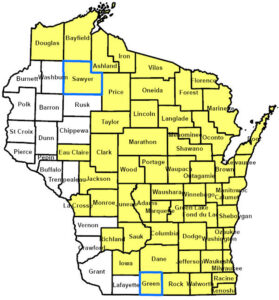
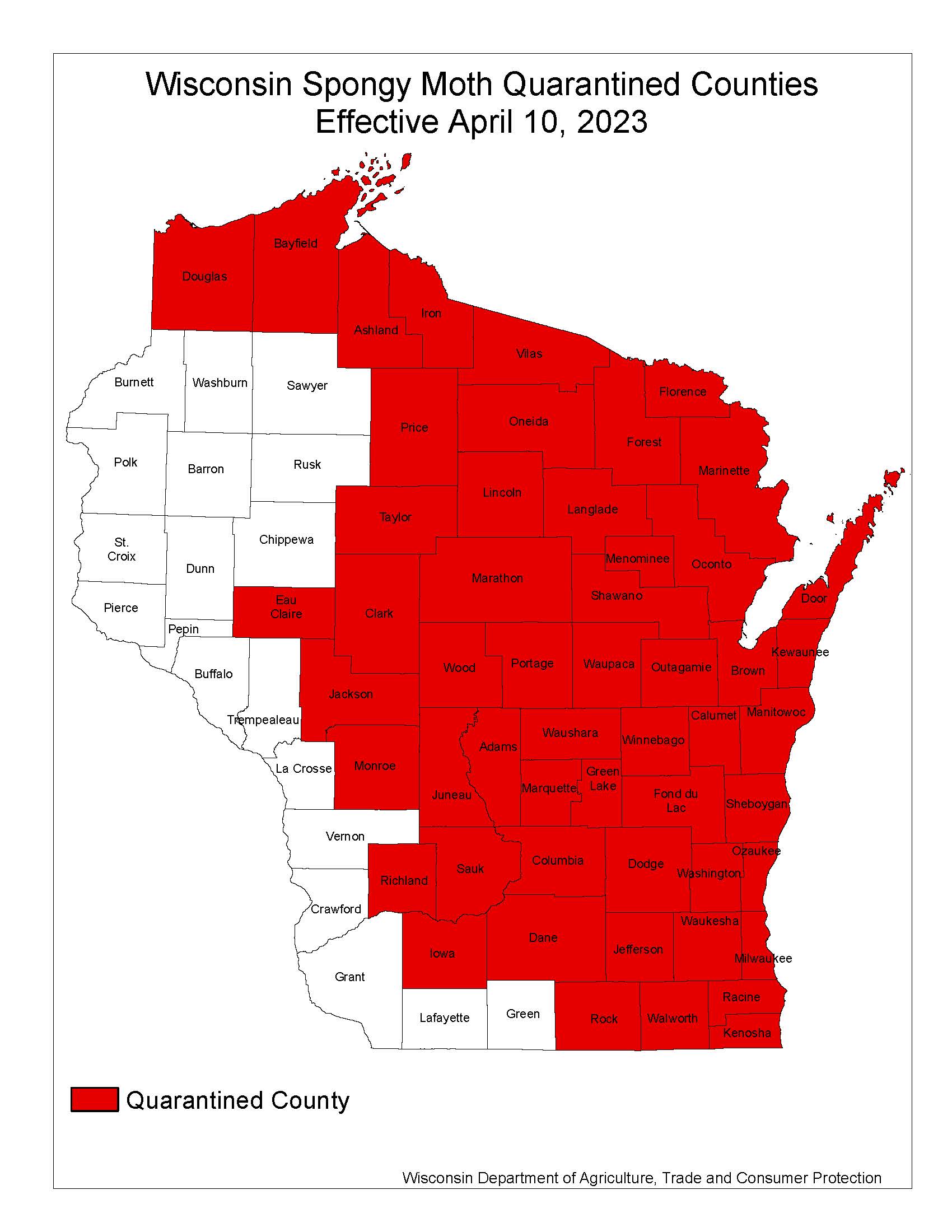
The updated map of spongy moth quarantined counties in Wisconsin, showing the April 15 addition of Green and Sawyer counties to the quarantined list. / Map Credit: Wisconsin DNR
By Wisconsin DNR
Green and Sawyer counties have become the latest additions to Wisconsin’s spongy moth quarantine, joining most eastern and central Wisconsin counties already considered to be infested by the invasive insect.
The announcement was made April 15 by the Wisconsin Department of Agriculture, Trade and Consumer Protection (DATCP), based on trapping data collected last year.
With the announcement, 56 of Wisconsin’s 72 counties are now under quarantine status for spongy moth. High spongy moth populations are most likely to be seen within the quarantined area, but may be present in non-quarantined counties.
Spongy moth is an invasive pest that has been spreading westward since its introduction to North America from Europe in 1869. In Wisconsin, spongy moth caterpillars are generally active from mid-to-late April through July, depending on location and weather.
As the caterpillars grow, they feed on the leaves of more than 300 tree species and can cause complete defoliation of trees, which may contribute to tree mortality. The caterpillars then pupate, emerge as adult moths and mate, with the females depositing lumpy, tan-colored egg masses that overwinter.
Placing a county under quarantine status activates regulations that have the greatest impact on plant nurseries, holiday tree growers, loggers and sawmills, invoking inspection requirements and movement restrictions.
According to a DATCP news release, these businesses must enter into a compliance agreement with state or federal plant regulatory officials certifying that their nursery stock and wood products are free of spongy moth before the stock and products can be transported into non-quarantined counties or states.
In addition, individuals living in or visiting a quarantined county are urged to be diligent when transporting outdoor items. Spongy moths can deposit egg masses on just about any surface left outdoors, including firewood, lawn furniture, campers and boat trailers, allowing the eggs to be transported and infest a new location.
With each egg mass capable of holding up to 1,000 eggs, it’s important to inspect items before moving them between a home and recreational site, or a business headquarters and a work site.
For more information, visit the State of Wisconsin Spongy Moth Resource Center, the DNR’s Spongy Moth webpage, the DATCP spongy moth webpage and the United States Department of Agriculture’s Spongy Moth webpage.