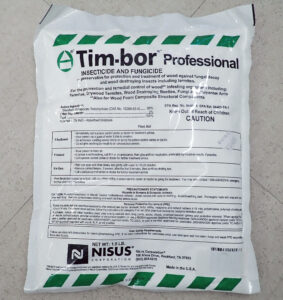
A bag of Tim-bor Professional, a borate-based chemical that fights Heterobasidion root disease. / Photo Credit: Wisconsin DNR
By Kyoko Scanlon, Forest Pathologist, Fitchburg
Kyoko.Scanlon@wisconsin.gov
People who have been dealing with Heterobasidion Root Disease (HRD) may be familiar with the product name “Cellu-Treat®.” It has been used to treat fresh cut stumps to prevent HRD.
But Cellu-Treat® is not the only chemical available for HRD. Another borate-based chemical, Tim-bor® Professional, can also be used legally for the same purpose in Wisconsin. Both products are manufactured by Nisus Corporation, and their labels are almost identical (Cellu-Treat label, Tim-bor label).
These products have the same active ingredient (disodium octaborate tetrahydrate), the same Environmental Protection Agency (EPA) registration number (64405-8) and the same Chemical Abstracts Service (CAS) number (12280-03-4).
Tim-bor® Professional is more readily available for purchase than Cellu-Treat®. An online search of “Tim-bor® Professional” will bring up many businesses that sell the product. Another advantage of Tim-bor® Professional is that though both products are available for purchase in 25-pound buckets, Tim-bor® Professional can also be purchased as a 1.5-pound bag. This matches well with the needs of a private landowner who owns a small woodlot, as they wouldn’t have to spend more than $100 for a 25-pound bucket and keep it in storage for a long time. A 25-pound bucket is cheaper than a 1.5-pound bag per ounce, but it provides another option to landowners and property managers.
As the manufacturer stopped selling Rotstop® C, a biological fungicide, in North America, these borate-based fungicides are currently the only options for purchase in Wisconsin to prevent HRD.
HRD is a serious disease of conifers that causes reduced height, shoot and diameter growth along with thin and yellowish/red foliage. It ultimately causes tree mortality.
Once HRD exists in a stand, it is very difficult to control. Prevention is the best approach. Preventive pesticide treatments can be applied to fresh cut stumps at the time of harvest to protect them.
Many factors influence the risk of infection and impact by HRD. A risk-based Fungicide Treatment Guide is available for landowners and property managers to determine whether fungicide treatment is warranted in a stand.