Wood Marketing Bulletin

GLTPA And Master Loggers Gather For Spring Celebration

Larry Krueger, right, accepts the Wisconsin Merit Award from GLTPA executive director Henry Schienebeck. / Photo Credit: Wisconsin DNR

By Brian Zweifel, Wisconsin DNR Forest Products Specialist

The Great Lakes Timber Professionals Association (GLTPA) held their 2026 Spring Celebration in Harris, Michigan, on April 1.  Each year, loggers and forestry professionals from Wisconsin and Michigan attend this conference to network, see the latest products and technology from over 60 exhibitors, and earn continuing education credits for training provided as part of the conference. This year’s training focused on wilderness first aid, worker’s compensation and chainsaw safety.

The Spring Celebration is also a chance for loggers to recognize leaders in their field. This year, GLTPA honored Larry Krueger of Krueger Lumber Company, Inc. in Valder with GLTPA’s Wisconsin Merit Award. Larry has been a long-time champion of Wisconsin’s forest products industry, most recently advocating fiercely for improved rail service for forest products companies to combat rising costs of shipping via truck.  Larry has also been a key external partner to the DNR Forest Products Services (FPS) team. Larry was instrumental in supplying kiln-dried white pine dimension lumber for FPS’s research and testing of white pine in mass timber panels.

GLTPA’s board met the day before the main event and included an update from DNR Chief State Forester Heather Berklund on current Division of Forestry (DoF) issues, projects and outlook for 2026. Furthermore, questions and concerns that the loggers had about the DNR and DoF were heard and addressed by Heather at the annual meetings. Some of the key themes discussed at the board meeting and in interactions with loggers were:

  1. Training and future workforce concerns: continued discussions on how DoF can work with the logging community on training with our staff, UWSP’s Wisconsin Forestry Center and others.
  2. Discussing ideas to support forest managers and loggers dealing with the long-term impacts of the loss of markets, as well as the recent impacts from shifting tariff policies and volatility in fuel prices.
  3. GLTPA and Henry Schienebeck’s work at the federal and state legislative level, including the Agricultural Roads Improvement Program (ARIP), Secure Rural Schools Program, Wisconsin Forest Industry Roadmap and Strategies for Tomorrow (WI ForestsFIRST) and more.
  4. Streamlining the process for loggers to access and utilize the DNR’s Temporary Bridge Program.
  5. Recognition of the importance and value of the USFS Wood Innovations Grant program for improving forest product markets.

The Wisconsin Master Logger Certification (WIMLC) program also met the evening before the main event. Forest Products Specialist Brian Zweifel, who acts as WIMLC’s Single Point of Contact (SPOC) with the DNR, attended their annual meeting along with Heather Berklund.  During the meeting, Zweifel provided information on how members can sign up for GovDelivery alerts to stay informed on DNR items of interest for loggers, including public input announcements and DNR property master planning updates. Zweifel also highlighted the first anniversary of WIMLC’s latest Green Tier Charter contract renewal, which granted them another five years of membership in the Green Tier program. For those unfamiliar, WIMLC recognizes loggers that meet and exceed the sustainable forest management standards set forth by the American Loggers Council. The program assesses and documents the harvest practices that loggers use in the forest through field audits and ensures that professional loggers are recognized for the excellent work that they do in responsible forest management and safety. WIMLC’s effort to go above and beyond minimum standards has made them a great fit as a Wisconsin DNR Green Tier Charter participant.

This is an increasingly challenging time to be in the forest products industry, but when stakeholders like GLTPA, WIMLC and the DNR can work together to find solutions, Wisconsin’s forests will remain in good hands.

Oregon Adopts Local-Use Lumber Grading

Two men in front of a PowerPoint main slide

Scott Lyon, left, Wisconsin DNR Forest Products Services team leader, and Scott Leavengood, director of Oregon Wood Innovation Center. / Photo Credit: Wisconsin DNR

By Brian Cole, Wisconsin DNR Forest Product Specialist

On Wednesday, April 1, at the Fitchburg Service Center, the Wisconsin Department of Natural Resources Forest Product Services team held its first Wisconsin Local Use Dimension Lumber Grading (WLUDLG) class for 2026.

Along with 10 Wisconsin students, we had the pleasure of hosting Scott Leavengood. Scott is the director of the Oregon Wood Innovation Center (OWIC) and has worked in Wood Products Extension with Oregon State University (OSU) since 1994. Last summer, Oregon passed and the governor signed into law Senate Bill 1061, otherwise known as the “Oregon Forests to Homes Act.” The bill establishes a training and certification program through OSU’s Extension Service to enable individuals to become certified lumber graders. Small sawmill operators can now mill and grade their own lumber and sell it directly to homeowners or contractors building one- or two-family homes. Scott Leavengood is leading Oregon’s efforts to develop a training program, and he came to Wisconsin to see how it’s done.

Wisconsin was one of the first states to pass a local-use dimension lumber bill in 2008 (2007 Wisconsin Act 208). The objective of the 2007 Wisconsin Act 208 was to produce local-use lumber that meets or exceeds the requirements of the one- and two-family dwelling code. The act recognizes that there is a vested interest among the parties: the homeowner, the home builder, the sawmill and the building inspector. They all want to ensure that quality lumber is being used in residential construction. It also recognizes that Wisconsin has a long history of using local-use lumber in construction. The act allows smaller sawmills, typically in rural areas where the cost of a grading bureau stamp would be prohibitive, to manufacture and sell dimensional lumber – keeping Wisconsin wood in Wisconsin and, by extension, supporting sustainable forest management.

The Forest Products Services (FPS) team, in cooperation with the University of Wisconsin-Stevens Point, held its very first WLUDLG class in 2009. Demand for the classes has increased every year, with the FPS team responding by offering multiple classes. In 2025, we had more than 80 graduates from the one-day class, and we look forward to another busy year of teaching in 2026. The FPS team would like to wish Scott Leavengood and the State of Oregon good luck with your new local-use lumber program. We know you’ll be successful.

The 21st Century Brings Changes To The Hardwood Lumber Industry

A pile of freshly processed hardwood timber.

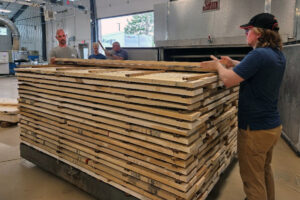
Hardwood lumber being stacked after processing. / Photo Credit: M. Bumgardner

By Matthew Bumgardner and Scott Bowe

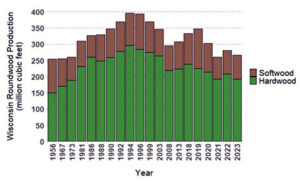
Hardwood lumber production in the United States reached a peak in 1999, with an estimated 12.6 billion board feet of output. However, the early 2000s ushered in a major structural shift – the large-scale offshoring of U.S. furniture manufacturing. Once the single largest user of hardwood lumber until the late 1970s, wood furniture has become the smallest major market for hardwood lumber today.

Continue reading “The 21st Century Brings Changes To The Hardwood Lumber Industry”

Markets Matter Convening Highlights

By Elle Soderberg, Wisconsin DNR Forest Products Specialist

Leaders from across the forest products industry, government agencies, research institutions and economic development organizations recently gathered in Madison for the U.S. Endowment’s Markets Matter Convening. The event focused on the central challenge facing the forest sector today: Developing sustainable markets for low-value wood fiber, including small-diameter timber and mill residues.

Throughout the convening, participants emphasized that while the forest products industry continues to face significant economic and market pressures, there are also growing opportunities for innovation, collaboration and investment.

Current Market Conditions And Industry Challenges

Presentations from consulting groups across the country highlighted the broader economic realities impacting the forest sector. Speakers noted continued uncertainty surrounding economic policy, low consumer confidence and ongoing challenges within the housing market, including elevated mortgage and inflation rates. Notes from the convening also pointed to a rising median age of first-time homebuyers, now around 40 years old, further impacting housing demand and construction activity.

The pulp and paper sector continues to undergo significant transformation. According to discussions during the event, U.S. pulp and paper capacity has declined substantially over the past decade, while aging infrastructure and global competition continue to pressure domestic facilities. Participants noted that many pulp mill closures have been tied to high operational costs and changing market conditions.

A recurring theme throughout the convening was that the issue is not necessarily a lack of available wood fiber, but rather a lack of markets capable of economically utilizing low-value material. Roy Anderson with the Beck group shared that millions of bone-dry tons of wood fiber remain underutilized annually despite existing infrastructure theoretically being capable of consuming significantly more material if fully utilized.

Supporting Existing Infrastructure While Expanding New Markets

Several speakers emphasized the importance of maintaining and supporting existing forest products infrastructure, particularly sawmills and pulp and paper mills, which were repeatedly referred to as “system anchors” for rural economies. These facilities not only provide direct employment, but also support logging contractors, trucking, land management and secondary manufacturing industries.

At the same time, participants discussed the need to diversify market opportunities for wood fiber. Increased interest in biomass energy, biochar, wood-based building materials and emerging carbon-focused products were highlighted as potential growth areas. Discussions also explored opportunities to expand wood use in non-residential construction and affordable housing initiatives.

Elvy Barton with the Salt River Project discussed what the company has done in terms of biomass utilization strategies in the western United States, highlighting efforts to diversify biomass markets through biochar production. Benefits discussed included scalability, environmental co-benefits and lower capital costs compared to some other technologies. Challenges, however, remain in developing supply chains, end-user markets and large-scale applications.

Learning From Successful State-Level Efforts

South Carolina’s Forestry Recovery Task Force was presented as an example of how states can respond proactively to market disruptions. After losing a significant portion of its fiber supply markets over a short period, the state focused on stabilizing remaining companies while pursuing innovation and new product opportunities. Participants stressed the importance of bringing together industry leaders, researchers, economic development organizations and elected officials to focus on realistic, actionable solutions.

Not only in this presentation but across the whole convening, a common theme seemed to be the importance of partnerships with universities, design professionals and organizations promoting wood utilization and mass timber construction.

Policy, Investment And Research Priorities

Breakout sessions on research, investment and policy generated extensive discussion around how to better align funding, innovation and market development efforts. Participants discussed the need for stronger commercialization pathways to help move new technologies and research “out of the lab” and into practical application.

There was also significant conversation around potential policy tools and funding mechanisms to support forest product markets. Ideas included loan guarantee programs, reinvestment of softwood tariff revenues into forest product infrastructure, incentives for domestic wood utilization and potential subsidies designed to reduce barriers for wood products in construction and energy markets.

Participants emphasized the importance of developing durable, long-term policies capable of supporting both existing infrastructure and emerging technologies. Several discussions also focused on the need for greater collaboration between public agencies, private industry, investors and research institutions. It was discussed throughout the convening that one clear message needs to be formed and backed by the industry as a whole.

 A Shared Message Moving Forward

One of the key messages throughout the convening was that maintaining healthy forests and strong forest product markets are closely connected. Speakers emphasized that conservation and production are not opposing ideas, but rather complementary goals that depend on sustainable management and active markets for forest products.

Participants also stressed the importance of broadening conversations beyond traditional industry stakeholders and continuing to bring new voices into discussions around forest management, biomass utilization and wood innovation. A lack of understanding and negative public perception were also often brought up and the need to reframe the education around forestry and wood-based products.

As the convening concluded, attendees and closer Chief Tom Shultz of the USFS reinforced the idea that supporting existing infrastructure while investing in innovation, collaboration and market diversification will be essential to strengthening the long-term resilience of the forest products industry. The event served as both a reflection on current market realities and a call to action for developing practical, collaborative solutions for the future of low-value wood fiber markets.

International Mass Timber Conference

A booth made entirely of mass plywood is displayed at an expo.

Freres, an Oregon-based mass plywood producer, created this unique booth entirely from mass plywood. / Photo Credit: Wisconsin DNR

By Alex Anderson, Wisconsin DNR Forest Products Specialist

For the last 10 years, stakeholders in the mass timber industry have gathered in Portland, Oregon, for the annual International Mass Timber Conference (IMTC).

The 2026 IMTC was well-attended by a variety of businesses showing off their wares: mass timber fastener manufacturers, mass plywood and cross-laminated timber (CLT) producers and fabricators, engineering and building firms specializing in mass timber applications, and many others from a host of different sectors came to network and show off new, unique products. More than 3,000 attendees from 28 different countries attended the 2026 IMTC, which was about six times the size of the inaugural event, held in 2016, and nearly twice the size of the event five years ago.

The DNR Forest Products Services team hasn’t been able to attend the conference since 2021. Since then, the event has continued to expand in popularity. This year, there were three keynote speakers at the event, which took place from Tuesday, March 31 through Thursday, April 2. On day one, the keynote address was a series of live pitchers from several developers to a group of investors from different agencies. This offered a rare glimpse into the nuances of financial discussions surrounding mass timber development. Day two of the event had Kengo Kuma as the keynote speaker. Kuma is a famed Japanese architect who was responsible for designing the primary stadium for the 2020 Summer Olympics when Japan hosted the events. He has also done a myriad of fascinating designs utilizing mass timber and other timber elements for both structure and appearance. Finally, day three’s keynote involved mass timber specialists from Amazon and Meta, who described their respective businesses’ interest and commitment to building with sustainable materials.

In addition to meeting many new folks and reconnecting with others, the IMTC provided a unique opportunity for the launch of the Great Lakes Mass Timber Collaborative’s (GLMTC) Regional Vision document, which spells out the long-term goals of the group and creates some hierarchical clarity for future funding. This event, hosted after the conclusion of the main IMTC presentations on the final day of the conference, involved each of the GLMTC state leads presenting for a few minutes on each leads’ respective state’s strengths, weaknesses and opportunities surrounding wider mass timber adoption. Alex Anderson, Wisconsin DNR Forest Products Specialist and Wisconsin’s state lead, gave a short presentation on Wisconsin’s forest products and forestry industries and how they might work in the larger Great Lakes mass timber ecosystem.

A couple of the many interesting products on display at this year’s IMTC:

A modular learning environment made of mass timber is displayed at an expo.

Kalesnikoff, a Canadian mass timber manufacturer, unveiled modular mass timber classrooms at this year’s IMTC. / Photo Credit: Wisconsin DNR

A curving arch made of Canadian mass timber displayed at an expo.

Art Massif, another Canadian mass timber company, showed off their “aspen pure” line of glulams, which are made entirely of quaking aspen (Populus tremuloides). Their testing showed these beams to be similar in strength and stiffness values to Spruce-Pine-Fir (SPF) products. / Photo Credit: Wisconsin DNR

USDA Announces Availability Of New Log Truck Route Planner Tool

logoThe U.S. Department of Agriculture’s Agricultural Marketing Service (AMS) announced the launch of an innovative new tool, the Log Truck Route Planner, to help forest owners, mill operators and log truckers in the Pacific Northwest allocate timber and schedule log trucks. The system can assist users in coordinating routing between logging sites and sawmills, which can significantly increase the returns to log truck owners/operators, create efficiencies in the operation of sawmills and ultimately increase the market for U.S. timber products.

The new tool, available on AMS’ Transportation and Marketing website, offers a way for the timber industry to reduce empty backhaul miles and increase the volume of timber moved daily, with a goal of increasing efficiency and revenue earned. The tool was developed in partnership with Washington State University and the Forest Service.

Log Truck Route Planner

The tool provides both a log allocator and truck scheduler, which can be run sequentially or independently, by uploading your own log delivery requests and using the scheduler to identify the optimal set of trips. The log allocator identifies the least-cost allocations from forests to mills to generate log delivery requests. The truck scheduler identifies the most efficient set of trips to fulfill log delivery requests.

For more information, check out the Log Truck Route Planner, User Guide, and Technical Documentation.

Fire At Ahlstrom Thilmany Paper In Kaukauna

external wide-angle view of a paper mill building

The Ahlstrom Thilmany Paper mill in Kaukauna.

A fire broke out at Ahlstrom’s Thilmany paper mill in Kaukauna on Saturday, May 16, affecting the wood chip conveyor system and main wood room area of the mill. Firefighters were able to extinguish the blaze, no injuries were reported and crews continue investigating the cause.

The fire is affecting the entire mill’s production, including roundwood procurement, which is currently on pause and will remain so until the mill repairs are complete. It is possible that no roundwood will be received at the mill for the entirety of June, though that is contingent on the speed of repairs. The Wisconsin DNR Forest Products Program will provide updates as more details become available.

Repurposing Closed Wood Products Facilities For Bioenergy Development

The U.S. Endowment for Forestry and Communities recently announced a request for proposals to “evaluate the technical, economic, and community feasibility of repurposing closed wood products manufacturing facilities for bioenergy.”

Due to the closure of many wood-using manufacturing facilities in the country, there are an abundance of facilities no longer in operation. To encourage the continued use of low-value wood fiber, the Endowment is seeking to support one or two projects that can lead to “redevelopment as biopower generation or biofuel production facilities.”

There will be up to $500,000 in funding available through this initiative. It will be granted to either one or two projects, depending on the quality of the applications and the feasibility of the sites. For further information, a PDF of the request for proposals is available.

Timber Bridges For Stream Crossings Now Available

One of the temporary bridge structures for stream crossings that will be available from selected Wisconsin Department of Natural Resources and private facilities for use by loggers who are working on timber sales. / Photo Credit: Wisconsin DNR

Through a U.S. Forest Service grant, along with a partnership with the Great Lakes Timber Professionals Association, the Wisconsin Department of Natural Resources (DNR) is soon going to be able to provide temporary bridge structures for stream crossings. Continue reading “Timber Bridges For Stream Crossings Now Available”

Forest Products Webinar Series: Recordings Available Now

The Wisconsin Department of Natural Resources Forest Products Service Team recently completed its webinar series highlighting Wisconsin’s forest industry. The sessions focused on product utilization and market development for urban wood, biochar and mass timber, along with economic trends for state and county economic development.

Webinar recordings are available to gain valuable insights and practical knowledge that support sustainable growth across Wisconsin’s forest sector. Details of the sessions are as follows:

Continue reading “Forest Products Webinar Series: Recordings Available Now”