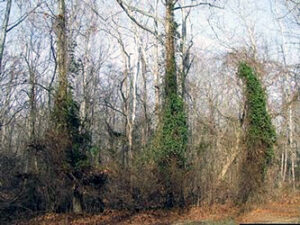
Japanese honeysuckle climbing up nearby trees. / Photo Credit: Leslie J. Mehrhoff, University of Connecticut, Bugwood.org
By Carter Hellenbrand, DNR Invasive Plant Field Specialist, Fitchburg
Carter.Hellenbrand@Wisconsin.gov
Note: This is the first installment in the Forest Health News “Invasives Spotlight” series, a monthly series of Forest Health News articles.
Many people recognize honeysuckle as a fast-spreading invasive shrub that can quickly displace native vegetation. But did you know that some honeysuckles exist as a vine?
Japanese honeysuckle (Lonicera japonica) is an invasive perennial vine that can grow to a length of 80 feet or longer. Birds will often eat and disperse the berries the vine produces, allowing for the creation of new populations.
Not only does this species reproduce via seed, it can also spread vegetatively through horizontal stems that grow underground (called rhizomes) and above-ground stems that grow horizontally along the soil (called runners).
Japanese honeysuckle grows in a variety of habitats including forests, grasslands and roadsides. Despite a lack of tendrils, it easily climbs and grows on top of surrounding vegetation. This results in the girdling of trees and shading out of native vegetation, creating hazard trees and lowering biodiversity within the ecosystem.
History Of Japanese Honeysuckle
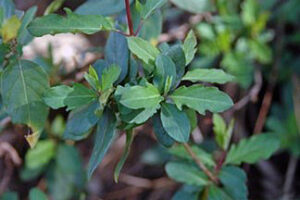
Japanese honeysuckle leaves can have entire and lobed margins. Lobed margins tend to appear the most on younger growth. / Photo Credit: Wendy VanDyk Evans, Bugwood.org
A native of eastern Asia, Japanese honeysuckle was first introduced into North America in 1806 and had been planted widely throughout the United States as an ornamental before becoming a regulated species in various states.
In Wisconsin, Japanese honeysuckle is listed as prohibited under the Invasive Species Rule NR 40. The rule makes it illegal to possess, transport, transfer or introduce this species in Wisconsin.
There have been positive detections for the species in Bayfield, Dane, Dodge, Columbia, Grant, Milwaukee, Portage, Rock and Sauk counties, but the overall distribution is still thought to be limited at this time.
Identifying Japanese Honeysuckle
Leaves: Occur in pairs along the stem and have an oblong to oval shape, with smooth or lobed edges. The paired leaves are not fused to the stem (i.e. not connate), which is a key characteristic.
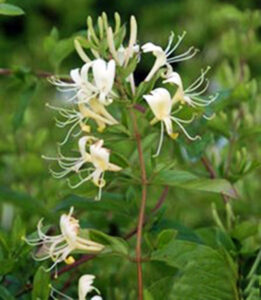
Japanese honeysuckle flowers along the stem at the leaf axils. The flowers start as white before fading to yellow as they mature. / Photo Credit: Chris Evans, University of Illinois, Bugwood.org
Flowers: Emerging in late spring and persisting into summer, the flowers are tubular and appear in pairs where the leaf connects to the stem (the axil). When they first emerge, they will look white in color, but they fade to yellow as they mature.
Fruit: Small berries that ripen in the fall, turning a deep purple or black color. Berries are approximately one-quarter inch in size.
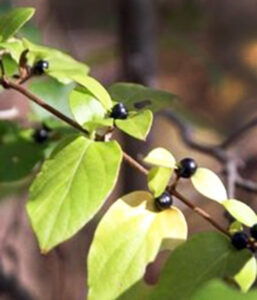
Mature Japanese honeysuckle berries at the leaf axils. / Photo Credit: Chris Evans, University of Illinois, Bugwood.org
Lookalikes
Native vine honeysuckles: In Wisconsin, there are a few native honeysuckle vines. Each of them closely resembles the other and the invasive Japanese honeysuckle.
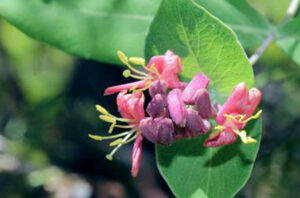
Native honeysuckle vine (Lonicera dioica) with a fused leaf encircling the stem. / Photo Credit: Rob Routledge, Sault College, Bugwood.org
The easiest way to tell the difference between native and invasive honeysuckle vines is the location of the flowers. Although the flowers can look similar, the flowers of the native honeysuckle vines appear at the tips of the stems and have two fused leaves circling the bottoms of the flowers. Japanese honeysuckle flowers appear at the spot the leaf emerges from the stem (the axil) and do not have leaves that are fused together.
Non-native bush honeysuckles: Although non-native bush honeysuckle leaves and flowers might resemble Japanese honeysuckle, the biggest difference between the plants is that one is a robust, multi-stemmed shrub and the other is a climbing vine. Non-native bush honeysuckle flowers are often white, pink or red and can fade to yellow as they mature.
Reporting Japanese Honeysuckle
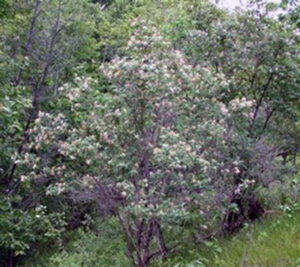
A robust nonnative bush honeysuckle flowering. / Photo Credit: Leslie J. Mehrhoff, University of Connecticut, Bugwood.org
A limited number of known populations of Japanese honeysuckle vines exist in Wisconsin. Eradication is still possible.
Wisconsin residents are asked to keep on the lookout for Japanese honeysuckle. If you discover the plant, please submit a report to Invasive.Species@wisconsin.gov. At a minimum, please include the location and clear photos of the plant’s identifiable features, including close-up and wide-angle views. Other important details, such as population size and landownership information, are also encouraged.
Controlling Japanese Honeysuckle
Small plants can be hand-pulled before the fruit develops. If the plant is larger, with vines extending into trees, do not try to pull the vines down. Doing so could lead to branches falling on those within the area.
To control larger and more developed populations, using a systemic herbicide directly on the leaves (foliar application) or by cut-stump application is most effective. Be sure to read the full directions on the label to determine mixing ratios, application rates and required safety measures.