
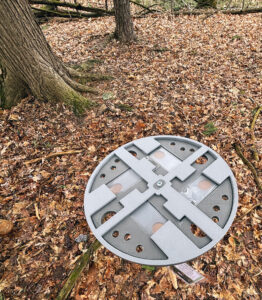
A 3-D printed trap used to collect hemlock woolly adelgid DNA. / Photo Credit: Wisconsin DNR
By Michael Hillstrom, DNR Invasive Forest Pest Coordinator, Fitchburg
Michael.Hillstrom@wisconsin.gov or 608-513-7690
This spring, the Wisconsin Department of Natural Resources (DNR) is collaborating with the Wisconsin Department of Agriculture, Trade and Consumer Protection (DATCP) to set traps to detect the invasive insect hemlock woolly adelgid (Adelges tsugae; HWA).
The project, funded by the Wisconsin Specialty Crop Block Grant Program, calls for traps to be set to detect the invasive insect. No detection of HWA has been made to date in Wisconsin forests.
Traps are being set at approximately 30 sites. Environmental DNA samples collected with the traps will be processed by the University of Wisconsin-Madison Biotechnology Center.
Detecting a tiny insect such as HWA in a large hemlock tree is extremely difficult. Rather than searching for the insect, traps are used to capture the mobile HWA life stage, known as crawlers, or other HWA material blowing in the wind. The 3-D printed traps hold microscope slides covered with petroleum jelly to collect the DNA that can then be analyzed in the lab.
The trap design was first refined for 2026 by students at Madison College. The college then used a 3-D printer to manufacture the traps using plastic that can hold up in Wisconsin weather. The traps were originally designed in Dr. Charlyn Partridge’s lab at Grand Valley State University.
Hemlock woolly adelgid is an invasive, aphid-like insect that feeds on eastern hemlock trees, often causing mortality. HWA has been spreading in western Michigan in recent years, so the Wisconsin DNR, DATCP and UW-Madison are collaborating to detect HWA before it becomes established in the state.