
By Elton Rogers, DNR Urban Forestry Coordinator
Elton.Rogers@wisconsin.gov or 414-294-8675
Most urban foresters and arborists are aware of the historical significance of Dutch elm disease (DED). Introduced to the United States in the 1930s, this deadly fungus wreaked havoc on urban and rural forests throughout the United States. In many ways, DED was the impetus for many of the best practices of urban forestry we see today, such as species diversification and modern plant health care practices.
Likewise, most urban forest practitioners understand DED is still very much prevalent today, and if they are managing any lingering American elms, they know they can help decrease their susceptibility to the disease by not actively pruning or wounding them during the growing season. Pruning these elms during the growing season attracts bark beetles, which can carry thousands of DED fungal spores on their bodies. But elm is a complex genus; there are over 30 different species of elm and hundreds (if not thousands) of hybrids and cultivars in the landscape. So, which of these species and cultivars can you prune during the growing season, and which shall you not?
The Native Elms
There are three native elms to Wisconsin. The aforementioned American elm, the slippery elm and the ultra-rare rock elm. Of these three, the American elm is the most common elm found in urban environments, although their presence is relatively rare these days. For context, prior to DED, the city of Milwaukee had nearly 100,000 American elm street trees, and today, there are only roughly 600 of those elms remaining. All three of the native elms are highly susceptible to DED, and none of these species should ever be pruned during the growing season. Pruning or injuring native elm trees anytime between the start of May through November increases the potential of overland transmission via one of three species of bark beetles. If pruning must occur due to storm damage or safety concerns, the wounds need to be immediately painted with a proper non-toxic wound dressing or latex paint.
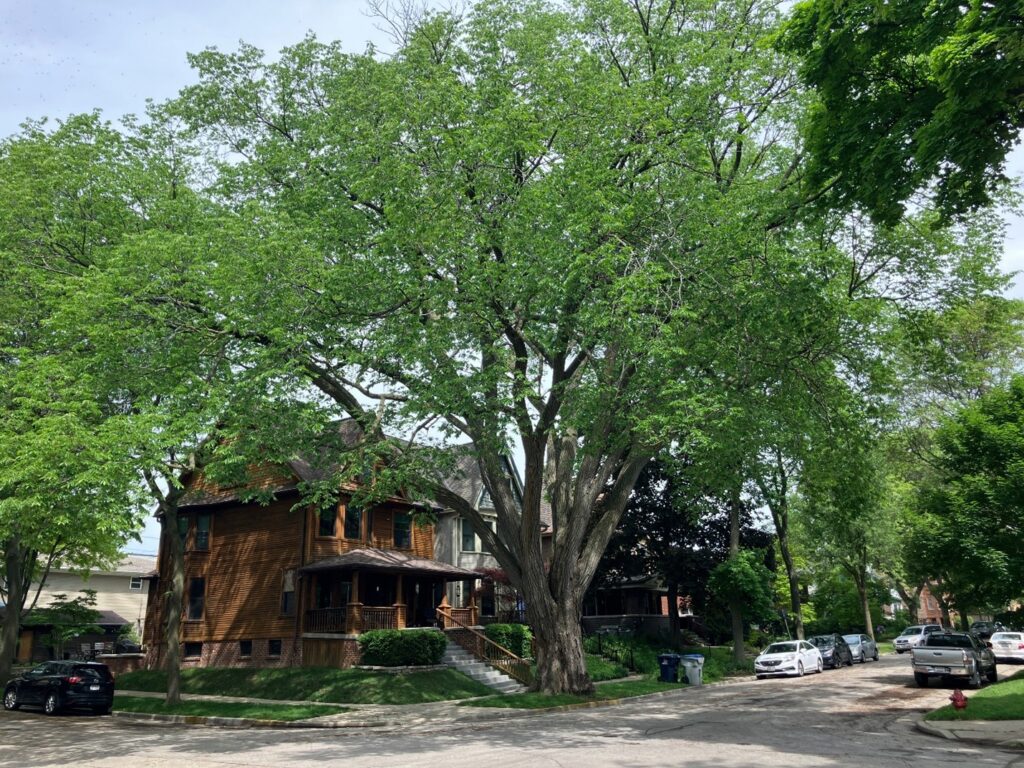
Figure 1: This is the largest known American elm tree left in Wisconsin today. This street tree on Milwaukee’s Eastside is over 5ft in diameter at breast height and over 100 feet in crown spread. / Photo Credit: Wisconsin DNR
The Nonnative Elms
There are several different non-native elms that have historically been planted in Wisconsin. By far, the most common nonnative elm is the Siberian elm. This invasive tree is no longer planted in the landscape but can still be found in parks, yards, forests and even as street trees. Siberian elms are highly resistant to DED, very seldomly succumbing to the disease. Conversely, Siberian elms seem to be one of the more attractive elms to European bark beetles, especially when wounded. So, although pruning a Siberian elm during the growing season will almost certainly not cause it to die from DED, it may increase bark beetle activity in the surrounding area.
DED-Resistant American Elm Cultivars
Almost immediately after the discovery of DED, researchers and propagators began working on cultivating disease-resistant American elms. Luckily enough, an existing cultivar from the 1920s, known as the Princeton elm, was found to be highly resistant to DED. Today, the ‘Princeton’ elm continues to be propagated and planted all over the United States. Additional American elm cultivars followed; these include ‘Valley Forge’, ‘New Harmony’ and Prairie Expedition®. Researchers continue to monitor these cultivars and many others for their DED resistance; this can be done both in a lab setting through inoculation of the fungus into the trees as well as case studies from around the United States as communities plant these trees in their parks, yards and rights of way. Although many of these American elm cultivars have shown great resistance to DED, some have not. In one such inoculation study, some American elm cultivars had 96% survival rate seven years after inoculation, while others showed as low as 18% survivability over the same time period. Additionally, some American elm cultivars touted for their DED resistance may have never been tested for their resistance at all. For these reasons, it is best to treat these DED-resistant elms the same way you would the straight American elm species and avoid pruning during the growing season.
DED-Resistant Hybrid Elms
This last group of elms is also the most complex. Hundreds of hybrid elms exist both in cultivation, as well as occurring naturally. There are hybrids of just two species; there are hybrids of three or more species; there are hybrids of hybrids and the list goes on and on. Probably the two most common hybrids that many urban foresters have worked with here in Wisconsin are Triumph® and Accolade®. These two hybrids, along with hundreds of others, are various combinations of Asiatic and European elm species (ex. Chinese elm x field elm = ‘Frontier’ elm). In some of the inoculation studies mentioned above, some of these hybrid elm cultivars had 100% survival rate after inoculation; however, some did not. The lowest survivability I could find for a DED-resistant hybrid elm was 82% six years after inoculation.
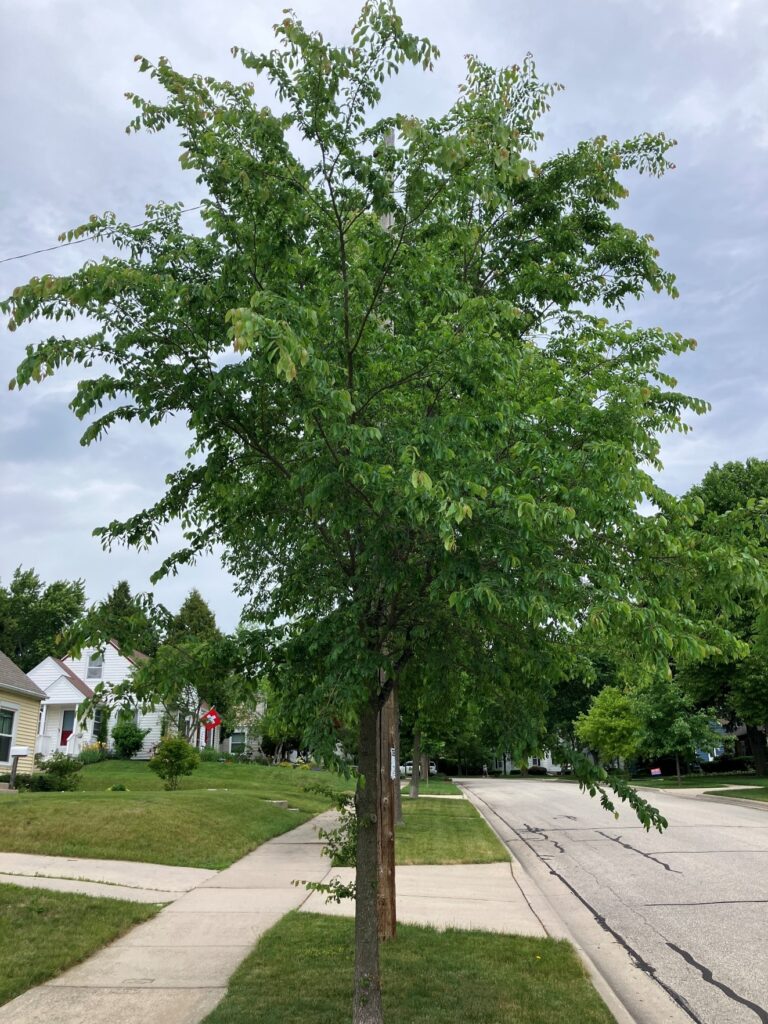
Figure 2: This ‘Frontier’ elm is a hybrid between field elm and Chinese elm. Although many of these hybrid elms are highly resistant to DED, they typically do not have the same mature size and form of our native American elm. / Photo Credit: Wisconsin DNR
Conclusion
No elm species has complete immunity to DED. Even in studies where cultivars or species exhibited 100% survivability, the fungus still attacks the vascular system of the trees. The trees are just able to respond and wall off the fungus. At least some level of dieback is almost always present after inoculation, even if very minimal. For this reason, it is best to avoid pruning all elm trees during the growing season when practical, with perhaps the exception being Siberian elm. But let’s be real, the majority of Siberian elm pruning is cutting out the hundreds of dead branches that accumulate in the crown anyways (dead branches can be pruned out of elms anytime). Another factor worth mentioning is that it can often be very difficult to distinguish between the elm species and cultivars. So, even if you think you are pruning an elm cultivar that has shown extremely high DED resistance, ask yourself, can you be totally sure?