
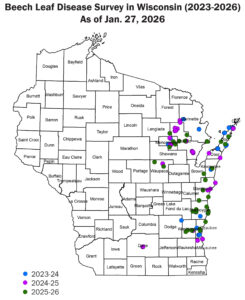
A Wisconsin map showing results of a beech leaf disease survey that ran from 2023 to 2026. / Graphic Credit: Wisconsin DNR
By Art Kabelowsky, DNR Forest Health Communications, Fitchburg;
Arthur.Kabelowsky@wisconsin.gov; 608-335-0167
To date, there have been no confirmed discoveries of beech leaf disease (BLD) in Wisconsin landscape, and we are on the lookout for this disease.
The disease is primarily found on American beech (Fagus grandifolia) but can also be found on ornamental species like European, Oriental, and Chinese beech (F. sylvatica, F. orientalis, and F. engleriana). Although it has not yet been found in Wisconsin, recent discoveries of the disease in Michigan and other states highlight the continued importance of monitoring BLD’s expansion.
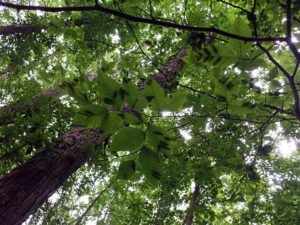
Symptomatic striping from beech leaf disease, as seen from under the canopy of a beech tree in Ohio. / Photo Credit: Wisconsin DNR
There is potential for BLD to move into Wisconsin, as the eastern portion of the state overlaps with American beech’s native range. Symptomatic trees can be identified by dark striping or banding between leaf veins on multiple leaves of a tree. More severe symptoms include leaf distortion such as curling, puckering, thickening, and development of a leathery texture or necrotic (dead) leaf tissue.
BLD is caused by the tiny nematode Litylenchus crenatae mccannii, which feeds on the leaf tissue within the buds of beech trees. This leads to dark banding between leaf veins, leaf curling, and ultimately canopy thinning and tree death. The damage disrupts the tree’s ability to photosynthesize effectively.
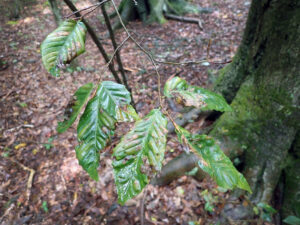
Severe symptomatic thickening, puckering and chlorosis show on leaves of a tree in Ohio infected by beech leaf disease. / Photo Credit: Wisconsin DNR
For the last three years, bud samples were collected throughout eastern Wisconsin, where American beech is distributed. The samples were tested for the DNA of Litylenchus crenatae mccannii by the Plant and Pest Diagnostic Lab at Purdue University. The DNA of Litylenchus crenatae mccannii was not detected from any of the 300 samples. This fall, workers plan to conduct follow-up surveys and collect additional samples.
Beech trees are important in our forests for many reasons, including providing food for wildlife. To report suspicious findings, take photos, exact locations and samples if possible and contact your zone’s Forest Health specialist or technician.
Beech Leaf Disease Fact Sheet Debuts
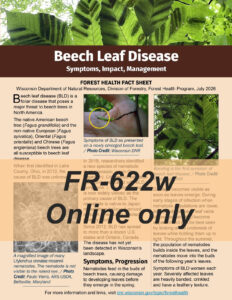
The front page of a Wisconsin Department of Natural Resources fact sheet on beech leaf disease. / Graphic Credit: Wisconsin DNR
The DNR’s Forest Health team has published a new fact sheet covering beech leaf disease (DNR Publication FR-622w). It discusses the source of the disease, symptoms, impacts and management options. The full-color fact sheet can be downloaded and printed for future reference.
A complete list of available DNR fact sheets is available on the Forest Health website.