
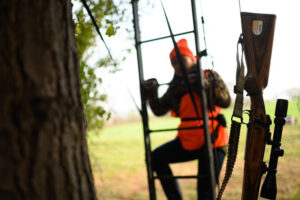
A hunter prepares to safely climb into a tree stand. Hunters are advised to stay away from ash trees when choosing a tree to use for their stand, due to the possibility of hidden damage to the tree due to emerald ash borer. / Photo Credit: Wisconsin DNR
By Wisconsin DNR
As deer hunters begin to scout for suitable tree stand locations, the Wisconsin Department of Natural Resources (DNR) warns hunters to avoid placing their deer stands in or near ash trees.
That’s because of the scourge of emerald ash borer (EAB), which has been confirmed present in all 72 Wisconsin counties. It has already left most ash trees in the southern half of Wisconsin dead or dying, along with many in Door County and the Mississippi River counties.
Trees killed or damaged by emerald ash borer may have intensive damage under a relatively normal-looking outer layer of bark, and may unexpectedly snap at the main stem or drop large branches.
Due to the danger posed by broken stems and branches, and the high percentage of affected ash trees in many areas of the state, it is best practice to simply avoid the risk of using ash trees for deer stands.
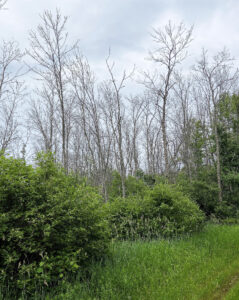
A stand of ash trees near Peshtigo shows heavy mortality due to emerald ash borer. / Photo Credit: Wisconsin DNR
Hunters should also be cautious around ash trees even when on the ground, especially in windy conditions, as infested trees are susceptible to sudden branch and stem breakage.
“Dead and dying ash trees are structurally weaker than healthy trees, so they are not safe places to put deer stands,” said Bill McNee, DNR Forest Health specialist for Northeast Wisconsin. “In many cases, it can be hard to tell if a tree has been infested by emerald ash borer, so hunters should choose to place deer stands in other types of trees instead.”
Regardless of the species of tree chosen, it’s vitally important to place and maintain tree stands carefully. Tree stand accidents are the leading cause of serious injury to deer hunters, as research shows one in four bowhunters have experienced a fall or near-fall from an elevated stand.
Basic Rules Of Tree Stand Safety
No matter the type of tree stand, it’s best to follow these basic safety rules:
- Always wear a full-body harness, also known as a fall-arrest system. Connect to your tether line and keep your tether line short. The tether is designed to keep you in your seat, not to catch you after you fall.
- Always have three points of contact while climbing into and out of the tree stand, including two hands and one foot or two feet and one hand at all times.
- Always use a haul line to raise and lower your unloaded firearm or bow into and out of the stand. You can also use the haul for other things, such as a heavy backpack.
- Use a lifeline when climbing up and down. This keeps you connected from the time you leave the ground to the time you get back down.
Additional tree stand safety information is available on the DNR’s tree stand safety webpage. Hunters can also participate in the Tree Stand Manufacturers Safety Course, a free, interactive course that takes just 15 minutes to complete yet contains valuable, potentially life-saving information.
How To Identify Ash Trees
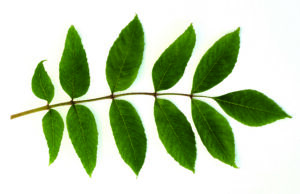
Leaves of a common ash tree are compound (growing opposite from one another), with five to 11 leaflets and serrated edges. / Photo Credit: Westonbirt Arboretum
Ash trees can be identified through two key features:
- Opposite branching patterns, with two branches come off the main stem directly across from each other
- Compound leaves with 5-11 leaflets.
More information on ash trees and how to identify them is available on the University of Wisconsin-Madison Department of Entomology’s Emerald Ash Borer in Wisconsin webpage.
Avoid Spreading Forest Pests And Diseases
When traveling for hunting season, get firewood from close to where it will be burned. This will reduce the chance of spreading tree-killing insects and diseases such as emerald ash borer, spongy moth and oak wilt.
Dry firewood with loose bark has the lowest risk of spreading harmful insects or diseases. Purchasing certified firewood is another option, as it is widely available and has been seasoned or treated to eliminate pests and diseases. Bundles of certified firewood have a printed label showing certification.
More information about emerald ash borer, signs and symptoms of infestation and where the pest has been found is available on the DNR website.