
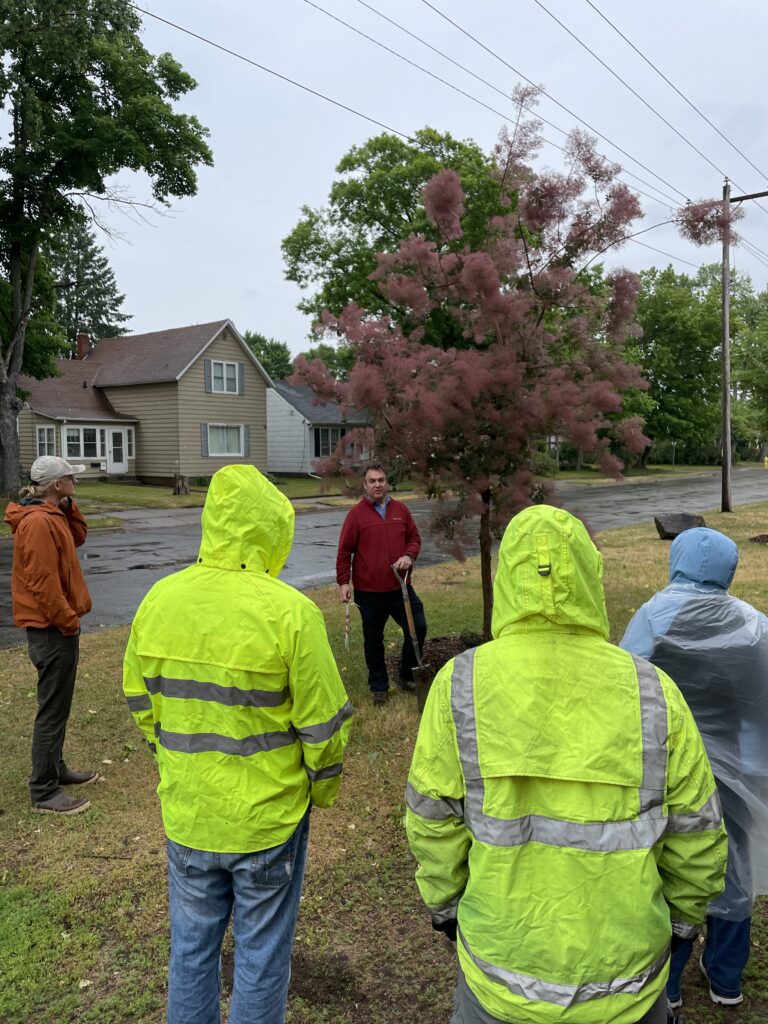
Photo Credit: Wisconsin DNR
* These training opportunities are provided as an information service only and do not constitute endorsement by the Wisconsin Department of Natural Resources (DNR).
See below for information on training topics and events, including planting, urban forestry risks, invasive species, tree selection, emergency response, tree biology, climbing and several upcoming conferences.
International Society Of Arboriculture
Advanced Arboriculture And Tree Science
This in-depth, science and research-based course is designed for tree professionals and allied industries that work with and around trees. It includes discussions of the latest training, techniques, science, research and tools. Biology, biomechanics, hydrology and pedology are important issues facing trees and tree professionals. Constantly updated with the latest science and research for discussion.
When: Sept. 4, 2026
Where: virtual
Register online.
The Urban Forest Myth?
What do we really mean when we say the “urban forest”? Are we all in agreement? What does it need to thrive? How do we know? Is it similar to a natural forest? If not, how is it different? Are we making any mistakes in trying to create or maintain it? Are there studies and standards we need to apply to it? If we can’t answer these questions, we may not be helping support our urban forests.
When: Sept. 11, 2026
Where: virtual
Register online.
Trees And The Design/Build Industries
Many industries work with and around trees, but there are many myths and misconceptions surrounding them. If tree professionals, landscape architects, engineers and architects better understand the needs of each other, as well as the needs of trees, truly sustainable designs are a more likely outcome.
When: Sept. 18, 2026
Where: virtual
Register online.
Risks To Our Urban Forests And Woodlands
More people, organizations, municipalities and companies are realizing the importance of our tree canopy. But are we doing all we can to ensure a healthy, long-lived canopy? Are we helping or hurting trees in our urban forests and woodlands? There is data indicating that all might not be as well as we hoped. What are the risks to our urban tree canopy, and can we reduce them? This course looks at those risks, from grower to installer to the tree workers charged with caring for them. We still have a long way to go.
When: Sept. 25, 2026
Where: virtual
Register online.
Midwest Invasive Plant Network
Rapid Detection And Intelligent Response: Combining AI And Human Intelligence To Detect Invasive Species
Rapid detection and rapid response has been critical to managing invasive species to ensure invasions are dealt with as quickly as possible, in order to minimize economic and environmental costs. Historically most detection was carried out by expert surveyors (e.g., botanists), but more recently, community scientists have also been providing valuable input in the process. At the same time, there has been a recent surge in the development of artificial intelligence (AI) tools to aid in the surveillance and processing of the data, including mapping to predict potential ranges. We need to ask some critical questions on how these tools work and how users, especially community scientists, can make the best use of them. The ideal RDRR strategy must be one of “rapid detection and intelligent response.”
When: Sept. 10, 2026, 11:30 a.m. CST
Where: virtual
Register online.
PennState Extension
Hidden Canopies: Exploring Underutilized Trees And Shrubs
Explore the “hidden canopies” of underutilized trees and shrubs in this engaging webinar with Dr. Beth Brantley, research scientist and plant pathologist at the Bartlett Tree Research Lab. Discover how lesser-known woody species can enhance resilience, biodiversity and sustainability in managed and natural landscapes. Learn practical strategies for selecting and integrating these plants into diversified production systems, with insights on food potential, pollinator support, climate adaptation and multifunctional design. Ideal for professionals in horticulture, agriculture and conservation, this session will expand your plant palette and inspire new approaches to landscape management. ISA CEU available.
When: Sept. 9, 2026, 11 a.m. CST
Where: virtual
Register online.
Utility Arborist Association
The Evolution Of The Vegetation Contractor: From Service Provider To Technology-Enabled Operational Partner
Today’s vegetation contractors do far more than trim trees. This webinar explores how AI, connected fleet technologies and remote sensing are helping contractors improve safety, identify risk, prioritize work and support utility reliability. Learn how technology is transforming vegetation management into a strategic partnership that delivers greater operational value.
When: Sept. 9, 2026, noon-1 p.m. CST
Where: virtual
Register online.
Urban Forestry Today
Planning For Roots: Optimal Spacing, Minimum Thresholds And Workarounds
Competition for space can be a key limiting factor for urban trees. Join Dr. Andrew Koeser as he discusses spacing requirements as well as techniques that may be implemented to foster healthy tree root development.
When: Sept. 10, 2026, 11 a.m. CST
Where: virtual
Register online.
University Of Minnesota Extension
Climate-Ready Trees
In this interactive workshop, participants will learn about how to select and care for tree species that are expected to be adapted to Minnesota’s future climate.
Topics
- Describe the impacts of climate change and other stressors on trees in urban and rural forests.
- Discuss the native and near-native tree species that are likely to be adapted to the future climate.
- Understand how to select, care for and monitor tree species that are likely to be resilient to Minnesota’s changing climate across the urban-rural continuum.
Audience: Tree care professionals, tree and woodland stewards, homeowners and woodland owners
Choose a session below to learn more and register.
- Duluth: Sept. 11, 2026, 1-4 p.m.
- Rochester: Sept. 15, 2026, 1-4 p.m.
- Collegeville: Sept. 17, 2026, 1-4 p.m.
- St. James: Sept. 29, 2026, 1-4 p.m.
Urban & Community Forestry Society
Sidewalks Vs. Trees: Integrating PROWAG, ADA And Urban Trees
As communities invest in safer and more accessible streets, urban foresters are increasingly challenged to preserve and expand tree canopy while meeting evolving accessibility requirements. The Public Right-of-Way Accessibility Guidelines (PROWAG), adopted by the U.S. Department of Transportation, went into effect in 2025 and establishes the national accessibility standards for sidewalks, curb ramps, street crossings, shared-use paths and other pedestrian facilities within the public right-of-way. These updated requirements come on top of already challenging infrastructure and tree conflicts that urban foresters navigate each day. As agencies implement PROWAG, the Americans with Disabilities Act (ADA) and critical sidewalk installation projects, urban forestry professionals have an important opportunity to shape projects that enhance accessibility while protecting the long-term health and benefits of the urban forest.
When: Sept. 16, 2026
Where: virtual
Register online.
Wisconsin Arborist Association
2026 WAA Tree Climbing Championship
Climbers from around Wisconsin will compete to see who the best-of-the-best is. The best male and best female climbers will be sent to compete in the ITCC.
When: Sept. 18-20, 2026
Where: Legion Park, DePere, WI
To sign up to volunteer or get on the waiting list to compete, email Tina Johnson.
Emergency Medical Response Training For Tree Care Professionals
This course focuses on first aid for tree care professionals and the injuries common on the job site. We split students into groups and practice first aid treatments with each other. A short portion of the course is outside, but 95% of the class is indoors. This is an 8-hour course with a lunch break in the middle. Attendees get hands-on experience with over $1,000 worth of first aid supplies.
When: Sept. 23, 2026
Register online and get more information.
WAA Fall Seminar
Please join the WAA for the 2026 Fall Seminar in West Bend at the Prairie Center. Two tracks of education will be offered, one indoors and one outdoors, so dress accordingly. Enjoy catching up with colleagues while feasting on a buffet lunch.
When: Sept. 30, 2026
Where: West Bend, WI
Watch the WAA website for more information.
University Of Florida
Incentive-based Policies For Tree Protection: A National Review
UF School of Natural Resources and Environment Ph.D. student Aline Kuzma presents a national review of incentive-based policies for tree protection – spotlighting urban forest incentives for private property owners across the U.S.
When: Oct. 1, 2026, 11:30 a.m. CST
Where: virtual
Register online.
Wisconsin Forestry Center
Tree Biology
This three-day Tree Biology Workshop combines classroom learning with hands-on field experiences to help participants better understand how trees grow and respond to their environment. Through interactive discussions, live dissections and real-world case studies, attendees will explore tree anatomy, wood structure, root systems and the science of Compartmentalization of Decay in Trees. Participants will also learn how to evaluate tree structure and compare different nursery stock and planting systems. Whether you are an arborist, urban forester, landscape professional or passionate tree enthusiast, this workshop will provide practical, science-based knowledge that can be applied to improve tree health, planting success and long-term tree care.
When: Oct. 6-8, 2026
Where: Legacy-Trees (Sparta, WI)
Register online.
Conferences
Trees And Utility Conference
Join fellow professionals for the premier convening in utility vegetation management — where fresh ideas, practical solutions and powerful connections come together to advance safe, reliable and resilient utility systems in harmony with our environment.
When: Sept. 22-24, 2026
Where: Portland, Oregon
Register online.
Urban Tree Summit
Explore the evolving landscape of urban forestry with insights from leaders across sectors – arborists, advocates, educators, nonprofit professionals, researchers and community organizers – addressing today’s most pressing challenges. From shifting technologies and funding realities to advocacy, partnerships, policy and best practices, gain the knowledge and tools needed to adapt your work and strengthen your impact.
When: Sept. 23, 2026
Where: Silver Spring, MD
Register online.
Upper Midwest Invasive Species Conference
The Upper Midwest Invasive Species Conference (UMISC) is a biennial conference that addresses all taxa of invasive species. In 2026, UMISC will celebrate 18 years of connecting the invasive species management, research and policy community. The goal of UMISC is to strengthen management of invasive species, especially prevention, control and containment. There have been great strides in invasive species research, prevention and management, but much work still must be done. The conference provides numerous opportunities to network with professionals, land managers, researchers, nonprofits and others.
When: Oct. 6-8, 2026
Where: La Crosse Convention Center
Register online.
Partners In Community Forestry
This gathering unites passionate individuals, communities, organizations and leaders to explore innovative solutions, share insights and collaborate on the future of urban forestry. Join leaders across the industry as we focus on strengthening the bonds between people and trees, fostering sustainable practices and creating green, thriving urban landscapes.
When: Nov. 16-19, 2026
Where: St. Louis, MO
Register online.
Resource of the month: Interview with UW-Milwaukee Director of Community Design Solutions about using reclaimed wood
As part of the University of Wisconsin-Milwaukee’s Community Design Solutions, students reclaimed wood from city trees to build park infrastructure. As part of the project, they partnered with Milwaukee City Parks to bring the project to life.