By Casey Czerwonka, DNR Urban Forestry Assessment Technician Intern
It’s not every day that you learn about something that goes against your instincts that’s actually a good thing. When I read about British foresters purposefully “aging” young trees with chainsaws, I thought that was odd because usually, we’re trying to improve the longevity of our trees, not speed up the clock. Why might someone want older trees faster? For the habitat, of course!
Many species thrive in the decaying wood of trees. One might think of birds and small mammals, but many different insects and microbes also utilize hollows in trees for food, nests and shelter. Trees that support these species are often closer to the end of their lives, and in many places there’s an “age gap,” meaning there aren’t enough older trees developing to replace them when they eventually fall. This is largely due to trees being harvested for lumber, or to make way for farms or urban development.
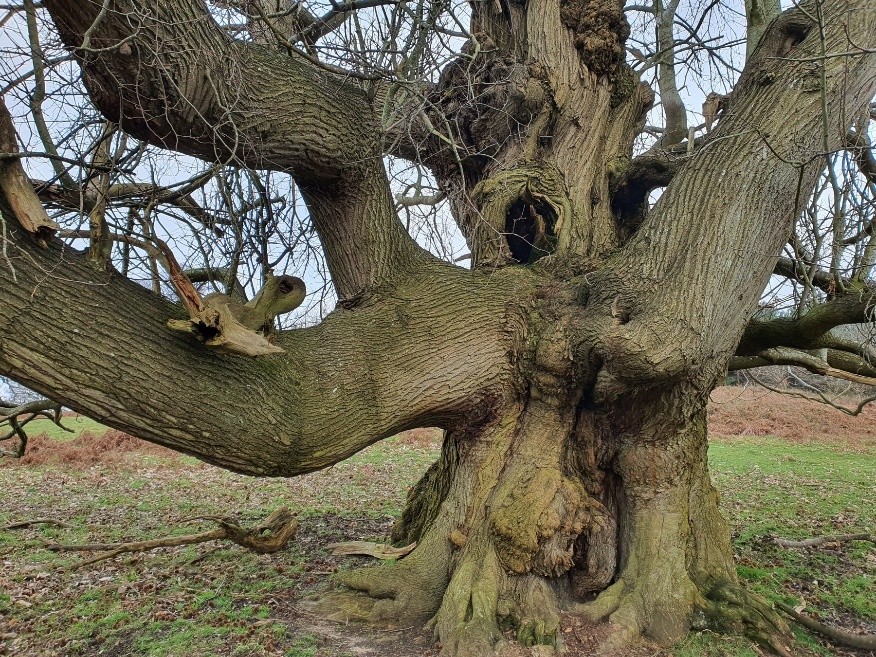
A veteran tree with natural hollows, dead wood, and twisted branches. /Photo Credit: Mark Laurence, 2023
This is where veteranization, the process of artificially aging trees, comes in. Veteranization introduces decay in younger trees to encourage the formation of hollows and other characteristics normally found in much older trees. While intentionally damaging a healthy tree may sound counterintuitive, veteranization is generally carried out in forested settings, where decaying trees pose much less risk than in urban environments. The goal isn’t to improve a tree’s appearance or shorten its lifespan without reason but to create habitat features that wouldn’t naturally form for decades.
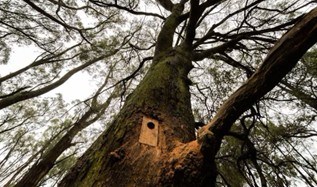
A veteran tree with an artificial cavity designed for marsupials to nest in. / Photo Credit: William Terry, 2021
Methods of veteranization include breaking or cutting branches to encourage decay or using chainsaws or specialized drills to create hollows that can be used immediately by the species that rely on them. An alternative to damaging the tree is adding artificial hollows or nesting boxes that mimic natural cavities found in older trees.
In urban areas, you wouldn’t want to introduce decay to young trees, but retaining the unique structures of veteran trees can be done through other methods. Over time, as the upper branches of older trees begin to die, they will produce new branches closer to the ground to replace them. Pruning dead exterior branches on veteran trees can help reduce the risk of injury to people or property while maintaining the habitat and ecosystem services the tree provides.
Although the practice may be surprising at first, veteranization is an example of how forestry can help support ecosystems by recreating habitat features that have become increasingly less common.