
By Emma Kimball, DNR Urban Forestry Assessment Technician Intern
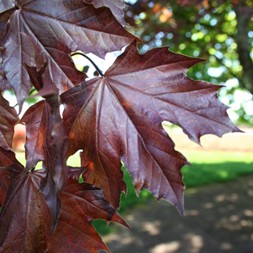
Crimson King Norway maple leaf. / Photo Credit: Van Wilgen’s Garden Center
Trees come in all shapes and sizes, but did you know they also come in all sorts of colors as well?
You may think about autumnal colors, but there are varieties of common trees with leaves that retain a purple hue from spring to fall. Trees with purple leaves such as copper beech (Fagus sylvatica ‘Purpurea’), purple catalpa (Catalpa x erubescens ‘Purpurea’) and the Crimson King cultivar of the ever-popular Norway maple (Acer platanoides ‘Crimson King’) are a gorgeous contrast to the foliage of green trees, offering aesthetic diversity to the landscape.
But how is it even possible for a tree to exist that doesn’t have green leaves?
Trees are green for a very important reason: photosynthesis. Plants photosynthesize to convert water, carbon dioxide and solar energy into oxygen and glucose, which the plant uses as food. Chloroplasts in plant cells start the process by absorbing energy from the sun. The green hue that most plants have is produced by chlorophyll in chloroplasts, and it helps plants absorb as much light across the spectrum as possible while reflecting green light. Green light is particularly intense during the middle of the day when the sun is at its brightest. Reflecting intense green light allows plants to take in as much solar energy as possible while also protecting the plant from solar damage.
Purple trees clearly lack the green complexion that allows plants to photosynthesize, so how do purple trees grow?
The purple coloring is caused by a pigment called anthocyanin that occurs naturally in plant cells. When there is a higher concentration of anthocyanin than chlorophyll in cells, they appear purple! Chloroplasts are still present and functioning normally in the leaves of purple plants, so photosynthesis can carry on as usual. However, anthocyanin only absorbs green and yellow light while reflecting all other light on the visible light spectrum. Since the chlorophyll in the chloroplasts also reflects green light, anthocyanin limits the amount of solar energy available to a tree.
Wait, that sounds bad. Why would plants have a pigment that hurts them?
Similar to the way we can get sunburned, too much sun can damage plant cells. Anthocyanin’s job is to absorb excess light and protect the leaves from sun damage. The coloring from anthocyanin can also have other positive impacts, such as attracting pollinators and deterring predators. Minor purple coloring from anthocyanin is natural in plants in the wild, but commercially available trees with entirely purple crowns are selectively cultivated for their stunning color. They would likely not be able to thrive in a forest setting due to their inability to absorb as much solar energy as plants with green foliage.
If you want to plant a purple tree, keep in mind that many cultivars with purple leaves would prefer full sun to counteract the anthocyanin in their leaves acting as natural sunscreen.