
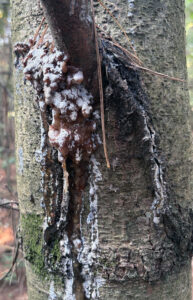
A pitch “glob”, with oozing pitch running down the trunk of a young white pine infected with pitch mass borer. / Photo Credit: Wisconsin DNR
By Linda Williams, Forest Health Specialist, Woodruff
Linda.Williams@wisconsin.gov, 920-360-0665
Have you seen big globs of gooey pitch on the main stems of eastern white pine trees? Or maybe you’ve seen them on spruce?
For those with an adventurous side, grab a stick and scrape off some of that gooey glob. You might be rewarded with the sight of large larvae feeding beneath all of that goo. This is the larvae of our native pitch mass borer. Adults are clearwing moths that look a bit like wasps.
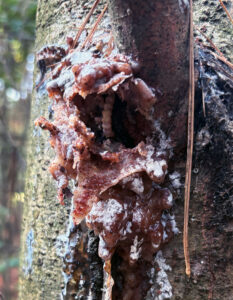
Using a stick to pry away some of the gooey pitch on a tree exposes a pitch mass borer larva underneath. / Photo Credit: Wisconsin DNR
Adults lay eggs on the bark. When eggs hatch, the tiny larvae chew into the bark and begin feeding on the inner bark. They feed enough to irritate the tree, causing more sap and pitch to be produced, which the larvae feed on.
Pitch mass borer can take two to three years to complete development, remaining in that same location throughout their life and continuously irritating the inner bark to promote continued pitch production. Pupation occurs under the glob of pitch and adults then chew their way out. Old pitch globs will harden and darken over time, remaining on the tree for a year or more before finally weathering off.
Hosts include pines (eastern white, jack, scotch and Austrian) and spruces (blue and Norway).
Management on forest trees is not necessary. Severely damaged and deformed trees can be removed during the first thinning. Management on yard trees includes maintaining healthy trees (which are less attractive to the adults), watering during droughts, avoiding pruning during mid-summer (which can attract adults to lay eggs near the fresh wounds), destroying any larvae under the globs of pitch and removing and disposing of severely infested trees.
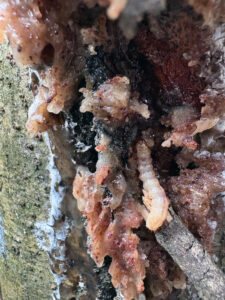
Scraping more pitch off a tree’s main stem shows a pitch mass borer larva on the end of the stick. / Photo Credit: Wisconsin DNR
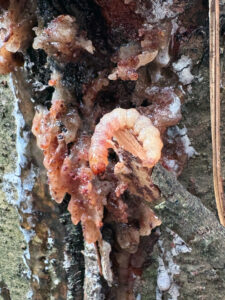
Pitch mass borer larvae can be shades of white to pink, depending on the host. / Photo Credit: Wisconsin DNR