
By Carter Hellenbrand, DNR Invasive Plant Field Specialist, Fitchburg;
Carter.Hellenbrand@Wisconsin.gov
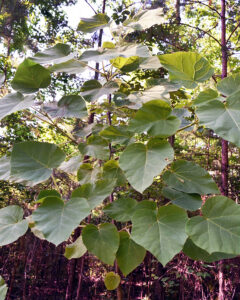
Princess tree growing in a hardwood forest. / Photo Credit: Nancy Loewenstein, Auburn University, Bugwood.org
Note: This is the fifth and final installment in the Forest Health News “Invasives Spotlight” 2026 series, a monthly series of Forest Health News articles.
It may have enormous heart shaped leaves, fragrant flowers and a name fit for royalty, but this botanical princess can quickly become an issue in forests.
Princess tree (Paulownia tomentosa) is a non-native invasive deciduous tree that can grow to be over 60 feet in height. It is a prolific seed producer, with individual capsules containing up to 2,000 winged seeds each. These seeds are readily dispersed by wind and waterways.
Not only does this species reproduce via seed, but it also can spread vegetatively through adventitious buds on its roots. When the tree is damaged, burned or cut, root suckers are often produced from these adventitious buds. The sprouts that form from these root suckers can grow up to 15 feet in a single growing season, resulting in more princess trees and a bigger problem.
Princess trees grow in a variety of habitats including forests, stream banks and roadsides. Due to its large leaves, typically ranging from 5 to 12 inches long but sometimes reaching 2 feet in length on juvenile trees, this species easily shades out surrounding vegetation and prevents native tree regeneration. This will ultimately lower the biodiversity of the ecosystem wherever this invasive tree is found.
History Of Princess Tree
A native of eastern Asia, princess tree was first introduced into North America as an ornamental and had been planted widely throughout the United States before becoming a regulated species.
In Wisconsin, princess tree is listed as prohibited under the Invasive Species Rule NR40. The rule makes it illegal to possess, transport, transfer or introduce this species in Wisconsin. There have been positive detections for this species in Dane, Grant, Waukesha, Milwaukee, Racine, Trempealeau and Door counties, but the overall distribution is still thought to be limited at this time.
Identifying Princess Tree
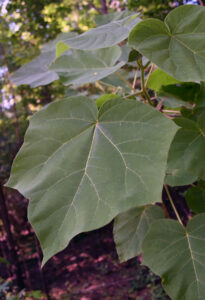
Large oval to heart shaped leaves of princess Tree. / Photo Credit: Nancy Loewenstein, Auburn University, Bugwood.org
Leaves: Broadly oval to heart-shaped and are very large, ranging from 5 to 12 inches long and 5 to 9 inches wide on more mature plants. Leaves can be more than 2 feet long on juvenile plants or stump sprouts.
Flowers: Bloom in early spring, tubular flowers appear in showy pyramidal clusters, are lavender in color and produce a vanilla fragrance.
Fruit: Seed is contained in clusters of green oval-shaped capsules that turn brown once mature. Each individual capsule contains up to 2,000 winged seeds.
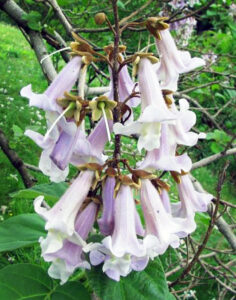
Tubular princess tree flowers that are lavender in color and grow in clusters. / Photo Credit: Leslie J. Mehrhoff, University of Connecticut, Bugwood.org
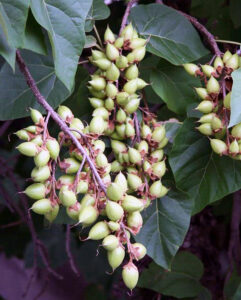
Green, oval shaped capsules that hold up to 2,000 princess tree seeds and will change color to brown once fully mature. / Photo Credit: Robert Vidéki, Dcoronicum Kft., Bugwood.org
Lookalikes
Northern Catalpa: Tree with large heart shaped leaves that closely resemble princess tree. However, catalpa has bell shaped white flower clusters and produces long slender bean-like seed pods instead of the capsules. The center of a princess tree stem, also known as a pith, is hollow or chambered on the inside while the pith of northern catalpa is solid without chambers.
Reporting Princess Tree
There is a limited number of known populations of princess tree in Wisconsin. Eradication is still possible. If you think you have found princess tree, please report it to Invasive.Species@wisconsin.gov. At a minimum, please include the location and clear photos of the plant’s identifiable features. Other important details such as population size and landownership are also encouraged.
Lookalikes
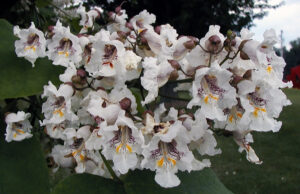
White, bell-shaped flower clusters of Northern catalpa. / Photo Credit: Dow Gardens, Dow Gardens, Bugwood.org
Northern Catalpa: Tree with large heart shaped leaves that closely resemble princess tree. However, catalpa has bell shaped white flower clusters and produces long slender bean-like seed pods instead of the capsules. The center of a princess tree stem, also known as a pith, is hollow or chambered on the inside while the pith of northern catalpa is solid without chambers.
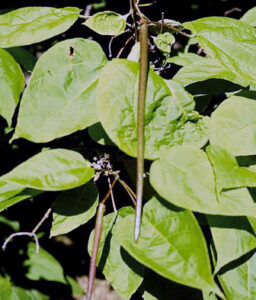
Northern catalpa long and slender seed pods. / Photo Credit: Tom DeGomez, University of Arizona, Bugwood.org
Reporting Princess Tree
There is a limited number of known populations of princess tree in Wisconsin. Eradication is still possible. If you think you have found princess tree, please report it to Invasive.Species@wisconsin.gov. At a minimum, please include the location and clear photos of the plant’s identifiable features. Other important details such as population size and landownership are also encouraged.
Controlling Princess Tree
Small plants can be hand-pulled or dug up, but be sure to remove the whole root system as best you can, to keep new sprouts from developing. Due to this plant’s extensive root system, herbicide is the most effective option at removing this tree species. Cut stump applications using systemic herbicide is the most effective control technique. Be sure to read the full directions on the herbicide label to determine mixing ratios, application rates and required safety measures.