
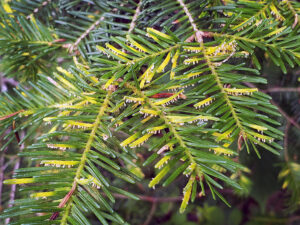
Balsam fir needles infected with needle rust turn bright yellow. / Photo Credit: Wisconsin DNR
Linda.Williams@wisconsin.gov, 920-360-0665
Although this summer has been dry in north-central Wisconsin, there was enough moisture this spring to promote some needle rusts. Needle rusts are fungi that infect needles of various conifers. Most rusts require two hosts to complete their life cycle.
A look at common types of needle rust:
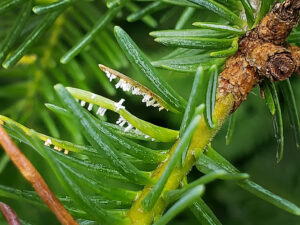
Balsam fir needle rust fruiting structures erupt from the undersides of infected needles. / Photo Credit: Wisconsin DNR
Balsam Fir Needle Rust: Causes some needles of balsam fir to turn yellow, with white “fingers” erupting from the bottom of the needles to release the spores of the fungus. When needle rust is extensive, balsam fir trees will appear a bit whitish from a distance. Balsam fir needle rust produces spores on ferns before infecting needles on balsam fir.
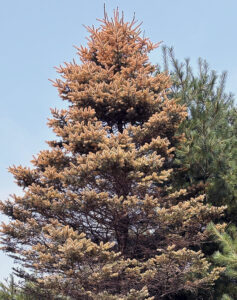
Needle rust infection is extensive on this blue spruce, giving it a tan or orangish appearance. / Photo Credit: Wisconsin DNR
Spruce Needle Rust: This rust is also making an appearance, causing spruce to look pink, yellow or orange from a distance. White spruce, black spruce and especially blue spruce are being impacted this year. Infected needles typically drop off the trees in September. The second host of this rust fungus is a shrub in the heath family, such as labrador tea, leatherleaf or bearberry.
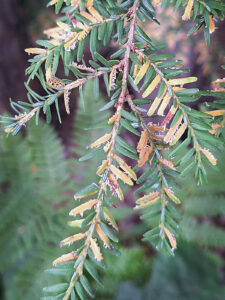
Hemlock needles infected with needle rust fungi turn yellow, with white structures emerging from the undersides of the needles. / Photo Credit: Wisconsin DNR
Hemlock Needle Rust: Was also observed this year, possibly hemlock-hydrangea rust, which requires hydrangeas as the second host.
Control of needle rust diseases requires preventative fungicide treatments in spring and early summer to protect needles. It must take place before symptoms appear. Repeated treatments may be necessary during rainy periods when treatments are washed off the needles.
In forested areas, loss of infected needles is not usually severe enough to put excessive stress on the trees unless there are successive years of severe infection.
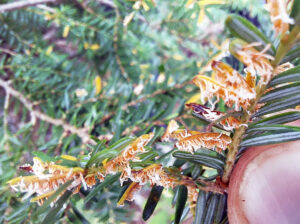
Hemlock needles infected with rust fungi show fruiting pustules erupting from the undersides of needles. / Photo Credit: Wisconsin DNR