
By Ryan Heiderman, Wisconsin DNR Forest Inventory Analyst
Recently, the United States Forest Service released updated data summaries from the Timber Products Output (TPO) survey, a component of the National Resource Use Monitoring (NRUM) program. This program falls under the larger Forest Inventory and Analysis (FIA) umbrella of programs. New data download, factsheets and other data products can be found on the NRUM webpage.
TPO is a survey on manufacturers who use harvested wood products that reports size of facilities, products manufactured, manufacturing capacity and other important indicators of the forest products industry. TPO data is reported for individual states based on an annual survey. The survey is administered by the Wisconsin DNR’s Forest Products Services team in partnership with the USFS. Annually, the team surveys approximately 85 primary wood processing facilities across Wisconsin. In addition to providing valuable industry data about roundwood production and wood residue generation, the survey offers an opportunity to connect with mills throughout the state, strengthening relationships and providing insight into current market conditions and trends within Wisconsin’s forest products industry.
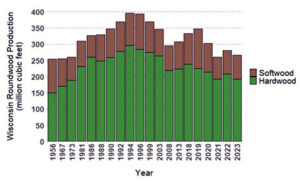
Figure 1: Annual hardwood and softwood roundwood production trends of Wisconsin’s primary wood-using mills. Data is sourced from various USFS publications reporting on the Wisconsin’s timber industry and wood product output. / Graphic Credit: Wisconsin DNR
The most recent TPO data is available for Wisconsin survey years 2022 and 2023. The most recent data shows 265 million cubic feet of roundwood production in Wisconsin mills, with about 75% of this production coming from hardwood species. Historic TPO data can be found in numerous reports published by the USFS dating back almost 100 years (Figure 1). Roundwood production ramped up in the 1980s as many of the cutover lands were becoming mature again and peaked in the 1990s. Wisconsin experienced a decline in large sawmills and paper mills from 1999 through 2008, with production subsequently declining during the 2008 financial crisis. Production rebounded slightly and again decreased during the COVID-19 years.
Roundwood is processed into different products depending on the species, tree size, market conditions, harvest site proximity to mills and a variety of other variables. In 2023, the majority of roundwood was processed into two major product categories accounting for over 80% of production: sawlogs and pulpwood (Figure 2).
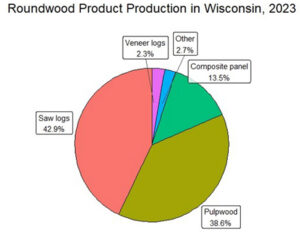
Figure 2: Roundwood product production by product class. / Graphic Credit: USDA Timber Products Output, Wisconsin, 2023
Sawlogs accounted for 43% of production and includes roundwood logs and bolts processed at sawmills into a variety of sawn products such as lumber, cants, squares and blanks. Red pine is the most commonly utilized species for sawlogs, accounting for approximately one-third of production. Red oak (18%) and sugar maple (11%) follow behind red pine in sawlog production.
Pulpwood accounted for 39% of production and includes roundwood logs, bolts and chips used in the manufacture of wood pulp for making paper and paperboard products. Many species are utilized for pulpwood including both soft (23%) and hard maple (15%), red (16%), white (6%) and jack (2%) pine, aspen (14%), and red (9%) and white (2%) oaks.
The third most common product made from roundwood are composite panels (13.5% of roundwood production), which include many different reconstituted wood products such as chip board, flake board, oriented strand board and various engineered lumber. The majority of composite panel roundwood is aspen (82%) with some basswood (14%) and other common hardwood species.