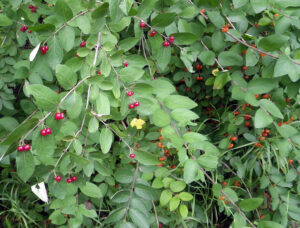
A nonnative honeysuckle plant with berries. / Photo Credit: Wisconsin DNR
By Wisconsin DNR
As temperatures begin to decline, the leaves of many plants and trees have begun to change color. Some trees in the northern part of the state have already begun dropping leaves.
The Wisconsin Department of Natural Resources (DNR) reminds the public that in addition to enjoying the changing hues in the woods, fall also presents a great opportunity to spot invasive plants.
As you walk through your woods this month, look for leaves that stay green into late fall, even after all other trees have shed their leaves. Those green leaves are likely evidence of an invasive plant species.
Invasive plants can hold on to their leaves much longer than native plants, taking advantage of late fall sunshine and ensuring they continue to grow and gain ground in the forest. That’s another way invasive plants take resources away from the native plant life that has already died out or gone dormant for the winter — which negatively impacts the biodiversity that native wildlife needs to thrive.
Late autumn and early winter can also be good times to treat invasive plants. With most native plants dormant, treating invasives with herbicides is much less likely to cause collateral damage.
Fall treatment is ideal for woody invasives, as the plants are busy directing resources to their roots to store them for overwintering, and the natural flow is more likely to carry the herbicide down to the roots. A variety of application methods are effective in the fall, from foresters completing broadcast sprays over many acres to landowners treating a few stems. Spring treatments for woody invasives tend to be less effective because the plants are pushing resources up and out to nourish new buds.
Common invasive plants that can be treated in the fall include nonnative honeysuckles, common and glossy buckthorns and garlic mustard.
Here are some basic identification characteristics and methods of treatment.
Nonnative Honeysuckles
Non-native honeysuckles can hold their leaves well into winter. They often have a thick canopy of leaves, which can shade out native plants. When other plants are bare and the honeysuckle still has a thick canopy, it’s a great time to attack and treat it.
There are several types of invasive honeysuckles in Wisconsin. Learn more about each variety as well as control methods on the Management of Bush Honeysuckles fact sheet from the University of Wisconsin-Madison Extension.
Common And Glossy Buckthorn
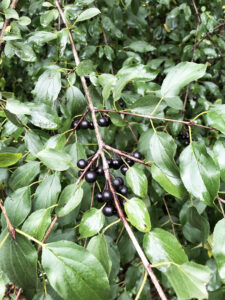
A common buckthorn shrub covered in berries. Control berry-producing plants first to prevent further spreading. / Photo Credit: Wisconsin DNR
A common sight in Wisconsin forests, common and glossy buckthorn is also best treated in late fall and early winter. Buckthorn is a multi-stemmed large shrub or small tree that can form an impenetrable understory layer, displacing native vegetation.
Small buckthorn seedlings can be removed by hand. Larger plants should be cut or girdled at the base. Buckthorn can easily resprout from cut stumps, so herbicide treatments are often best. Find more information on control methods in the Buckthorn Management fact sheet.
After treating any invasive plants in the fall, make sure to follow up in spring to check for new growth and seedlings. Controlling invasive plant species almost always is a long-term effort requiring multiple treatments and monitoring over several seasons.
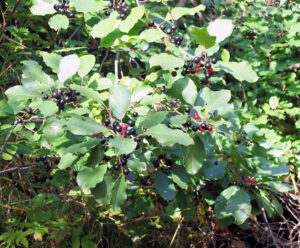
A glossy buckthorn plant with berries. / Photo Credit: Wisconsin DNR
Garlic Mustard
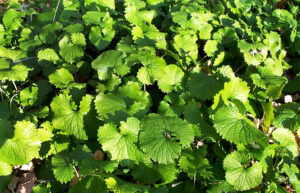
Rosettes on a garlic mustard plant. / Photo Credit: Wisconsin DNR
Though not a woody plant, the basal rosettes (a cluster of leaves at ground level) remain green through fall and winter and are easy to spot. Due to its kidney bean-shaped leaves, garlic mustard looks somewhat like wild ginger or violets. To check, crush a leaf — the leaves of garlic mustard should release a garlicky scent when crushed.
If only a few plants are present, they can be hand-pulled and should be destroyed by burning or sending them to a landfill in bags clearly labeled as “Invasive Plants — Approved by Wisconsin DNR for Landfill.” For larger infestations, plants may be cut or torched, or herbicide may be used as recommended in the Control Methods section of the Garlic Mustard Fact Sheet.