
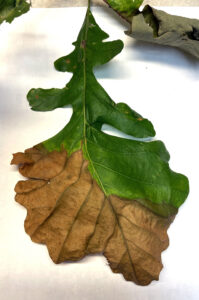
Oak wilt, a deadly disease that affects oak trees, has been found in Manitowoc County. A symptomatic leaf from the infected tree is shown in the photo. Photo Credit: Wisconsin DNR
By Bill McNee, DNR Forest Health Specialist, Oshkosh
Bill.McNee@wisconsin.gov
In mid-October, the DNR forest health lab confirmed that oak wilt, a deadly disease that affects oak trees, has been found in Manitowoc County for the first time.
DNA analysis confirmed the presence of the fungus that causes oak wilt (Bretziella fagacearum) in a tree in the town of Mishicot. The tree was planted in the mid-1980s and is believed to be a hybrid of bur oak and swamp white oak. It was reported to the DNR by the property owner after the tree started showing symptoms consistent with an oak wilt infection.
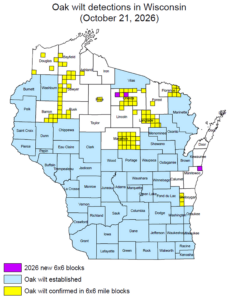 At present, this tree has the only confirmed oak wilt infection in Manitowoc County. The nearest known oak wilt infections are about 20 miles away, in Brown County.
The origin of the oak wilt pathogen in this area is currently unknown. It’s possible that oak wilt has been present in the area at low levels for many years but was never noticed. Alternatively, someone could have introduced the disease into the local area through infected oak firewood or logs.
Overall oak wilt impacts in Manitowoc County will likely be limited, as oak species are estimated to be less than 2% of the county’s rural forest and about 1% of urban trees. Other tree species are not affected by the disease.
Oak wilt is commonly found in the southern two-thirds of the state and is increasingly being found in northern Wisconsin. Oak wilt has now been identified in 67 of Wisconsin’s 72 counties, but three nearby counties – Calumet, Door and Kewaunee – have never had a detection of oak wilt.
The most obvious symptoms of oak wilt are seen when the disease strikes in mid- to late summer, prematurely leaving branches with wilted leaves and leaves on the ground. These oak leaves are often partially green and partially bronze (see photo).
The fungus causing oak wilt is easily brought to new areas by being carried on firewood and other raw oak materials from infected oaks. Beetles that feed on the sap from tree wounds spread the fungus, and the disease, from tree to tree.
To prevent infection:
- Avoid pruning or injuring oak trees from April through July (the high-risk period).
- If oaks are cut down, pruned or damaged between April and July, immediately seal the cuts or wounds with a water-based (latex) paint or pruning sealant.
- Keep firewood local. Leave oak firewood and uncut firewood logs where they were cut for one year or until the bark is naturally loose.
Preventing the introduction of oak wilt to a new area is much easier than containing an infection. After a tree is infected, oak wilt can spread short distances to nearby oaks through underground root connections, and longer distances through contaminated beetles that are attracted to fresh oak wounds. Preventing underground spread can be difficult and expensive, with no guarantee of success.
Additional information and staff contacts can be found on the DNR oak wilt webpage.