Division of Forestry News

Certification audits praise DNR land management

Wisconsin’s forested lands are some of the state’s most valuable resources and the Department of Natural Resources is doing a good job caring for them according to audits conducted by SCS Global Services.  Independent, third-party certification means DNR management of its properties meets strict standards for ecological, social and economic sustainability. The words “exemplary” and “superb” were used in reporting 2016 audit findings on 1,551,440 acres of state-owned lands.  Department owned lands are certified under the Sustainable Forestry Initiative (SFI) and the Forest Stewardship Council (FSC).  Read more in this DNR news release.

For more information, contact Mark Heyde at 608-267-0565.

Forestry professionals gather in Madison

Professional foresters from across the U.S. and Canada are gathering in Madison on Nov. 3-6 for the 2016 national Society of American Foresters convention.  Wisconsin DNR forester Julie Peltier, who is serving as general chair of the convention, said the gathering of about 1,600 foresters will provide the opportunity to showcase Wisconsin’s 17.1 million acres of forests and the social, cultural, ecological and economic benefits they provide.  Read more in this DNR news release.  For more information, contact Kirsten Held, Kirsten.Held@Wisconsin.gov.

BMPs found to protect water quality

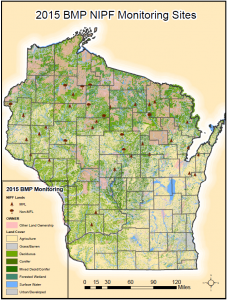
Map of 2015 BMP Monitoring Sites on private, nonindustrial forestland in Wisconsin

The Wisconsin forestland sites monitored by the 2015 BMP teams. Coniferous trees represent sites that were in the Managed Forest Law (MFL) program and deciduous trees represent sites not in the MFL program. Note: Some dots are close together making the total number of sites difficult to determine on this map.

Newly-released results from 2015 monitoring for the application and effectiveness of Wisconsin’s Forestry Best Management Practices (BMPs) for Water Quality show excellent results. The effectiveness of BMPs that were applied correctly was extremely high (99.6%) at protecting water quality, but when BMPs were applied incorrectly or not applied, BMP effectiveness rates woefully dropped (6.3% and 9.4% respectively).  Even with the low water quality protection of BMPs that were applied incorrectly and not applied, no major impacts were reported on any of the monitored sites.   Read more details about the results from the monitoring of 36 non-industrial private forestland (NIPF) sites (26 of the landowners are enrolled in the MFL program) in the 2015 BMP Monitoring Report.

For more information, contact Forest Hydrologist Dave Kafura, david.kafura@wisconsin.gov, (715) 416-4140