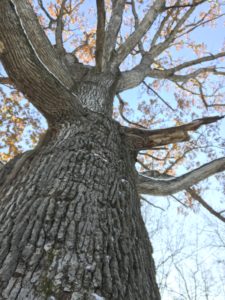
Oak wilt found in Forest Co. and northern townships

By forest health specialists Paul Cigan, Hayward, paul.cigan@wisconsin.gov, 715-416-4920 and Linda Williams, Woodruff, linda.williams@wisconsin.gov, 920-360-0665

Oak wilt has been found for the first time in Forest County and several new northern townships in 2019. These previously undocumented infections were detected using a combination of ground surveys, forester and landowner reports and aerial survey flights. This deadly fungal disease of red oaks has now been confirmed in 65 of Wisconsin’s 72 counties.

Updated oak wilt detection map shows new county and township detections described in text.

Oak wilt detection map as of January 1, 2020.

Continue reading “Oak wilt found in Forest Co. and northern townships”

Protect your trees from disease by pruning when they have no leaves

By Paul Cigan, forest health specialist, Hayward, paul.cigan@wisconsin.gov, 715-416-4920

With the new year upon us, healthy lifestyle habits are sure to be on many people’s minds as they plan for changes in diet and exercise. The new year is also the perfect opportunity to make healthier choices for trees! Winter is the ideal time for tree pruning while avoiding harmful, disease-carrying pests such as the tiny beetles that carry oak wilt from one tree wound to another.

“The best time to prune trees that lose their leaves is during winter when the trees are dormant,” said DNR forest health specialist Paul Cigan. “Not only is it easier to see where pruning is needed when leaves are gone, but disease-carrying pests are inactive due to the cold, making pruning both more effective and less likely to invite unwanted pests.”

While pruning in winter reduces the risk of spread through beetles, Cigan pointed out that the disease can spread year-round in firewood. “Several recent oak wilt finds in northern Wisconsin, including a first-ever find in Forest County, may have been the result of infected firewood brought from areas with oak wilt,” Cigan said. “Keep oak firewood where it is cut for one year, or until the bark is naturally loose, to prevent the spread of oak wilt,” he advised.

For more information, visit DNR webpages for oak wilt and firewood.

Pruning tips

Yard trees and trees in urban settings should be pruned throughout their entire life to maintain strong structure and remove dead wood. Young trees should be pruned to establish a central trunk, proper trunk taper and good branch structure and spacing. Older trees should be pruned to remove dead and/or hazardous limbs. “Pruning should not remove more than 25 percent of the live tree crown, and the lower third of deciduous tree trunks should be free of limbs,” advised DNR urban forestry coordinator Don Kissinger. You can find more detailed, step-by-step tips for tree pruning in this DNR tree pruning publication

Certified arborists who offer pruning and other tree care services can be found at waa-isa.org/arborists/search.asp.

2019 Forest Health Annual Report now available

Forest health annual report now available for 2019.

The Forest Health Annual Report summarizes notable impacts for that year of pests, diseases and weather on the health of Wisconsin’s forests. The report is a collaborative product created by DNR forest health specialists from around the state. It outlines the damage and spread of both native and invasive pests and diseases during that year and puts these into context of observations from previous years. Management programs and their results are also described. Highlights from the 2019 annual report include:

  • Dramatically increased decline and mortality from emerald ash borer in southern WI
  • New county and township detections of oak wilt
  • Precipitation record and major storm damage
  • Summary of state nursery studies on Diplodia sapinea, galls on jack pine seedlings, and testing new fumigants to replace methyl bromide

This year’s annual report is available on the DNR forest health homepage. Previous annual reports, including historical reports dating back to 1951, are archived and available upon request. Contact your local forest health specialist if you’d like digital copies of any archived annual reports.

Snow fleas spring to surface in early December

By Todd Lanigan, forest health specialist, Eau Claire. todd.lanigan@wisconsin.gov; 715-210-0150

Snow fleas are a species of springtails that are active during winter and are generally found in groups where their dark-colored bodies stand out against the white snow. While often observed in late winter or early spring, they also come to the surface on warm winter days, making an early December appearance in west central Wisconsin something to note but not altogether unusual given the relatively warm weather in the area. 

Tiny flecks against an impression in snow are hundreds of snow fleas at surface.

Easily mistaken for specks of dirt or debris, snow fleas are tiny soil-dwelling animals that gather on the surface of snow on warm winter and spring days.

Continue reading “Snow fleas spring to surface in early December”

Staff highlights of 2019

As the year draws to a close, we asked DNR urban forestry staff to reflect on the last twelve months and choose their top highlight – whether it’s a project they’re especially proud of, a new partnership, or a deeper relationship with coworkers. Here are their responses:

“My highlight of the year was working with park staff and 45 volunteers from Johnson Controls to plant 170 trees at Havenwoods State Forest.”  -Dan Buckler, Urban Forestry Assessment Outreach Specialist

“I enjoyed watching Barron, Wisconsin with a bare bones tree program attain Tree City USA for the first time and quickly start growing their community forestry program. In the same year (2019), they did a tree inventory and urban forest management plan. They also experienced a violent windstorm which encouraged them to apply for and receive a catastrophic storm grant, as well as reinventory their damaged forest. Finally, they were awarded a start-up grant to begin to operationalize portions of their new forest management plan. This all happened in 2019 with grants and assistance from the DNR Urban Forestry Program.”  -Brad Johnson, West Regional Urban Forestry Coordinator

Continue reading “Staff highlights of 2019”

Save the date for the WAA/DNR Annual Urban Forestry Conference

The Wisconsin Arborist Association (WAA) teams up with the Wisconsin Department of Natural Resources to present the WAA/DNR Annual Urban Forestry Conference, Sustaining Urban Forests to Ensure a Healthy Future.

Dates: February 16-18, 2020

Location: Hyatt on Main & KI Convention Center, 333 Main Street, Green Bay, WI 54301


This three-day conference is intended for professional arborists, community foresters, nursery professionals, park and recreation directors and staff, tree care workers, landscape architects, green industry professionals, community administrators, volunteers, and students to come together with top researchers and educators to learn the latest in research, innovations and industry developments.

Continue reading “Save the date for the WAA/DNR Annual Urban Forestry Conference”

Deadlines approaching for Tree City, Bird City, and Bee City applications

Act fast to keep your Tree City, Bird City, and Bee City status! Due dates are as follows:

  • Tree City USA (TCUSA) applications are due December 31st
  • Bird City Wisconsin renewal applications are due January 31st (new applications can be submitted anytime)
  • Bee City USA renewal applications are due February 28th (new applications can be submitted anytime)

These three programs are each managed by a different nonprofit, but they have a lot in common. In fact, a single project could be used to help meet all three programs’ requirements!

Continue reading “Deadlines approaching for Tree City, Bird City, and Bee City applications”

For best selection, place your nursery orders soon!

As we settle into winter, the spring planting season may seem a long way off, but it’s best to get a head start. December is an ideal time to contact your nursery supplier and place your order for spring. By ordering your trees now, you’ll have more trees to choose from and a greater chance of finding the species you want.

Not sure which species to plant? Check out the DNR’s Tree learning center webpage and the replanting tab of the Emerald ash borer community toolbox. These resources and tree selector tools can help you discover trees that may perform well in your community.

Once you’ve identified the best species for your area, draw up a planting plan that includes as many different species as possible. If you have a tree inventory, make sure to consult it. Your goal is to create an urban forest that is as diverse as possible. By planting with species diversity in mind, you are helping to protect your forest from future pests and pathogens.

To learn more about how to design a diverse urban forest, take a look at our Diversity rules and considerations pdf.

Recipients announced for regular and startup grants

This October, thirty-six applicants were selected to receive funding from the WDNR Urban Forestry program. Of the thirty-six selected, twenty will receive regular grants while the remaining sixteen will receive startup grants. $419,680 in available grant funding was awarded towards their efforts during the 2020 calendar year. The selected recipients join fifteen recipients of 2020 WDNR catastrophic storm grants earlier this year.

Between regular and startup grant projects, the funds awarded will range from $3,500 to $25,000 in a dollar-for-dollar match on projects that are estimated to total nearly $2 million.

The DNR Urban Forestry Grant program funds projects consistent with state and national goals for increasing the urban forest canopy and the benefits it provides. The urban forest encompasses trees on both public and private property. Priorities for the 2019 grant cycle include, but are not limited to, projects that increase the ability of local municipal partners to expand their urban forestry program; increase the ability of all local partners to provide ongoing urban forestry funding, services and/or markets; benefit multiple communities; and put existing inventories of urban trees to use.

Continue reading “Recipients announced for regular and startup grants”