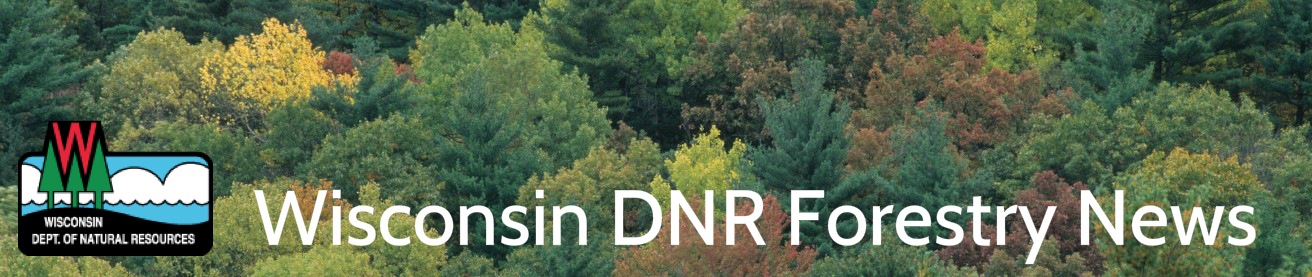
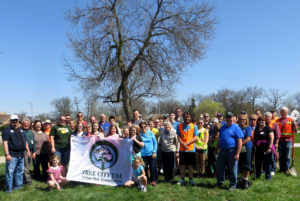
 Trees make a town a special place to live. Trees shade homes, businesses and streets. They clean air and water, increase property values, reduce energy costs and make neighborhoods greener, safer and healthier. By becoming recognized and fulfilling the standards of Tree City, Tree Line, or Tree Campus USA, communities, companies and campuses are putting their citizens first and building a better community with the forest outside your door. Thousands of communities across America are enjoying these many benefits of trees and being recognized as a Tree City USA.
Markets growing for urban wood across Wisconsin
Written by Scott Lyon, Forest Products Specialist
Many communities have expressed greater interest in local goods and services over the last few years; as a result urban wood recycling efforts have increased in Wisconsin. The increase of trees killed by invasive insects and disease caused many municipalities to seek alternative uses for urban wood rather than disposing material in a landfill. Recent efforts to market this growing source of material and develop ways to recycle urban trees within communities led Wisconsin to become one of the leading states in urban wood utilization. Continue reading “Markets growing for urban wood across Wisconsin”
Accounting for trees in stormwater models
Accounting for Trees in Stormwater Models is a resource to share with stormwater engineers. The paper is intended to help the stormwater engineering community more easily account for trees in runoff and pollutant load calculations and incorporate them into stormwater management strategies. It summarizes existing hydrologic and hydraulic models that can be applied at the site and small watershed scales to account for the stormwater benefits of conserving existing trees and/or planting new trees. The paper also includes examples of specific techniques to modify stormwater models to account for urban tree benefits, as well as associated resources and tools for estimating the hydrologic benefits of trees in the urban landscape. Continue reading “Accounting for trees in stormwater models”
Does your community have forest-friendly development practices?
 Not every city in Wisconsin has a municipal code or ordinance that includes trees, and even then, those that do have codes may not have forest-friendly ones. A new resource has been created and has taken care of the hard work of determining if your city’s codes are forest-friendly; and if they are not, the resource provides advice on how trees can be more welcome in your neighborhoods. Continue reading “Does your community have forest-friendly development practices?”
Trapping project found no non-native beetles
By Mike Hillstrom, forest health specialist, Fitchburg. Michael.Hillstrom@wisconsin.gov; 608-513-7690
The Wisconsin DNR’s forest health team received funding to trap for non-native beetles in 2018. This project was funded by the US Forest Service through an Early Detection and Rapid Response (EDRR) grant. The project is complete, and we happily share that we did not find any non-native beetles!
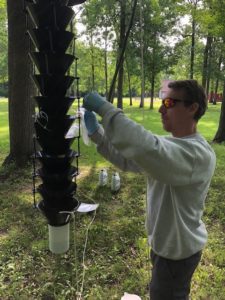
Forest health staff member Scott Schumacher hangs a Lindgren funnel trap to survey for non-native beetles.
The Forest Service periodically provides funding to states to trap for non-native bark and ambrosia beetles. The goal of trapping is to detect, delimit and monitor newly introduced exotic beetles and to quickly assess and respond to newly detected infestations.
We placed traps at 12 high-risk sites in Jefferson, Waukesha, Milwaukee, Racine, Manitowoc, and Brown counties. Sites were selected in collaboration with the Wisconsin Department of Agriculture, Trade and Consumer Protection and were based on proximity to large commercial port entries on Lake Michigan or recycling facilities for pallets and other waste packaging. Three Lindgren funnel traps (12 funnels stacked to look like a tree trunk) and lures were assembled at each site and checked every two weeks between early May and early August. Specimens collected from the traps were sent to a Forest Service taxonomist for identification.
New northern oak wilt detections
By Paul Cigan, forest health specialist, Hayward. Paul.Cigan@wisconsin.gov; 715-416-4920 and Linda Williams forest health specialist, Woodruff. Linda.Williams@wisconsin.gov; 920-360-0665
Oak wilt (OW) was confirmed for the first time in Bayfield and Douglas counties and in 16 new northern townships in 2018. The new OW infections occurred on a range of properties, including county, tribal, private, U.S. Forest Service and Board of Commissioners of Public Lands. Wisconsin Department of Natural Resources (DNR) forest health staff are working proactively with affected property managers and landowners to address these infections and prioritize disease prevention and detection in the future.
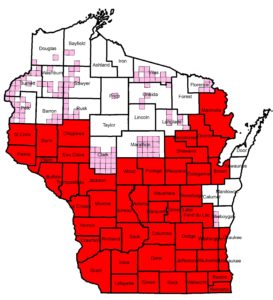
Oak wilt distribution map. Confirmed counties are displayed in red. Confirmed townships are displayed in pink 6-mile square blocks.
The greatest risk of overland transmission in northern Wisconsin is from April 15 to July 15, when fungal spores readily infect open wounds. Most of these new cases occurred during this time frame due to stem and branch damage. The primary causes of damage were roadside brush clearing, pruning, lot clearing and storm-caused branch breakage. Fungal spores may have come from diseased oak firewood and unprocessed wood recently transported into these areas.
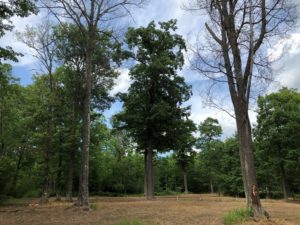
OW disease center. Oak on far left was infected through belowground root contact with tree damaged in lot clearing (far right). Dairyland Township, Douglas County (photo taken by Paul Cigan).
If oak wilt is present in or within 6 miles of the county where you manage oak, your management activities may be affected by seasonal harvesting restrictions to reduce OW introduction and impact. Read DNR’s oak harvesting guidelines for more information and refer to the list below of new 6 square mile blocks by township and county to see if OW has been detected near your property.
| Bayfield County | |
| Barnes | T45N R9W |
| Cable | T43N R7W |
| Drummond | T45N R8W |
| Douglas County | |
| Dairyland | T43N R15W |
| Gordon | T44N R11W |
| Langlade County | |
| Elcho | T34N R11E |
| Langlade | T33N R13E |
| Neva | T32N R11E |
| Sawyer County | |
| Couderay | T39N R8W |
| Hayward | T41N R8W |
| Hunter | T40N R7W |
| Round Lake | T41N R8W |
| Spider Lake | T42N R7W |
| Vilas County | |
| Boulder Junction | T42N R6E |
| Lac du Flambeau | T41N R5E, T40N R5E |
| St. Germain | T40N R8E |
Please report any suspected oak wilt infections to your local DNR forester or regional forest health specialist and learn more about oak wilt identification and biology on the DNR oak wilt webpage. To learn more about firewood rules and how you can help reduce transmission of pests and diseases, including oak wilt, visit the DNR firewood page.
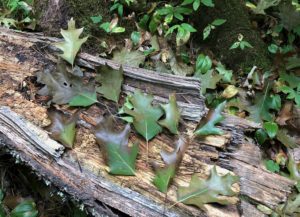
Bronzed leaves fallen from infected oak. Leaves were observed beneath infected northern red oak. Cable Township, Bayfield County (photo taken by Paul Cigan).
Heterobasidion root disease in Monroe County
By Todd Lanigan, forest health specialist, Eau Claire. Todd.Lanigan@wisconsin.gov; 715-210-0150
Heterobasidion root disease (HRD), formerly known as annosum root rot, was recently found in Monroe County for the first time in the town of Little Falls. With this detection, HRD is now known to occur in 28 Wisconsin counties.
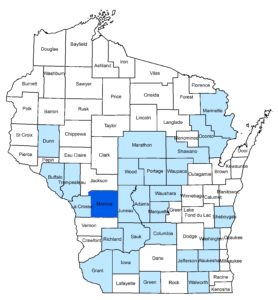
HRD distribution map. Counties where HRD is present are shown in blue with most recently confirmed county shown in dark blue.
Fruiting bodies of the pathogen, Heterobasidion irregulare, were found on dead overstory red pine and both live and dead white pine saplings in the Big Creek Fishery Area. The 20-acre stand was a red pine plantation established in 1958 and last thinned in 2012. Wood samples were collected to isolate and identify the pathogen through microscopic identification at the Forest Health Lab in Fitchburg.
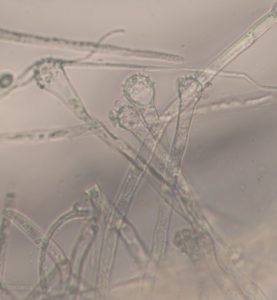
Microscopic spores isolated from wood samples and confirmed as HRD in Forest Health Lab.
Based on this new find, a number of townships were added to the 25-mile buffer zones used in determining appropriate management activities according to the HRD Management Guide. There will be a one-year grace period for implementation of the guide in these townships.
The Forest Health Program has records of all confirmed HRD detections. If you suspect this disease is present in a stand, contact your regional forest health specialist.
For more information about HRD, visit the DNR Forest Health webpage.
Improve mental health with exposure to trees and nature
If stress about the upcoming holiday season is beginning to build, put on your coat and hat, get yourself outside and walk around under your neighborhood trees. Exposure to nature reduces depression, anxiety and stress! Time spent in nature provides a wealth of mental health benefits. Continue reading “Improve mental health with exposure to trees and nature”
Social media study explores how to connect homeowners with arborist
How do people respond differently to messages about caring for the trees in the yard? Which messages motivate homeowners to contact a certified arborist to help them care for their trees? This spring, the Wisconsin DNR partnered with the Wisconsin Arborist Association (WAA), University of Wisconsin-Madison and UW-Extension to design a Facebook outreach campaign to test these questions. A new resource with the results and social marketing insights from the study is now available.
Continue reading “Social media study explores how to connect homeowners with arborist”
A tool to integrate public health considerations in the development of parks and trails
The National Park Service, Department of Health and Human Services and the Center for Disease Control came together to create the “Parks, Trails, and Health Workbook,” a quick guide and outline for incorporating public health considerations in the development of a park or trail. Utilizing the health impacts of these natural areas is a different and critically important way to promote parks and trails. Applying health benefits provides a personal connection and increased relevance to community members and encourages them to act and get outdoors. Continue reading “A tool to integrate public health considerations in the development of parks and trails”