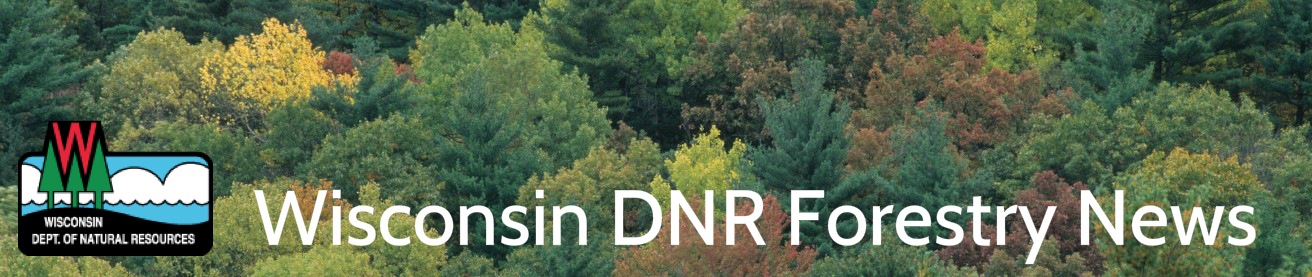
T he Urban Forestry team has recently added a new member, Abner Jacobson. Abner will be an Urban Forestry Grant Specialist. Originally from the East Side of Madison, Abner graduated from the University of Wisconsin in 2017 with degrees in Communication Arts and Political Science. Continue reading “Welcoming a new team member”
2018 Urban Forestry Grant recipients
By Alex Elias, Urban Forestry Grants Manager
Thirty communities, nonprofit groups and counties will share $465,661.99 in 2018 state grants from the Department of Natural Resources Urban Forestry Grant program to promote and sustain urban forest resources in Wisconsin.
Another productive year for WI Urban Forestry!
By Jeff Roe, Urban Forestry Team Leader
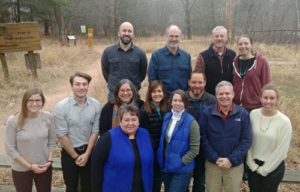 As I reflect on the last year, what stands out most for me is the great people that I work with – both staff and partners!
This has been a year of change, with new structures and leadership within the agency. Nonetheless, the staff dedication and leadership support for our program, and the work we do, remain strong. We have also had some staff changes this year: we added a new coordinator to the team, Brad Johnson, to serve the West Central area of the state; Bobbi and Dan joined the team to help with grants and the urban assessment program, respectively; and later in the year, Bobbi moved on to a full-time position within another DNR program. Continue reading “Another productive year for WI Urban Forestry!”
Evergreen: A Holiday History
By Dan Buckler, Urban Forest Assessment Specialist
The winter blues are not a modern phenomenon, but something that struck an existential chord in our ancestors. Luckily there were things growing in the forests which sparked hope in hearts until the sun returned, slowly but surely, at the winter solstice. Continue reading “Evergreen: A Holiday History”
Urban Forestry, Green Tier and the League of Wisconsin Municipalities
By Laura Lorentz, DNR Urban Forestry Partnership and Policy Specialist
This past October Will Erikson, of DNR’s Green Tier Legacy Community (GTLC) program, and I staffed a booth at the 119th League of Wisconsin Municipalities (the League) Annual Conference in Appleton. Each year the three-day conference attracts hundreds of municipal professionals; among them elected officials, directors of parks and forestry, city engineers, and consultants. Continue reading “Urban Forestry, Green Tier and the League of Wisconsin Municipalities”
Comments sought re: change in gypsy moth rule
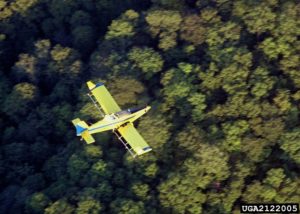
Aerial spraying for control of gypsy moths. Photo: John Ghent, bugwood.org
The WI DNR is proposing to deactivate the gypsy moth suppression program as requests for treatment have fallen to very low levels and this small need can be met by private businesses. The DNR is taking input on the proposed change to rule NR 47.910. If you have questions, concerns, or comments about this proposal you may give your input by attending a hearing or in writing. Input must be received on or before Tuesday, Dec. 19, 2017 to be considered.
Public hearings will be held on Dec. 19, at 11:00 a.m. at DNR service centers in Fitchburg, Milwaukee, Green Bay and Eau Claire. Input may be given verbally or in writing at the hearing.
Written comments may be submitted by U.S. mail, e-mail, or through the internet. Written comments will have the same weight and effect as oral statements presented at the public hearing.
E-mail comments may be made at: DNRAdministrativeRulesComments@wisconsin.gov (Please include “Attn: Andrea Diss-Torrance” in subject line.)
Written comments and any questions on the proposed rules should be submitted to:
Department of Natural Resources
Attn: Andrea Diss-Torrance
P.O. Box 7921
Madison, WI 53707-7921
Written by: Andrea Diss-Torrance, invasive forest insects program coordinator, Madison. Andrea.DissTorrance@wisconsin.gov; 608-264-9247
Pesticide applicator training offered in 2018
The University of Wisconsin Pesticide Applicator Training (PAT) Program will offer two training sessions for forestry training (Category 2.0) in 2018. The trainings, which will each last one day and be conducted indoors, offer attendees an opportunity to review materials in the PAT training manual. The Wisconsin Department of Agriculture, Trade and Consumer Protection (DATCP) will administer a certification exam at the end of each session. Dates and locations of the training sessions are:
- January 25, 2018 in Merrill (Lincoln County Extension Office)
- May 10, 2018 in Phillips (Price County Extension Office)
Preregistration is required. The cost to attend a training session is $30. For more information, visit UW Extension’s website.
Written by: Kyoko Scanlon, forest pathologist, Fitchburg. Kyoko.Scanlon@Wisconsin.gov; 608-275-3275
Gypsy moth numbers rising in northern WI
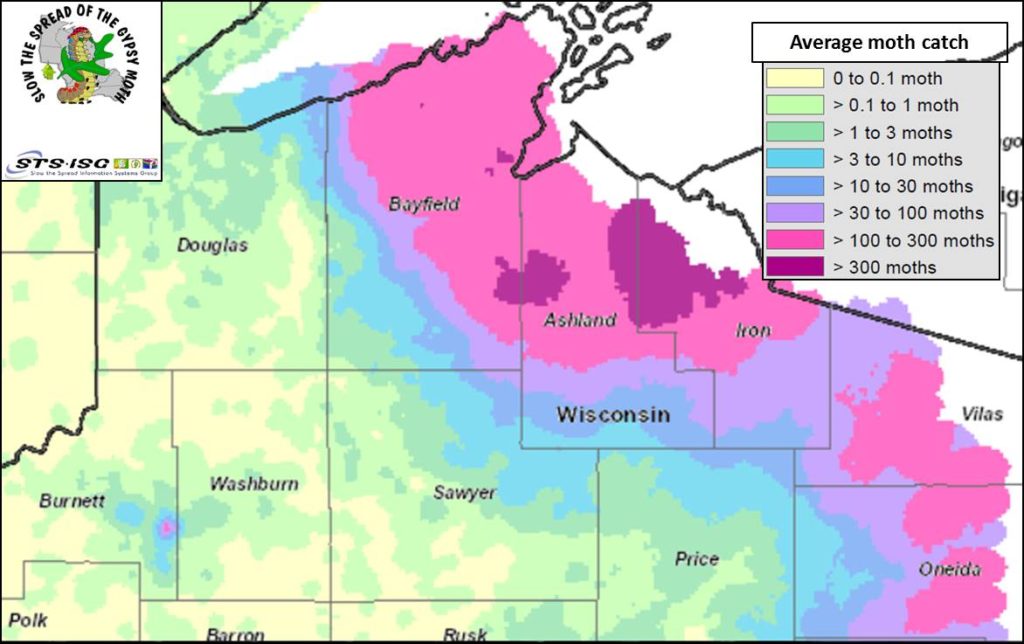
Fig 1. Average gypsy moth trap counts in northern Wisconsin counties. Map adapted from the Slow The Spread Foundation, Inc.
Annual surveys conducted by the Wisconsin Department of Agriculture, Trade, and Consumer Protection (DATCP) indicate gypsy moth populations have increased in several northern Wisconsin counties and by 20% statewide. High moth counts were detected in pheromone traps in Ashland, Bayfield, Burnett (Dewey Township), Iron, Oneida, and Vilas counties, with the highest overall count in Bayfield County (14,354 moths total). Areas with an average catch per trap of 100 moths or more will likely experience damaging levels of defoliation by gypsy moth caterpillars in the following year or years (Fig. 1).
Defoliation can be reliably predicted at the stand level by counting gypsy moth egg masses from August through March before egg hatch; these estimates help determine if preventive measures, such as physical controls, insecticide treatments, or delaying thinning activities are needed until populations collapse.
In recreational and residential high-use areas, physical controls such as sticky bands and burlap barriers may be used to help reduce nuisance and aesthetic impacts from gypsy moths. Aerial treatments are used when gypsy moth populations are high. In managed forests, use of silvicultural techniques may be economically feasible to reduce productivity problems caused by the pest.
Learn more about prevention and management options for your property by consulting with your local DNR forester or regional forest health specialist.
More information about population sampling and management options is available online at www.gypsymoth.wi.gov.
Written by: Paul Cigan, forest health specialist, Hayward. Paul.Cigan@wisconsin.gov; 715-416-4920
Recent finds of emerald ash borer in WI
Emerald ash borer (EAB) continues to be found in new areas in the state. Wisconsin tracks EAB at the municipality or township level. Quarantined counties are shown in tan; infested areas are shown in green on the map.
New county quarantines
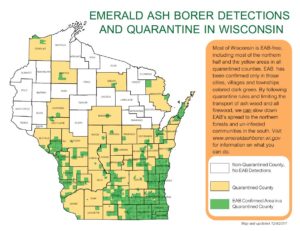
EAB quarantine map. Counties shaded in tan are quarantined for EAB, green areas are townships and municipalities where EAB has been confirmed. Map courtesy of WI DATCP.
- none
New finds in counties already quarantined
- Monroe County — Town of New Lyme
- Richland County — City of Richland Center
Written by: Linda Williams, forest health specialist, Woodruff. Linda.Williams@wisconsin.gov; 715-356-5211, x232
Updated forest health fact sheet – conifer bark beetle
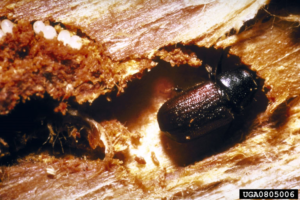
Spruce beetle (Dendroctonus rufipennis). Photo: Edward H. Holsten, USDA FS, Bugwood.org
The Division of Forestry’s forest health team recently updated another forest health fact sheet about conifer bark beetles. Like the oak wilt and hickory dieback and mortality fact sheets revised earlier this year, the conifer bark beetle publication offers information about biology, impact, prevention and management of the insects. The conifer bark beetle fact sheet is available on the DNR’s forest health webpage.
Written by: Mike Hillstrom, forest health specialist, Wisconsin Dells. Michael.Hillstrom@Wisconsin.gov; 608-513-7690