Care for your woods

Spring Cleaning: Storm Damage Cleanup Brings Oak Wilt Risk

By Linda Williams, DNR Forest Health Specialist, Woodruff, Linda.Williams@wisconsin.gov, 920-360-0665 & Paul Cigan, DNR Forest Health Specialist, Hayward, Paul.Cigan@wisconsin.gov, 715-416-4920.

Spring cleanup is always a busy time in the Northwoods as those with second homes and cabins make the trek northward to prepare for a summer of fun. For many, this will mean cleaning up trees and branches damaged by winter storms.

A forested scene with broken branches at the base of a white pine tree.

Large white pines (pictured here) and young birch growing on forest edges were most heavily impacted by winter’s storms. Photo: Wisconsin DNR

Continue reading “Spring Cleaning: Storm Damage Cleanup Brings Oak Wilt Risk”

April Showers Bring May Garlic Mustard

By Brenna DeNamur, DNR Forest Health Outreach Specialist, Madison, Brenna.DeNamur@wisconsin.gov; Jaqi Christopher, DNR Forest Invasive Plant Specialist, Rhinelander, Jacquelyn.Christopher@wisconsin.gov; & Mary Bartkowiak, DNR Forest Invasive Plant Coordinator, Rhinelander, Mary.Bartkowiak@wisconsin.gov

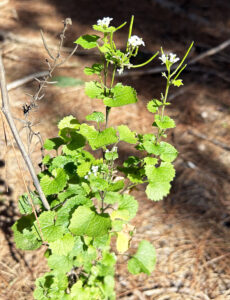
Spring is here! Invasive plants, like garlic mustard, are often among the first green life to emerge in the new season.

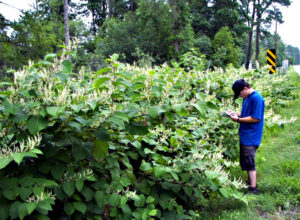
A dense population of garlic mustard carpets a forest floor.

Garlic mustard is an invasive plant that appears early in spring. Photo: Wisconsin DNR

Continue reading “April Showers Bring May Garlic Mustard”

Species Recommendations Available

If you’re reading this, you love trees and have no doubt been asked for your tree species recommendations. The Wisconsin Department of Natural Resources (DNR) Urban Forestry Program is no different. Because species recommendations are an evergreen request, we developed four lists, accounting for a small number of large and small trees in street and park environments.

These lists are not exhaustive (only ten species in each) and any general list of recommendations is somewhat fraught with uncertainty due to the nuanced conditions of specific planting sites. We highly suggest consulting with your local nurseries and other experts who can not only discuss what is available but also provide other recommendations and planting advice. With just a few exceptions, these lists do not include cultivars and varieties, but your local experts can provide that amount of detail.

Continue reading “Species Recommendations Available”

Rochester Creates Arboretum To Encourage Species Diversity

By Sara Minkoff, retired DNR Urban Forestry Council Liaison

Many smaller Wisconsin communities would like to expand their tree planting efforts but have limited budgets. One village in southern Wisconsin came up with a solution.

Rochester Commons Park has been working to create an arboretum using several grants from the American Transmission Company, an electric transmission utility that aids in promoting natural resources in areas separate from electrical utility service lines.

The western Racine County village of about 4,000 people is lined predominantly with maple trees in the public right-of-way along streets and sidewalks. The goals of the ATC-funded project are to exhibit a variety of species beyond the maples to encourage residents to plant and grow more types of trees and diversify and beautify Rochester.

Continue reading “Rochester Creates Arboretum To Encourage Species Diversity”

Emerald Ash Borer Found In Bayfield County

By Paul Cigan, DNR Forest Health Specialist

Paul.Cigan@wisconsin.gov or 715-416-4920

Emerald ash borer (EAB) has been discovered in Bayfield County for the first time in both the city of Bayfield and Bayview township to the south. This marks the 63rd out of Wisconsin’s 72 counties to have an EAB discovery since its initial detection in 2008.

Dead white ash with woodpecker damage in a park

Figure 1: First known infested ash tree in Bayfield County with characteristic woodpecker damage (i.e., flecking).
Photo: Wisconsin DNR

Several white ash trees (Fig 1.) were observed in and around a roadside park in the city of Bayfield, and larval specimens were subsequently lab-confirmed. In Bayview, a black ash swamp had several infested black ash (Fig 2). 

After introduction, EAB populations remain low for at least several years as most larvae in newly infested, healthy ash require two years to complete their life cycle. The abundance of healthy ash at each site suggests EAB populations have remained low since their introduction at least three years ago. However, EAB will kill ash more quickly as beetle numbers mount and more larvae transform from egg to adult in a single year. Unfortunately, many ash in the area are expected to die within four to seven years based on detection-to-impact timeframes observed from the Superior and Duluth area and research conducted in midwestern states. Continue reading “Emerald Ash Borer Found In Bayfield County”

Squirrel Damage Mayhem

By Linda Williams, DNR Forest Health Specialist, Woodruff

Linda.Williams@wisconsin.gov or 920-360-0665

Finger pointing at tooth marks on the wood of a maple that squirrels stripped of bark.

Narrow grooves are left when squirrels chew the bark off a young tree or a branch.
Photo: Wisconsin DNR

In late winter, it’s common to see tree branches that have been freshly stripped of their bark. Damage can be extensive where entire branches, and sometimes entire small trees, can be stripped of bark. This damage, believe it or not, is from squirrels! While primarily found on sugar maples, you can also find squirrel damage on red maples and the occasional oak. So far this year, the damage has been noted in Langlade, Shawano, Oneida and Vilas Counties. 

On sunny days, the pale wood of branches where the bark has been stripped off stands out in the forest. This type of feeding can remove enough bark to girdle the branches or the main stem, causing the tree to die from that point to the end of the branch. Branches that are not entirely girdled will continue to grow, and callus tissue will begin to grow over the wounds. If branches are nearly girdled, they may leaf out in the spring only to have the leaves suddenly wilt and die as hot weather hits because the tree can’t move enough water to keep the leaves alive. Continue reading “Squirrel Damage Mayhem”

EAB Identified In Lincoln County For The First Time, Continues Spread Into Northern Wisconsin

By Linda Williams, WI DNR Forest Health Specialist, Woodruff
Linda.Williams@wisconsin.gov or 920-360-0665

Emerald ash borer (EAB) continues to spread into areas of Northern Wisconsin and was detected for the first time in Lincoln County, in the Town of Harrison and the City of Tomahawk. EAB was first identified in Wisconsin in 2008, only 14 years ago. It is now in 62 of Wisconsin’s 72 counties.

S-shaped markings in an ash tree trunk where a hatchet has removed the bark.

S-shaped galleries under the bark of this ash were created by EAB larvae. You can also see epicormic branches (water sprouts) coming out of the trunk. These are a sign of significant stress in the tree. Photo Credit: Wisconsin DNR

Continue reading “EAB Identified In Lincoln County For The First Time, Continues Spread Into Northern Wisconsin”

Garden Planning – Avoid Invasive Plants

By Jaqi Christopher, DNR Forest Invasive Plant Specialist, Rhinelander, Jacquelyn.Christopher@wisconsin.gov and Mary Bartkowiak, DNR Forest Invasive Plant Coordinator, Rhinelander, Mary.Bartkowiak@wisconsin.gov

With winter in full swing, many gardeners dream of spring and begin planning what plants to add to their gardens. Now is a great time to brush up on what not to plant to avoid invasive species that might be hiding in plain sight.

Woodlot in fall, most trees have lost their leaves which are covering the ground. Several burning bush shrubs still with their bright red leaves stick out against the brown backdrop.

Burning bush as a forest invasive.
Photo: Leslie J. Mehrhoff, University of Connecticut, Bugwood.org

Continue reading “Garden Planning – Avoid Invasive Plants”

International Society of Arboriculture Trees Are Good Brochures Available For Download

Now available for download are the Trees Are Good brochures from the International Society of Arboriculture. Brochures contain educational information for tree owners on best management practices throughout the life of a tree, from tree selection and planting to mature tree care and risk assessment. They also serve as a helpful tool to generate greater awareness of the benefits that trees provide in our communities.

Brochure topics include:

  • Benefits of Trees
  • Tree Values
  • Tree Selection
  • Buying High Quality Trees
  • Recognizing Tree Risk
  • Avoiding Tree Damage during Construction

Continue reading “International Society of Arboriculture Trees Are Good Brochures Available For Download”

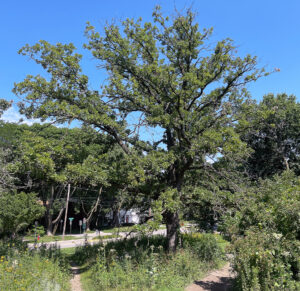
What Accounts For Your Neighborhood’s Tree Canopy?

By Dan Buckler, DNR Urban Forest Assessment Specialist, Madison, daniel.buckler@wisconsin.gov or 608-445-4578

When I returned to my hometown neighborhood in northeast Ohio this past August, I was delighted to rekindle my friendship with so many trees that I have known most of my life. There are, of course, the Norway maples and crabapples and blue spruces found in maintained spaces throughout eastern America. One also finds a fair number of sugar maples and Ohio buckeyes. But despite apparently living in a democracy, red oak is king of my neighborhood.

During this visit, I did something that I don’t always do; I looked down. What I saw concerned me. Or, rather, what I didn’t see. Few trees had been planted in a decade, and fewer still will grow into canopy-replacing size. Windstorms were slowly bleeding the neighborhood of its great oak and maple trees, but there were no longer any kings or queens being coronated.

Continue reading “What Accounts For Your Neighborhood’s Tree Canopy?”