
This fall Wisconsin DNR Urban Forestry program hosted the inaugural Wisconsin Community Tree Management Institute (WCTMI) graduate workshop. It was held over two days in mid-October at the Green Lake Conference Center. The workshop included presentations and mini-workshops on many topics. One of the topics was risk tree assessment, presented by Dan Traas. Continue reading “Risk tree assessment”
Events
2017 First Downs for Trees
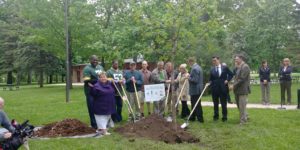 In the Green Bay Packers 2016 regular season they completed 349 first downs, 20 more than their opponents. This is one of many impressive statistics the Packers have. This particular state is even more rousing because of a green initiative titled “First Downs for Trees.” Continue reading “2017 First Downs for Trees”
Consider participating in MFI
MFI (Municipal Forestry Institute) is an exciting, high-level training opportunity educating professionals in the leadership and managerial aspects of urban forestry. Continue reading “Consider participating in MFI”
Tree planting in Gillett
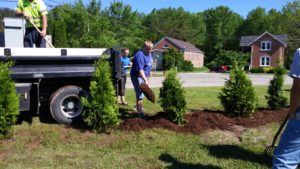 On June 7, 2017, sixty-three (63) arbor vitaes were planted in Gillett at their Nicolet Trail Campground. Continue reading “Tree planting in Gillett”
Wisconsin celebrates Arbor Day
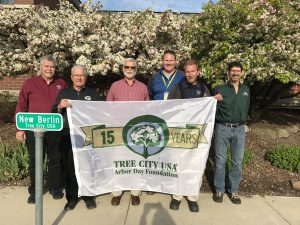 Breathe in… breathe out. The clear air that fills your lungs has been purified by trees. Clean air is one of the many ecological, economic and social benefits trees provide us. Trees also reduce crime rate, increase property values, reduce heating and cooling costs, increase tests scores, beautify communities, and provide lumber by-products. In late April, people around the world, both old and young, took time to celebrate these and other benefits by participating in Arbor Day celebrations. Continue reading “Wisconsin celebrates Arbor Day”
NAASF UCF conference review
DNR Urban Forestry staff, led by Urban Forestry Coordinator Olivia Witthun, successfully planned and executed a 4-day annual meeting for the Northeastern Area Association of State Foresters – Urban & Community Forestry Committee (NAASF UCF) in Madison in May. Continue reading “NAASF UCF conference review”
Properly plant your trees this season
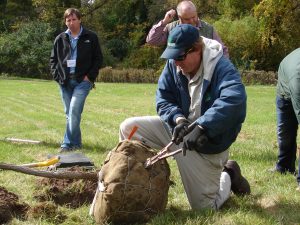 In April we celebrated Earth Day and Arbor Day, the perfect time to plant trees. Planting trees in urban areas provides communities with many benefits, but in order to receive the benefits it must first be properly planted. There are several resources that can help ensure that trees are planted properly. Continue reading “Properly plant your trees this season”
Urban wood used in local art exhibit
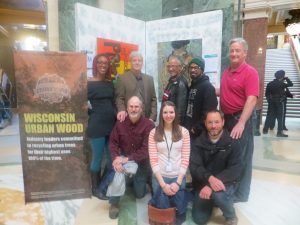 The cabinets in your kitchen, your dining room table, floors in your office, and even the paper you write on are all products made from wood. Usually rural wood is used to make the products, but over the past several years a shift has been made, introducing the use of wood from urban areas to make these, and other, products. For example, urban wood has successfully been used in architecture, creating bowls, staircases, tables and now art. Continue reading “Urban wood used in local art exhibit”
Urban training and events update
Please view our Urban Forestry Training and Events page. This webpage is constantly being updated, but we have recently added some events we would like to let you know about. Various levels of SAWW training will be offered at different locations in the coming months, be sure to pre-register. Additionally, Golden Sands RC&D Council is hosting a workshop on emerald ash borer management. Be sure to check out these and other trainings listed on our page.
For more information contact Ellen Clark (EllenA.Clark@Wisconsin.gov), Urban Forestry Communication Specialist, at 608-267-2774.
DNR will conduct aerial spraying for gypsy moth in Madison, Monona and at Devils Lake State Park
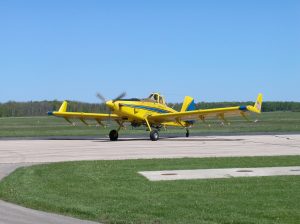
Spray aircraft used in gypsy moth control.
Residents in the Madison and Baraboo areas can expect a morning or two of loud, low-flying planes this May. The DNR Gypsy Moth Suppression Program will be spraying to control high populations of gypsy moth, an invasive and destructive pest whose caterpillars feed on the leaves of many tree and shrub species. Aerial spraying will occur in the following locations:
- Cities of Madison and Monona: Three sites in and around Orton Park, Quaker Park, and Acewood/Elvehjem Parks
- Devils Lake State Park: Day-use area at the south end of the lake, and the day-use area and several campgrounds at the north end of the lake.
Maps of the treatment areas can also be seen at the Wisconsin Cooperative Gypsy Moth Program website. Spraying is currently predicted to occur in mid-May, but actual dates will depend on weather conditions and caterpillar development.