Southern WI Forest Health

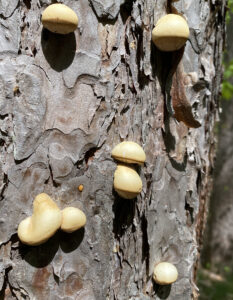
Veiled Polypore Fungi Growing On Red Pine Bark

Closeup photo of veiled polypore fungi showing as yellow, leathery fruiting bodies on the bark of dead red pine trees.

Veiled polypore fungi show as yellow, leathery fruiting bodies on the bark of dead red pine trees. / Photo Credit: Linda Williams, Wisconsin DNR

By Linda Williams, Forest Health Specialist
Linda.Williams@wisconsin.gov or 920-360-0665
You may have seen these leathery, yellow fungi growing on recently dead red pine trees and wondered if they were what killed the tree. The short answer: No, they did not kill the tree.

The veiled polypore (Cryptoporus volvatus) is a decay fungus that grows on the bark of red pine in the year after they die. They can be found anywhere on the trunk of the tree.

Continue reading “Veiled Polypore Fungi Growing On Red Pine Bark”

Non-Native Caterpillars Attacking Non-Native Euonymus

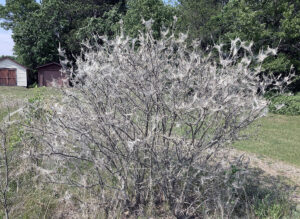
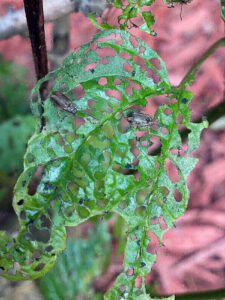
A wide view of a shrub covered by Euonymus caterpillars' web branches as they feed on the leaves of Euonymus species.

Euonymus caterpillars web branches as they feed on the leaves of Euonymus species. / Photo Credit: Wisconsin DNR

By Michael Hillstrom, DNR Forest Health Specialist
Michael.Hillstrom@wisconsin.gov

Euonymus caterpillars (Yponomeuta cagnagella) made a dramatic appearance in June, webbing and defoliating Euonymus shrubs in several counties.

Multiple species of Euonymus may be attacked, including spindle tree, winged (e.g., burning bush), eastern wahoo, winter creeper and others. Winged euonymus is listed as Restricted in Wisconsin’s invasive species rule NR40.

Continue reading “Non-Native Caterpillars Attacking Non-Native Euonymus”

Woolly Elm Aphid Causes Elm Leaves To Curl

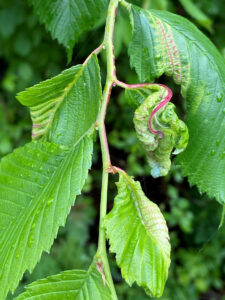
Closeup photo of a group of elm leaves that show varying levels of wrinkling and curling, due to feeding by wooly elm aphids on the underside of the leaves.

A group of elm leaves shows varying levels of wrinkling and curling, due to feeding by wooly elm aphids on the underside of the leaves. / Photo Credit: Linda Williams, Wisconsin DNR

By Linda Williams, DNR Forest Health Specialist, Woodruff
Linda.Williams@wisconsin.gov or 920-360-0665 

Woolly elm aphids (Eriosoma americanum) are a minor pest of American elm. The aphids’ feeding causes leaves to curl at the edges and develop a characteristic wrinkled appearance.

Uncurling the leaves exposes many pale gray aphids on the underside of the leaves, which are protected by the rolled leaf.

Continue reading “Woolly Elm Aphid Causes Elm Leaves To Curl”

Spongy Moth Population In Decline

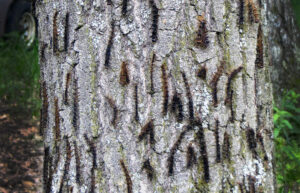
A photo of a tree trunk showing spongy moth caterpillars killed by nucleopolyhedrosis virus (NPV) hang in an inverted “V” orientation; caterpillars killed by the fungus Entomophaga maimaiga hang vertically.

Spongy moth caterpillars killed by nucleopolyhedrosis virus (NPV) hang in an inverted “V” orientation; caterpillars killed by the fungus Entomophaga maimaiga hang vertically. / Photo Credit: Wisconsin DNR

By Michael Hillstrom, Wisconsin DNR Forest Health Specialist
Michael.Hillstrom@wisconsin.gov; 608-513-7690

Spongy moth caterpillars began hatching at the end of April in 2025 and are now actively feeding on leaves. In most Wisconsin locations, though, the population will not be as high as it has been in the last few years.

Wisconsin has had the largest outbreak in state history over the past few years. Fortunately, the outbreak collapsed in many areas of the state in 2024. The wet spring weather in April and May of 2024 allowed a fungus and a virus that infects spongy moth caterpillars to cause heavy mortality. Although some hot spots still exist in south central and northeast Wisconsin, we expect those populations to decline in 2025.

Continue reading “Spongy Moth Population In Decline”

Watch For Oak Wilt Symptoms

A wide-angle photo showing an oak tree in the center that died rapidly from oak wilt during the summer of 2024.

An oak tree (center) that died rapidly from oak wilt during the summer of 2024. / Photo Credit: Wisconsin DNR

By Michael Hillstrom, Wisconsin DNR Forest Health Specialist
Michael.Hillstrom@wisconsin.gov or 608-513-7690

Oak wilt symptoms typically begin to appear in southern Wisconsin in late June and in northern Wisconsin during July.

Watch for browning leaves, starting at the top of the canopy and progressing downward. Most leaves will fall from infected trees as they die, typically within two to four weeks.

Continue reading “Watch For Oak Wilt Symptoms”

What’s That Under The Bark Of Red Pines?

A close-up photo showing pitch blobs near the base of a red pine, indicating attack by red turpentine beetle.

Pitch blobs near the base of a red pine indicate attack by red turpentine beetle. / Photo Credit: Linda Williams, Wisconsin DNR

By Linda Williams, Wisconsin DNR Forest Health Specialist
Linda.Williams@wisconsin.gov or 920-360-0665

Red turpentine beetle and pine root collar weevil are the most common insects found attacking near the base of red pine trees in Wisconsin, whether near ground level or just below ground level.

Here are some tips on identifying and controlling these pests.

Continue reading “What’s That Under The Bark Of Red Pines?”

Web-Spinning Caterpillars Not Spongy Moth

By Linda Williams, DNR Forest Health Specialist, Woodruff
Linda.Williams@wisconsin.gov,  920-360-0665

You may already be seeing the web nests created by eastern tent caterpillars, which hatch early in the spring and start feeding on emerging leaves as the weather warms up.

Eastern tent caterpillars can sometimes be mistaken for forest tent caterpillars or spongy moths. Check out the DNR’s comparison fact sheet, which includes pictures for identification and control options. Continue reading “Web-Spinning Caterpillars Not Spongy Moth”

Columbian Timber Beetle Fact Sheet Debuts

Photo showing staining, in the shape of a many-pointed star, evident in the cut ends of silver maple logs.

Staining, in the shape of a many-pointed star, is evident in the cut ends of silver maple logs. / Photo Credit: Chris Firgens, Oconto County Forest

By Linda Williams, DNR Forest Health Specialist, Woodruff
Linda.Williams@wisconsin.gov or 920-360-0665

Columbian timber beetle (Corthylus columbianus) is an ambrosia beetle native to the eastern United States.

In Wisconsin, we have had reports of Columbian Timber Beetle (CTB) attacking silver maple in the northeastern and lakeshore areas of the state, dating back to the early 1990s. The insects have caused significant staining from repeated attacks. In southern Wisconsin, CTB can attack oaks to a lesser degree, including bur, northern red and white oak.

Continue reading “Columbian Timber Beetle Fact Sheet Debuts”

Fight The Bite! Watch For Ticks

By Michael Hillstrom, DNR Forest Health Specialist
Michael.Hillstrom@wisconsin.gov

Ticks are active now, so it’s time to start taking precautions to prevent tick bites and transmission of the diseases they carry. Whenever temperatures at ground level get above 40-42 degrees Fahrenheit, ticks will start to be active.

Continue reading “Fight The Bite! Watch For Ticks”

Watch For Oak Decline And Mortality This Summer

Oak decline and mortality at Big Foot Beach State Park in 2024.

Oak decline and mortality at Big Foot Beach State Park in 2024. / Photo Credit: Wisconsin DNR

By Michael Hillstrom, DNR Forest Health Specialist
Michael.Hillstrom@wisconsin.gov

Oak decline and mortality continue to be an issue in Wisconsin, and because of the recent droughts and spongy moth outbreak, we expect these impacts to become more widespread this summer.

Forest decline is the progressive loss of tree and stand vigor and health over several years without obvious evidence of a single causal factor. Typically, trees die in a scattered fashion across a large area over several years. The additional stress from defoliation can result in pockets of heavy oak mortality, particularly on dry, sandy sites and steep, rocky ridges and hills.

Continue reading “Watch For Oak Decline And Mortality This Summer”