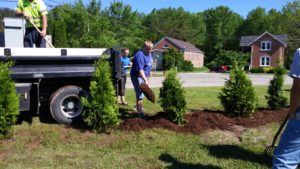
 On June 7, 2017, sixty-three (63) arbor vitaes were planted in Gillett at their Nicolet Trail Campground. Continue reading “Tree planting in Gillett”
Urban wood
Community forests are emerging
Urban gardens and urban forests have been growing in popularity over the years. The goal of community gardens is transforming small, simple spaces into beautiful areas that can be used in many ways. Community gardens are not only for vegetables, but for trees, shrubs and grasses as well. Continue reading “Community forests are emerging”
Menomonie re-uses ash trees
Every year, Urban Forestry grants provide assistance to communities throughout Wisconsin, and can be awarded to cities, villages, towns, counties, tribes and nonprofit organizations. This year, the city of Menomonie received a $9,000 grant to help pre-emptively remove ash trees in the city parks to prevent the spread of emerald ash borer, a pest spreading throughout Wisconsin. Thirty trees will be removed and replaced with hackberry, honeylocust, Kentucky coffeetree, swamp white oak, Redmond linden and Princeton elm. Continue reading “Menomonie re-uses ash trees”
Wisconsin celebrates Arbor Day
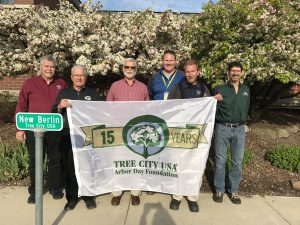 Breathe in… breathe out. The clear air that fills your lungs has been purified by trees. Clean air is one of the many ecological, economic and social benefits trees provide us. Trees also reduce crime rate, increase property values, reduce heating and cooling costs, increase tests scores, beautify communities, and provide lumber by-products. In late April, people around the world, both old and young, took time to celebrate these and other benefits by participating in Arbor Day celebrations. Continue reading “Wisconsin celebrates Arbor Day”
Trees help clean the air
 A recently published report from The Nature Conservancy titled “Planting Healthy Air,” detailed which cities could benefit most from tree plantings, focusing on the benefit they could gain from the heat and PM (particle matter) reduction credited to tree plantings. This report found that investing $4 per resident in these cities for tree planting could improve the health of millions, further showcasing trees as a cost-effective solution for air pollution and heat islands, among many other urban difficulties. Continue reading “Trees help clean the air”
Properly plant your trees this season
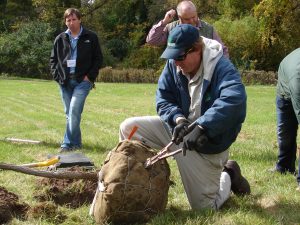 In April we celebrated Earth Day and Arbor Day, the perfect time to plant trees. Planting trees in urban areas provides communities with many benefits, but in order to receive the benefits it must first be properly planted. There are several resources that can help ensure that trees are planted properly. Continue reading “Properly plant your trees this season”
UW-Stevens Point students gain real world skills while helping communities
In an attempt to find an avenue to get small communities in the fold of beginning, or better managing their community tree resources DNR Regional Urban Forestry (UF) Coordinator, Don Kissinger, resurrected memories of his college days when he and his classmates were given a computer simulation to react and manage a fictitious community forestry program. Through this attempt the collaboration with UW- Stevens Point Professor Rich Hauer and his senior level Urban Forestry Lab class began.
Continue reading “UW-Stevens Point students gain real world skills while helping communities”
Urban wood used in local art exhibit
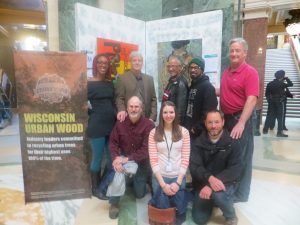 The cabinets in your kitchen, your dining room table, floors in your office, and even the paper you write on are all products made from wood. Usually rural wood is used to make the products, but over the past several years a shift has been made, introducing the use of wood from urban areas to make these, and other, products. For example, urban wood has successfully been used in architecture, creating bowls, staircases, tables and now art. Continue reading “Urban wood used in local art exhibit”
Second round of Urban Forestry grants awarded
The DNR Urban Forestry Grant program awarded $86,185.66 to five Wisconsin communities for urban forestry projects during our 2017 second round of funding. In order to ensure a pool of catastrophic storm funds throughout the year, we have switched to awarding grants in two rounds, instead of awarding all of our funds in December. The communities who received grants in April include DeForest, Neillsville, Port Washington, Watertown, and Witting. Continue reading “Second round of Urban Forestry grants awarded”
Wisconsin Community Tree Management Institute
 CTMI is a continuing education course specifically tailored to the needs of municipal parks, planning or public works employees who have tree related responsibilities, but do not have a strong background in urban forestry. This training is appropriate for those who manage or contract forestry work, review planting plans, issue permits, or inspect trees. The course focuses heavily on management, rather than the technical aspects of municipal forestry programs. Continue reading “Wisconsin Community Tree Management Institute”