
By Carter Hellenbrand, DNR Invasive Plant Field Specialist, Fitchburg
Carter.Hellenbrand@Wisconsin.gov
Note: This is the second installment in the Forest Health News “Invasives Spotlight” series, a monthly series of Forest Health News articles.
Monarch butterflies are dependent on native milkweed for survival. But did you know there are invasive plants within the milkweed family that negatively impact this relationship?
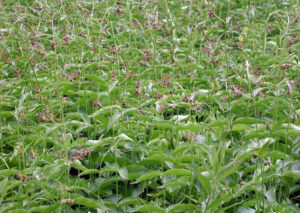
Pale swallow-wort infestation twining upwards. / Photo Credit: Leslie J. Mehrhoff, University of Connecticut, Bugwood.org
Black and pale swallow-wort (Vincetoxicum spp.) are invasive perennial vines that twine up to 6 feet in length. These two species predominantly spread through the production of seeds but can also spread vegetatively through horizontal stems that grow underground (rhizomes). The seed has thin filaments that aid in wind dispersal.
Black and pale swallow-wort grow in a variety of habitats, including forests and grasslands. Despite not having tendrils, this species twines and grows on top of surrounding vegetation, resulting in the displacement of native vegetation. Because these species are within the milkweed family (Apocynacae) and can easily outcompete native milkweed, monarch butterflies have been observed laying their eggs on swallow-wort. Once these eggs hatch, the larvae are unable to survive on the non-native milkweed relatives and die off.
History Of Black And Pale Swallow-wort
Native to Europe, black and pale swallow-wort were first introduced into North America as ornamentals and had been planted throughout the United States before becoming regulated. In Wisconsin, the Invasive Species Rule NR40 regulates both swallow-wort species. Pale swallow-wort is prohibited statewide; black swallow-wort is prohibited in most counties, with the exception of some of the southernmost counties, where it is restricted. For both species, the rule makes it illegal to transport, transfer or introduce them anywhere in Wisconsin. In areas where they are prohibited, the rule also makes it unlawful to possess them, meaning management may be required where feasible.
There have been positive detections for black swallow-wort in Kenosha, Racine, Walworth, Rock, Grant, Iowa, Dane, Jefferson, Waukesha, Washington, Richland, Waushara, Door, Shawano, St. Croix and Oconto counties.
This month, a confirmed detection of pale swallow-wort (Vincetoxicum rossicum) in Oconto and Shawano counties was announced, near their easternmost shared border just north of where State Hwy. 32 intersects Gohr Rd. These are the first known populations in the state, making rapid response efforts critical in preventing the establishment of this species in Wisconsin.
Identifying Black And Pale Swallow-wort
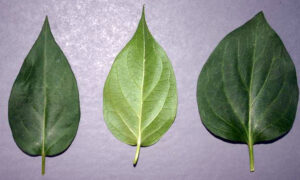
Various coloration and shapes of swallow-wort leaves. / Photo Credit: Leslie J. Mehrhoff, University of Connecticut, Bugwood.org
Leaves: Occur opposite of each other along the stem and are oblong to oval with a pointed tip and smooth edges. The color is light to dark green, and leaves can sometimes appear glossy.
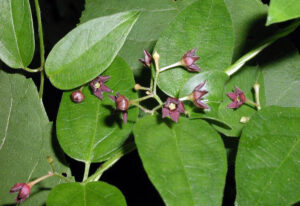
Black swallow-wort flowers along the stem at the leaf axils. / Photo Credit: Leslie J. Mehrhoff, University of Connecticut, Bugwood.org
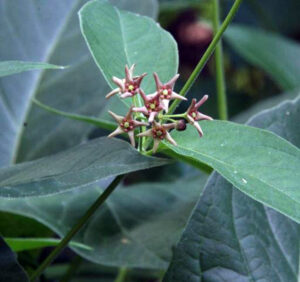
Pale swallow-wort flowers along the stem at the leaf axils. / Photo Credit: Chris Evans, University of Illinois, Bugwood.org
Flowers: Emerging from late spring to summer, the flowers are star-shaped, with five petals, and appear in clusters where the leaf connects to the stem (the axil). Black swallow-wort flowers will appear as dark purple in color with fine, white hairs; pale swallow-wort flowers will appear as pale pink with no hair.
Seed: Swallow-worts have slender seedpods that are 2-3 inches in length and appear from mid- to late summer. Seedpods start as green before turning to light brown as they mature.
Lookalikes
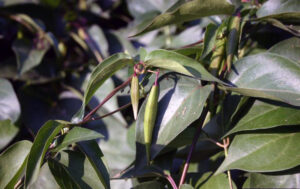
Seedpods of swallow-wort species. The seedpods start as green before fading to a light brown as they mature. / Photo Credit: Leslie J. Mehrhoff, University of Connecticut, Bugwood.org
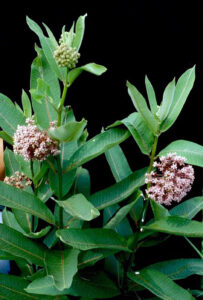
Native common milkweed (Asclepias syriaca) with large flower clusters. / Photo Credit: Theodore Webster, USDA Agricultural Research Service, Bugwood.org
Native milkweed: In Wisconsin, there are 13 known native milkweed species. The easiest way to tell the difference between native milkweed and the invasive swallow-wort is that milkweed is an upright plant and not a vine. Some species such as common milkweed can have star-shaped flowers that look similar to swallow-wort but appear in large, rounded clusters rather than small clusters.
Reporting Black And Pale Swallow-wort
If you think you have found either of these species, please report it to Invasive.Species@wisconsin.gov. At a minimum, please include the location and clear photos of the plant’s identifiable features. Other important details, such as population size and landownership, are also encouraged.
Controlling Black And Pale Swallow-wort
Swallow-worts can be controlled by digging up and removing the plant along with its entire root system. However, this can be quite a challenge because the species can reproduce through rhizomes and has a deep, fibrous root system. The most effective control method is to use systemic herbicide directly on the leaves (foliar application) when the plant is flowering, or immediately after flowering before the seedpods develop. Be sure to read the full directions on the herbicide label to determine mixing ratios, application rates and required safety measures.