
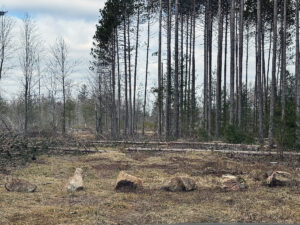
Red pine damaged by the April 2nd, 2026, ice storm in central Wisconsin. / Photo Credit: Wisconsin DNR
By Michael Hillstrom, DNR Invasive Forest Pest Coordinator, Fitchburg
Michael.Hillstrom@wisconsin.gov or 608-513-7690
Spring 2026 has seen a variety of tree stress events. Wisconsin trees have experienced snow and ice damage, severe storms that resulted in wind, hail and flood damage and swings in temperatures that brought leaf out and subsequent frost damage.
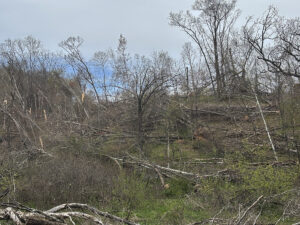
Tree damage in Juneau County, Wisconsin from severe storms the week of April 13, 2026. / Photo Credit: Wisconsin DNR
Tree-damaging events in March, April and May 2026 include:
- A blizzard March 14-16 that produced up to 34 inches of snow in northeast Wisconsin.
- An ice storm April 2 in central Wisconsin that coated trees with up to a half-inch of ice. Damage was observed on all tree species, with white pine and birch experiencing extensive damage. Ice loads caused large branch breakage, top failure and tipping in some cases. Ground surveys found scattered and variable damage across the region. Aerial survey was not possible, but damage will be mapped with satellite imagery.
- Oak Wilt: Although the high-risk period for oak wilt typically starts on April 1 in the south and April 15 in the north, accumulations of growing degree days (GDD’s) at the time of the April 2 storm had not yet hit the threshold (231 GDD’s is start of high-risk) for nitidulid beetle emergence. Wounds are susceptible to oak wilt infection for 72 hours after they are exposed, but the high-risk threshold was not reached in impacted counties until mid-April. As a result, the risk of new oak wilt infections from this ice storm should be low.
- White Pine Damage: Branch breakage, sometimes more than 50 percent, was the most common damage noted. As long as the main stem was not structurally compromised, and less than 50 percent of the branches were broken, the trees have a high likelihood of survival.
- Red Pine Damage: Localized top failure was recorded in some red pine plantations. Red pine degrades faster than hardwoods and is susceptible to bark beetles in cases when material greater than 2 inches is left on the ground after a storm. At sites where heavy damage occurred, salvage as quickly as possible to reduce potential bark beetle infestations on residual pines.
- Severe thunderstorms the week of April 13 produced numerous tornadoes, including 11 on April 17. Several tornadoes were rated as EF3. These storms also produced hail as large as 3.5 inches in diameter.
- Heavy precipitation in April set several monthly records. Green Bay received 8.56 inches of precipitation, beating the previous record by more than 2 inches. Wausau received 8.74 inches in April, beating the previous record by more than 2.5 inches. Several rural areas of Wisconsin received between 10 and 12 inches of precipitation in April, with a weather station at Clintonville (Waupaca County) recording 12.02 inches of precipitation. Portions of Brown, Shawano and Waupaca counties likely received more than 6 inches of rain in a 24-hour period of heavy thunderstorms April 13-14.
- Several major rivers had historic flooding in April, including the Embarrass, Menominee, Peshtigo, Rock, Wisconsin and Wolf rivers. According to the National Weather Service, flood records were set on several rivers, with the Wolf River basin being particularly impacted (see precipitation in April link above).
- Isolated frost damage occurred as warm April and May days resulted in leaf-out, but nighttime temperatures dipped into the 20s repeatedly.
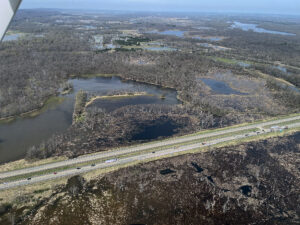
Flooding on the Wisconsin River near Portage in April 2026. / Photo Credit: Wisconsin DNR
The DNR storm damage to forests webpage has information for forest landowners recovering from damage.
The DNR Forest Health Program also has a fact sheet with more information about Environmental Causes of Tree Damage.