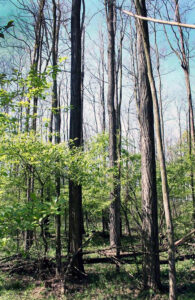
A stand of dead or dying black locust trees. / Photo Credit: Norbert Frank, Bugwood.org
By Ryan Franke, University of Minnesota
The Blanchette Forest Pathology Lab at the University of Minnesota is leading a project to study black locust in Minnesota and Wisconsin and requests the help of foresters and the public in locating stands of dying black locust (Robinio pseudoacacia) this summer.
The university plans to collect native pathogenic fungi from stands of dying black locust and testing them for their suitability to biologically control black locust clones.
Black locust is an aggressive tree that threatens many different habitats in the Great Lakes Region, especially those that have historically supported oak savannah and prairie plant communities.
Black locust is native to the United States, but not to the Upper Midwest. However, it is spreading into states such as Wisconsin that are outside its historical range.
Once established, black locust is exceedingly difficult to manage, due to its ability to develop new shoots from root collars and suckers, its pernicious thorns and the large size of its mature individuals.
Fungal biological control of black locust with mycoherbicides is an unexplored area of research that could provide land managers with another tool to transition sites dominated by black locust to more desirable plant communities.
To that end, the Blanchette Lab is asking those who observe stands of dying black locust to fill out a Google Form pinpointing the location of their find. From there, researchers from the Blanchette Lab may contact the email address provided in the report to coordinate the sampling of dying black locust trees.
For more information, contact Ryan Franke at the University of Minnesota.