
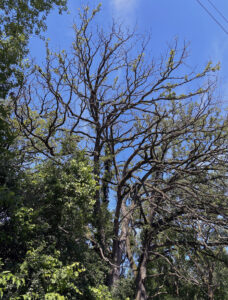
Oak trees with thin canopies experiencing decline following spongy moth defoliation and drought in the prior few years. / Photo Credit: Wisconsin DNR
By River Mathieu, DNR Forest Health Specialist, Fitchburg
River.Mathieu@wisconsin.gov
Oak decline is a complicated forest health issue impacting oak forests in Wisconsin.
In the past few years, oak decline has been recorded in several regions of Wisconsin, primarily linked to spongy moth defoliation and drought conditions that occurred from 2022-2024.
As the summer months of 2026 continue to unfold, oak decline may continue in areas previously impacted by spongy moth and drought.
What Is Oak Decline?
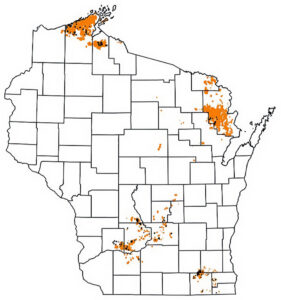
A map of spongy moth defoliation in Wisconsin observed during the 2022-24 outbreak (orange) and oak mortality observed in 2025 (black). Small areas are enhanced for visibility. / Map Credit: Wisconsin DNR
Oak decline is a complex of biotic and abiotic factors that result in individual tree and stand-level oak mortality. Three factors are required for oak decline to be diagnosed: predisposing factors, inciting factors and contributing factors.
- Predisposing Factors: Underlying factors that cause tree stress, including old age, abnormally high tree density, poor site conditions and land use history.
- Inciting Factors: Stress events that further weaken trees, including drought, insect defoliation and flooding.
- Contributing Factors: Native pests and diseases that serve as the final nail in the coffin, killing trees that are weakened by inciting factors. In Wisconsin, these often include Armillaria root disease and twolined chestnut borer (TLCB).
Knowledge of site history, recent weather patterns and the presence of contributing factors (e.g., TLCB and Armillaria) are crucial components for oak decline diagnosis.
The first physical sign of oak decline noticeable on trees is branch tip dieback. In subsequent years, branch dieback progresses, with larger branches and entire trees dying. Oaks may also produce epicormic branches on the stem or trunk when they are in decline.
Typically, these impacts become more abundant in a stand over time. If these signs are apparent, along with long-term site stress, a stress event within the past few years and signs of TLCB and Armillaria on oak trees, oak decline may be the cause of mortality at a given site.
Oak Decline Management
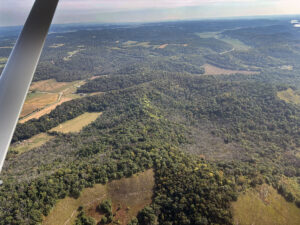
Patches of oak mortality observed during aerial survey in 2025. / Photo Credit: Wisconsin DNR
Oak decline in a forest stand is generally irreversible once it has started. Where practical, prevention of oak decline is recommended as a management strategy. Proper forest management, such as periodic thinning and stand regeneration, can reduce the risk and impacts of oak decline. Some options to reduce the risk of oak decline in forests are listed below:
- Avoid harvesting in a stand for 3-4 years following stress events like severe drought or greater than 50% defoliation.
- Thin stands to maintain vigor.
- Diversify oak forests to improve resilience. Manage for multiple oak species and a diverse mix of other tree species.
- Regenerate mature stands. Maintaining some older oak trees is desirable as a seed source and habitat for wildlife.
- If oak decline has occurred, work with a forester to determine if a salvage harvest is reasonable.
Sites experiencing oak decline can continue to grow oak in the future. Trees affected by oak decline may not produce many, or any, stump sprouts when harvested; planting may be necessary to keep oak on the site.
If oak decline is suspected in a forest stand, contact a forester or DNR Forest Health Specialist for technical assistance and management advice.