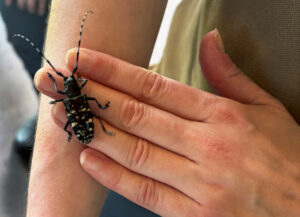
An adult Asian longhorned beetle. / Photo Credit: Wisconsin DNR
By Michael Hillstrom, DNR Invasive Forest Pest Coordinator, Fitchburg
Michael.Hillstrom@wisconsin.gov or 608-513-7690
Asian longhorned beetle (ALB) has not been found in Wisconsin, but early detection is critical to eliminating it from infested areas. Forest Health workers from Wisconsin, Michigan, Minnesota and Manitoba, Canada, recently had the opportunity to visit an active ALB infestation in South Carolina to learn how to identify infested trees. This experience will greatly enhance staff’s ability to detect ALB and respond rapidly.
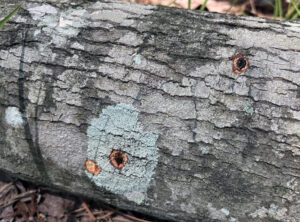
Female Asian longhorned beetles chew pits in tree bark as egg laying sites. / Photo Credit: Wisconsin DNR
If you suspect you’ve found ALB, please report it and send photos to your DNR Forest Health specialist or to the Wisconsin Department of Agriculture, Trade and Consumer Protection (DATCP) Pest Hotline (DATCPPestHotline@wi.gov or 866-440-7523) .
ALB is a very destructive pest and major threat to maple and other hardwood trees. It is typically introduced, unintentionally, to new areas via wooden pallets, wood packing materials or firewood.
The whitespotted sawyer beetle (Monochamus scutellatus), also known as the pine sawyer beetle is native to Wisconsin and is often confused with ALB (see the DNR’s ALB webpage for comparison photos). Whitespotted sawyers attack stressed conifers rather than the maple and other hardwood species preferred by ALB. During the summer, you can hear whitespotted sawyer larvae loudly chewing under the bark of pine trees. They pupate within the tree and adults chew their way out, leaving large, round exit holes like those from ALB.
For additional information, visit the DNR Forest Health ALB webpage. For information about the ALB exterior quarantine in Wisconsin, visit the DATCP ALB webpage.
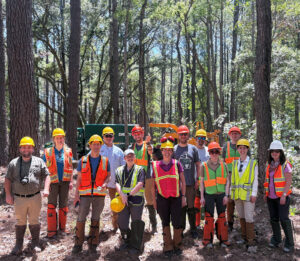
Forest Health staff from Manitoba, Michigan, Minnesota and Wisconsin visited forests in South Carolina to learn how to detect and manage Asian longhorned beetle. / Photo Credit: Wisconsin DNR