
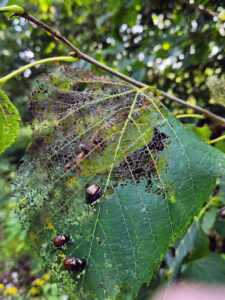
Japanese beetles defoliating a basswood leaf. / Photo Credit: Wisconsin DNR
By Linda Williams, Forest Health Specialist, Woodruff;
Linda.Williams@wisconsin.gov, 920-360-0665
The Japanese beetle (Popillia japonica) is an invasive insect that feeds on many plant species. The adult beetles “skeletonize” leaves by eating the material between the veins.
Adult Japanese beetles feed on the flowers and leaves of more than 300 plant species, including trees, shrubs and herbaceous plants. Forest trees can be defoliated, with open-grown or edge trees suffering the highest defoliation rates.
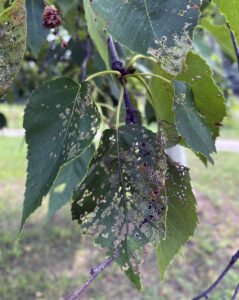
Birch leaves defoliated by Japanese beetles, leaving behind the lacy network of veins. / Photo Credit: Wisconsin DNR
In Northern Wisconsin, Japanese beetle populations are still building up – for the first time in some areas – and are expected to continue to build and spread.
The favorite trees of Japanese beetles in the Northwoods include birch, mountain ash and basswood/linden, but they have also been observed feeding on the leaves of young oaks and other trees as well. Defoliation on birch can put enough stress on the trees that they can then be attacked by bronze birch borer, which can kill the top of the tree or even the entire tree.
Biological control can help to control beetles in the forest. The Winsome fly, which has been expanding its range into Wisconsin, lays its eggs on adult Japanese beetles. Their eggs look like small white dots near the heads of the beetles. When the eggs hatch, the fly larvae bore in and feed within the beetle, usually leading to death.
If you see fly eggs attached to Japanese beetles, please take a moment to report them in the iNaturalist app so we can track their progress. You can see some great pictures of Winsome fly in iNaturalist.
Visit the University of Wisconsin-Madison Extension’s Japanese beetle webpage for information on control measures for beetle adults and grubs. If you have questions or concerns about Japanese beetles on your ornamental and yard trees, visit Extension’s Ask A Gardener page to use their form to submit your questions.
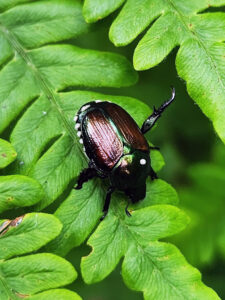
Winsome fly eggs are white ovals near the heads of beetles. There may be one or several. / Photo Credit: Wisconsin DNR