
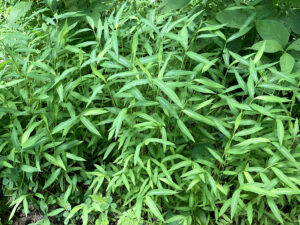
A dense patch of Japanese stilt grass growing within a forest. / Photo Credit: Wisconsin DNR
By Carter Hellenbrand, Invasive Plant Field Specialist, Fitchburg;
Carter.Hellenbrand@Wisconsin.gov
Note: This is the fourth installment in the Forest Health News “Invasives Spotlight” series, a monthly series of Forest Health News articles.
What has stilts, is green in the summer and reddish-purple in the fall? Japanese stilt grass!
Japanese stilt grass (Microstegium vimineum) is an annual that grows up to 3 feet tall. It gets its name due to branching rootlets, or stilts, that appear toward the base of the plant and act as structural support and to grow over nearby vegetation.
Japanese stilt grass is a prolific seed producer, with each plant producing up to 1,000 seeds during its growing season. This is possible thanks to its open pollinated flowers and closed (cleistogamous) flowers within the stem sheath. The closed flowers never open but self-fertilize to create even more seeds to aid in reproduction.
Japanese stilt grass can grow in a variety of habitats, including grasslands, forests and wetlands. Due to its mat-like growth, it creates dense patches that prevent other vegetation from growing. This results in the displacement of native plants. These dense patches also increase the risk of fire frequency and intensity within an area, because it is an annual grass that that dies back each year — leaving large amounts of flammable material.
There is a limited number of known populations for Japanese stilt grass in Wisconsin. If you think you have found this species, please report it to Invasive.Species@wisconsin.gov. At a minimum, please include the location and clear photos of the plant’s identifiable features. Other important details, such as population size and landownership, are also encouraged.
History Of Japanese Stilt Grass
Native to Asia, Japanese stilt grass was first documented in the United States in 1919, discovered in Tennessee – likely from the use of packing material that contained this grass species.
In Wisconsin, this species is regulated as prohibited under the Invasive Species Rule NR40. The rule makes it illegal to possess, transport, transfer or introduce prohibited species anywhere in Wisconsin.
There have been positive detections for stilt grass in Dane, Grant, Rock, Walworth and La Crosse counties.
Identifying Japanese Stilt Grass
Stem /Leaves: Leaves alternate along the stem, come to a taper at both ends and are 1 to 4 inches in length. The most notable feature is a distinct slightly off-center, silvery stripe. The leaves and stem turn to a reddish-purple color in the fall. The nodes of this invasive grass (the point on a stem from which a leaf or branch extends) are hairless and smooth.
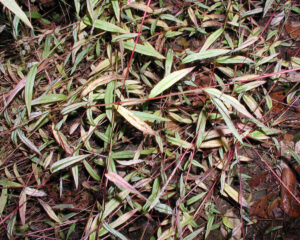
Japanese stilt grass stems and leaves change to a reddish-purple color in the fall. / Photo Credit: Leslie J Mehrhoff, University of Connecticut, Bugwood.org
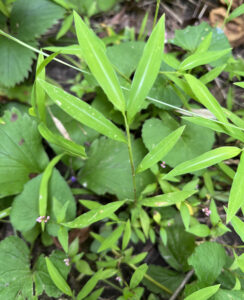
Japanese stilt grass leaves show a prominent, slightly off-center silvery stripe. / Photo Credit: Wisconsin DNR
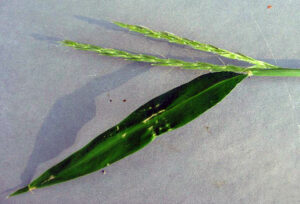
Open flowers of Japanese stilt grass that grow in short spikelets. / Photo Credit: Leslie J. Mehrhoff, University of Connecticut, Bugwood.org
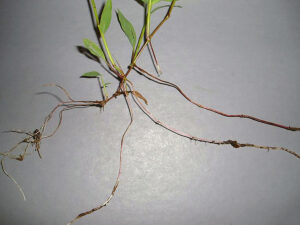
Japanese stilt grass root system with adventitious roots known as stilts. / Photo Credit: Leslie J. Mehrhoff, University of Connecticut, Bugwood.org
Flowers: Emerging in early to mid-fall, clusters of tiny flowers are formed together to create a spikelet ranging from 1 to 3 inches in height.
Roots: its fibrous root system does not extend deep into the ground. Adventitious roots (known as stilts) extend from the nodes of the lower part of the stem.
Japanese Stilt Grass Lookalikes
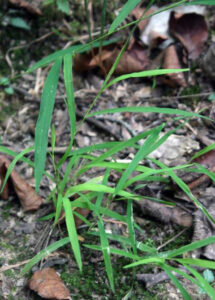
Thin and long leaves of native white grass (Leersia virginica). / Photo Credit: Chris Evans, University of Illinois, Bugwood.org
White grass: The leaves of white grass are much thinner and longer than those of Japanese stilt grass. They also lack the silvery slightly off-centered stripe. White grass has flower spikes occurring in July in Wisconsin, significantly sooner than when the flowers of stilt grass appear. The nodes of white grass are hairy, unlike Japanese stilt grass, which lacks hairs along the stem.
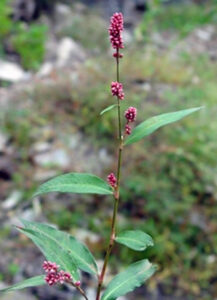
Non-native lady’s thumb (Persicaria maculosa) with pink flowers. / Photo Credit: Dan Tenaglia, Missouriplants.com, Bugwood.org
Smartweed: Although the leaves can look similar to stilt grass, smartweeds are not actually grasses. They also have small pink to white flowers, swollen nodes where the leaves meet the stem, and a thin membranous sheath that encircles the stem.
Controlling Japanese Stilt Grass
Japanese stilt grass can be controlled by hand-pulling small populations or using a butane torch to spot-treat populations. Alternatively, grass-specific, pre-emergent herbicide can be used on the ground where known Japanese stilt grass populations have occurred. This treatment should occur in early spring, before seed begins to germinate. Systemic herbicides can be applied directly on the leaves (foliar application) in the summer. Often, the most effective treatment will be a combination of a pre-emergent application in the spring, followed by a foliar application in the latter half of summer. All control methods should occur before the seed is produced, usually beginning early to mid-October.
Be sure to read the full directions on the herbicide label to determine mixing ratios, application rates, and required safety measures.