
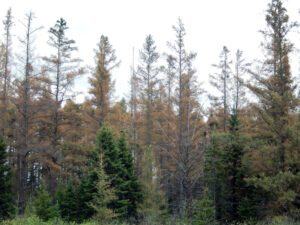
Tamarack trees showing the effect of larch casebearer defoliation. / Photo Credit: Wisconsin DNR
By Linda Williams, Forest Health Specialist, Woodruff;
Linda.Williams@wisconsin.gov, 920-360-0665
Earlier this spring, scattered areas of tamarack in North Central and Northeastern Wisconsin showed tan or light brown foliage. Sometimes that is due to frost, but this year it was the work of an insect called larch casebearer.
As the foliage started to expand this spring, the larch casebearer became active and began to feed. The tiny caterpillars mine out the needles of tamarack and use them as “cases” to protect themselves, thus their name.
Larch casebearer caterpillars overwinter as young caterpillars and start feeding as soon as the weather warms and buds begin to break.
Defoliated tamarack trees that were tan or brown this spring have now produced a second set of needles and are green once again.
However, repeated defoliation of tamarack can weaken the trees, making them more susceptible to attack by eastern larch beetle, which feeds beneath the bark and girdles larch trees, causing mortality.
Larch casebearer populations are usually controlled by parasitoids, predators and abiotic factors such as late frosts. Management is not usually recommended in forest stands. Insecticides should be used only to protect high-value ornamental trees.