
By Gabe Spangler, Wisconsin DNR Forest Regeneration Monitoring Coordinator
Beginning in 2018, with the perspective that we as Wisconsinites should understand the effect of deer on our forested systems, the Forest Regeneration Monitoring (FRM) program was created.
Since then, there have been many plots sampled, lessons learned, and questions raised as the sampling protocol has been refined and the data has accumulated. FRM as a research-focused dataset involves how forest types are regenerating over time.
To assess this, we re-sample or “revisit” sites every three years. In a few weeks’ time, we will close the ninth year of FRM, and the third “cycle” for all original 2018-2020 sites still in the program. This cap-off of tertiary visits is the key to establishing trends in forest regeneration, where many sites have seen three separate visits over the years.
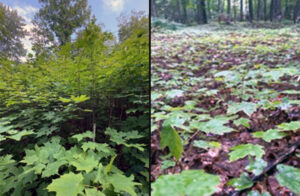
Sugar maple at various stages in Vilas County, showing examples of what revisits can illustrate. / Photo Credits: Wisconsin DNR
In 2025, the program was able to resample 83% of all stands sampled in 2022. Of the 17% not sampled, common reasons included:
- The private landowner could not be reached or declined to have us sample.
- The stand was not a true regeneration harvest, not harvested at all, or was regenerating artificially (i.e. planted into red pine).
- Old overstory removals sometimes fell into this category, with the former advanced regeneration graduating into the tree category, which causes the data to look like there is not ample regen when there otherwise may be.
- The stand was too difficult to access, there were safety concerns, or the acreage was too large.
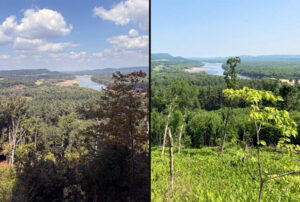
A regenerating forest stand in Pepin County, shown in two photos taken from the same location but three years apart. / Photo Credits: Wisconsin DNR
I believe that, for a good read on how Wisconsin forests are regenerating, FRM needs to have many young, regenerating stands in the program, 3-5 years from the original harvest meant to spur regeneration, in addition to these aging revisit sites. Data from young sites is likely just as valuable in evaluating how deer are impacting forest regeneration as our older sites.
Many things can change in three years of forest management, including change of ownership, change in management direction, and change in FRM sampling protocol.
At the beginning of our third cycle in 2024, we in FRM decided we would not be targeting forest stands that relate to the forest types described in the USDA’s Forest Inventory and Analysis (FIA) as elm-ash-cottonwood, and fir-spruce. This narrowed down our focus to commonly managed cover types of maple-birch-beech, oak-hickory, white/red/jack pine, and aspen in very few select counties.
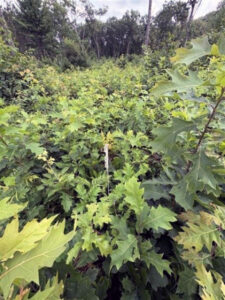
A survey pole is swallowed by oak regeneration in Monroe County. / Photo Credit: Wisconsin DNR
Additionally, we try to sample only regenerative harvests to deepen our understanding of how commonly managed forest types in Wisconsin are responding to their treatments, to the presence of deer, and to our ever-shifting ecosystems.
In many other inventory systems, sites are sampled whether they are managed or not; the forestry-related goal of FRM is to reflect on data in stands where the objective is regeneration. This will give us a window into the impact of forest management and the future availability of forest products and forest ecosystem services.
The 2026-2027 goal of the Wisconsin DNR’s FRM program is to:
- Get the big picture data out there, in the form of reports, figures, and interactive maps, for internal and external use.
- Reflect on strengths and shortcomings, adjusting the protocol and sampling accordingly.
Notes From The Field
I can’t begin this section without personally expressing my gratitude that I live in a state with so many uniquely powerful forestry programs and intelligent professionals working to make Wisconsin forests so wonderful. I have sampled for regeneration in nearly every county in the FRM program through my time as a technician and as a coordinator doing team and group trainings and have been consistently impressed at our ability to maintain incredible ecosystems. With each stand, with each county, come a different set of challenges; we aren’t always successful right away. Economic logistics, invasive species and deer all pose a threat to forest regeneration, but the adaptability and thoughtful measures I have seen applied have given me a lot of hope for the future.
What Is FRM Good At?
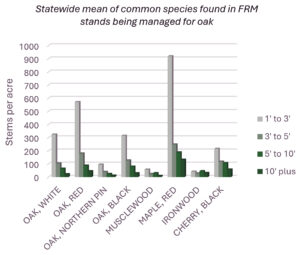 Tallying species into height classes and resampling the same sites gives insight into what species are commonly succeeding in systems across our state. This not only lets us examine those “reverse J-shaped” curves of species we want to dominate the canopy, but also of the species that may give some trouble in management. A good example of a statewide trend in recruitment is how prevalent red maple is in regenerating stands where the objective is oak. Red maple germinates and stump sprouts with extremely high success, and continues to perform highly in the absence of fire from our land. As for oak, a “scrubby” species like black oak recruits aggressively when present. The dry sites that this species primarily exist on seem more resistant to turning over into mesic hardwood forests. Black oak, despite only being found on 39% of sampled FRM sites, makes up a significant proportion of our sampled oak saplings over 5 feet statewide. Northern red oak is found on 79% of FRM sites managed for oak, and makes up a somewhat comparable volume of all 5-feet-plus saplings.
FRM data can give us foresight of not only forest product availabilty, but the ecological challenges that we may face. Our trees are threatened by all too many pests and diseases, and local overabundance of any one particular species could be a red flag for forest health.
What Could FRM Data Do Better?
I believe that FRM could tell a more complete story of competition. For example, FIA data is more descriptive of other challenges to forest regeneration that we face. In recent years, the federal program has begun tallying buckthorn as it is a rapidly growing component of our forests. This is comparable to FRM, where we do not tally buckthorn, but we do tally some non-commercial species like ironwood and musclewood within plots, as these species provide a challenge to foresters managing for timber production and ecologically important canopy trees. Having more non-commercial and invasive species tallied is important, as serviceberry means something very different to the future of the forest as woody competition compared to an exotic species like glossy buckthorn. In FRM, the estimated percent of cover of various competition only tells half the story.
Caveats Of FRM Data
FRM plots are taken on a basis of roughly one plot per every five acres. With the immense variability of forests, this is simply not enough to tell definitively whether or not an individual stand has successfully regenerated. Stand level data gives us insight, but forests still need watchful eyes of trained professionals. Individual stand observations and stand level data supplement each other, with neither being a standalone indicator of successful regeneration in many cases.
Deer browse is scored as a percent of stems of a species within a plot browsed within the last 12 months. This means that if a species has regeneration with many stems above 5’, that species could have significant deer pressure at the browse level, however, the data will show a low browse value, suggesting the immediate next generation of that species on the site is not heavily impacted by browse. Deer browse data within FRM is good for determining how forests are faring in the presence of deer, but there is noise when it comes to overall deer pressure at the browse level. Another consideration is stump sprouts, often extremely vigorous and preferred by deer. We do not tally stump sprouts, but anecdotally, I have noticed stump sprouts at the browse level often become deer buffets, whereas stump sprouts making it past the browse level drastically drop the deer browse estimates of that particular species.
Some Factors Affecting Regeneration
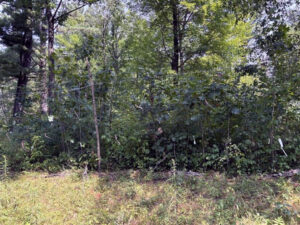
Successful deer fencing on private property in Waupaca County. / Photo Credit: Wisconsin DNR
Depending on where one is in the state, herbivory could be at the front of your mind, or at the back. We have counties in Wisconsin where deer population estimates have nearly tripled in the last 20 years. These areas are generally within an agricultural matrix and have aging and decreasing hunter populations. Foresters working on private land in these regions often have a significant challenge with getting forests to regenerate under such heavy deer pressure. However, FRM deer exclosure sites in remote forested regions of the same counties show very little difference between stems browsed inside the fence versus outside. One could speculate if deer are “urbanizing” across our state, flocking to vacation homes and woodlots connecting to farms and moving out of remote areas with predator populations, almost acting as livestock as opposed to wild creatures. Deeper interpretations of this phenomenon are better left to wildlife professionals.
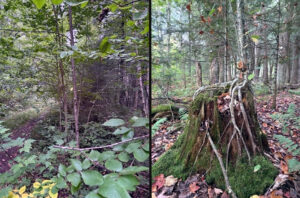
The duality of seedbed preference of yellow birch. At left, seedlings grow on a skid trail; at right, on a nurse log. Rarely is new growth seen in between. / Photo Credits: Wisconsin DNR
There are many site-specific factors that FRM does not include in the dataset. For example, regeneration may be greatly affected if the site had been scarified, burned, had earthworms, or was flooded for years post-harvest. Some species have very specific seedbeds and can be present in small amounts, and sampling may gloss over it entirely. Yellow birch comes to mind; this is a species that does not show a large amount of small seedlings, but the rate of recruitment can be rather good when it is present. All sorts of nuances and anomalies exist in the field, and this is a reason why I think taking a moment for 2-3 sentences of notes in addition to quantitative data can prove extremely useful in the interpretation of stand data.
An infinite number of factors swirl about when discussing successful regeneration. To name a few more, silvicultural efficacy and the presence of advanced regeneration, changing soils and weather patterns, and invasive species all play a role in our success in regenerating healthy forests. Statewide regeneration is not a simple thing to dissect. I hope that FRM data will continue to provide to our understanding of forest systems in Wisconsin, and that we can continue to adapt to challenges and innovate new ways to use the dataset.