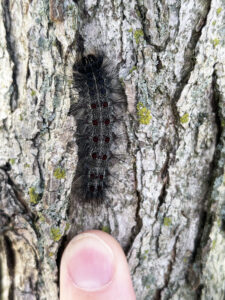
The only mature spongy moth caterpillar detected at Harrington Beach State Park in Ozaukee County in July 2026 crawls up a tree’s mainstream. / Photo Credit: Wisconsin DNR
By Bill McNee, DNR Forest Health Specialist, Oshkosh
Bill.McNee@wisconsin.gov
Wisconsin’s recent period of high spongy moth (Lymantria dispar) populations came to an end in 2025 and the population remained very low in 2026.
Only a handful of caterpillar reports were received, most often coming from southern Jefferson County and eastern Dane County. Most notably, numerous bur oaks were reported to be infested with several hundred caterpillars per tree in and around Cambridge, Fort Atkinson and Lake Mills; light feeding damage was visible.
No aerial spraying is known to have occurred in 2026 to reduce high spongy moth populations, although the Slow-The-Spread program run by the Wisconsin Department of Agriculture, Trade and Consumer Protection continued to treat newly established, low populations in several western Wisconsin counties. These treatments included a site at Perrot State Park in Trempealeau County.
Overall spongy moth populations are likely to be low in Wisconsin for at least the next few years, although it is possible that some sites could see a population increase before then if local weather conditions are favorable for the insect.
Tree Defoliation and Mortality Update
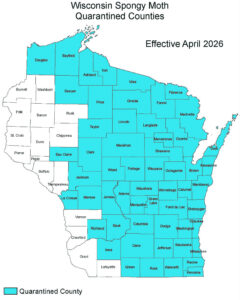
A Wisconsin map showing quarantined counties due to spongy moth. as of April 2026. The quarantine is meant to limit the westward spread of the invasive insect and requires inspection and certification of certain wood products and outdoor items before they can be moved into non-quarantined areas. / Map Credit: Wisconsin Department of Trade, Agriculture and Consumer Protection.
No observable spongy moth defoliation was mapped during Wisconsin Department of Natural Resources aerial surveys this summer. 2026 was the second consecutive year without observed defoliation – a dramatic change from more than 300,000 defoliated acres in both 2023 and 2024.
Aerial surveys in southeast Wisconsin and central Marinette County found that there was no significant expansion of moderate or heavy oak mortality, but some areas already showing heavy oak mortality were observed to have a slight but noticeable increase in the amount of tree mortality. Scattered ongoing mortality in the previously defoliated areas was also observed from the ground in south central and southwest Wisconsin. Other areas of Wisconsin were not surveyed in 2026 but are presumed to have comparable observations.
During the recent outbreak, it is believed that areas with average or above-average precipitation in early summer had greatly reduced mortality, even though defoliation may have been heavy.
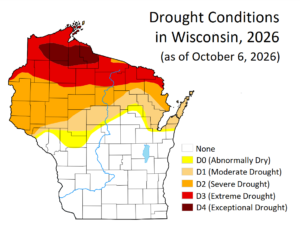
A Wisconsin map showing drought conditions as of October 6, 2026. Map created by David Mocko, NASA/GSFC/SSAI. / Graphic Credit: Wisconsin DNR
Scattered twolined chestnut borer mortality was observed in areas of Marinette County that had experienced defoliation-related mortality in 2025. A DNR fact sheet on twolined chestnut borer is available online. Since the last major defoliation occurred in 2024, most of the resulting defoliation-related tree mortality should have occurred by now. It is possible that some trees weakened by prior defoliation may still die from lingering defoliation stress, but it is likely that more recent stresses such as severe or extreme drought will be the ultimate cause of future tree mortality in 2027 and beyond.
As of late September, much of Wisconsin was in a dry condition and the northern half of the state was especially droughty (see map below). It is important to monitor forest stands in drought-stressed areas for signs of decline and mortality, especially in stands that were defoliated in 2024. These stands may still be experiencing residual stress from the defoliation and have now faced a summer of intense drought. Weakened oaks are commonly infested by Armillaria root disease and twolined chestnut borer and then die.
In particular, stands in far northern Wisconsin should be monitored. Several of these counties with previous heavy defoliation transitioned to a droughty condition early in the growing season and areas continued to worsen into “Exceptional Drought” by September (see map). This is the most severe drought classification and it is only the second time since 1999 that part of Wisconsin has been in this category (source: National Weather Service).
Forest Management Considerations
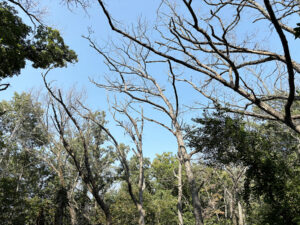
A pocket of oak mortality on the Kettle Moraine State Forest in Waukesha County, September 2025. / Photo Credit: Wisconsin DNR
Consult a local forester if significant tree decline or mortality is observed in forest stands impacted by current drought or recent defoliation, or if planning management activities in stands that were heavily defoliated within last few years.
A previous edition of Forest Health News had an article summarizing the management of impacted stands. Watering yard trees during dry periods can help to reduce tree stress and increase the likelihood of survival.
Forest management activities such as stand thinnings or oak shelterwood creation in susceptible forests may be best conducted while spongy moth populations are low and defoliation-related stress is not expected. Considerations include drought, tradeoffs between the time required to prepare and conduct a timber sale and the declining value of dead trees over time.
Conduct Egg Mass Surveys to Predict Next Year’s Populations
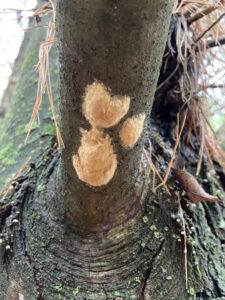
Three egg masses on a tree on the Kettle Moraine State Forest – Southern Unit. Each egg mass can contain 300 or more eggs that will hatch in early spring. / Photo Credit: Wisconsin DNR
Late fall is a good time to look for and dispose of spongy moth egg masses produced during the summer by adult moths. Spongy moth egg masses are tan-colored lumps about the size of a nickel or quarter and are found on trees, buildings and other outdoor objects. They may also be found in protected places such as firewood piles and birdhouses. Each newly produced egg mass contains hundreds of eggs that will hatch in the spring. Newly produced egg masses will feel firm and appear darker in color than older egg masses, which appear faded, feel spongy and do not contain viable eggs.
Sites where heavy caterpillar mortality was seen over the past few summers are unlikely to have high numbers of egg masses. Management options include scraping egg masses into soapy water or applying egg mass oil to suffocate the eggs. An egg mass survey can be conducted to help property owners and communities predict the level of defoliation in 2027, and to determine if active management (physical controls or insecticide application) is needed.
A “Protect Your Trees From Spongy Moth” video is available online to assist property owners in conducting predictive egg mass surveys.
Quarantine Area Expands By Two Counties In 2026
A Wisconsin map showing quarantined counties due to spongy moth. as of April 2026. The quarantine is meant to limit the westward spread of the invasive insect and requires inspection and certification of certain wood products and outdoor items before they can be moved into non-quarantined areas. / Map Credit: Wisconsin Department of Trade, Agriculture and Consumer Protection.
In April 2026, Green and Sawyer counties were added to the spongy moth quarantine area. The announcement was made April 15 by the Wisconsin Department of Agriculture, Trade and Consumer Protection (DATCP), based on trapping data collected last year. Under quarantine regulations, wood products and outdoor household items must be inspected or certified before moving them from quarantined areas to non-quarantined areas. Quarantine regulations apply to both businesses and individuals. Information about the spongy moth quarantine can be found online.
Fifty-six of Wisconsin’s 72 counties are currently included in the spongy moth quarantine area. Spongy moth is considered generally established across the eastern two-thirds of Wisconsin in the quarantined counties (see map), but small numbers of egg masses may also be found at sites in the western counties that are not quarantined.
Additional Recommendations
Property owners are encouraged to examine their trees and take action if needed. Specifically:
- Visit the online Spongy Moth Resource Center for management information relevant to both forest and ornamental trees. Physical controls and insecticide application to individual trees may be a suitable management strategy while populations are low.
- Consult a forester or arborist for additional management recommendations. The DNR maintains an online forester directory. When seeking an arborist for advice about ornamental trees, check these directories: Wisconsin Arborist Association, International Society of Arboriculture, and Tree Care Industry Association.
- An Aerial Spray Guide is available online for landowners or groups interested in organizing an aerial spray to protect high-value trees. Planning for an aerial spray in the spring of 2027 should begin this fall. In recent years for-hire applicators have used airplanes, helicopters and drones to apply insecticide from the air. The State of Wisconsin does not offer a state-sponsored or cost-share program for treating private property to prevent defoliation by spongy moth.