
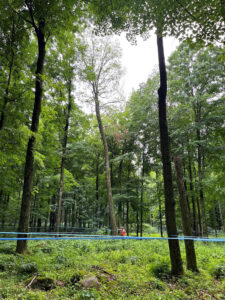
DNR Forester Paul Etten stands at the base of a sugar maple tree that has small leaves and a thin crown. The tree was dissected and found to have extensive sapwood streaking. / Photo Credit: Wisconsin DNR
By Alex Hornung, DNR Forest Health Specialist, Plover
Alexandra.Hornung@wisconsin.gov
There are some tree diseases that really get a lot of attention and others that get lost in historical documents, only popping up now and again to ignite excitement within the local plant pathologist community.
Maple sapstreak is one of the latter. This year, a site in Shawano County was found to have several trees experiencing symptoms of the disease. The symptoms led to a positive identification of maple sapstreak.
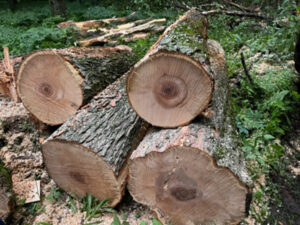
A cross-section of sugar maple logs from the same tree, showing sapwood streaking not related to the maple syrup taps located near the lower five feet of the tree. / Photo Credit: Wisconsin DNR
Maple sapstreak is a vascular xylem disease that causes thinning crowns, chlorotic (discolored) and stunted leaves, and eventual mortality of sugar maple. The fungus that causes the disease can enter new trees through wounds made near the roots during the growing season, most often during late spring through August.
Wounds near the ground can be made during logging activities, road building, or hauling maple sap out of sugar bushes. The fungus causes extensive vascular staining, ranging from very light to very dark color in cross-section. The forest that was positively identified this year is used for maple syrup production, but the taps themselves are not likely the source of disease based on research done on maple taps in the 1980s and 90s. The more common infection points are wounds made closest to the ground by the above-mentioned activities.
Prior to this detection in Shawano County, sapstreak of sugar maple was only mentioned a few times in the Wisconsin Department of Natural Resources Forest Health team’s annual reports. The first detection in Wisconsin was made in 1971 on the Nicolet National Forest in Forest County. It was then detected in 1984 and 1986 in Menominee County. After that, the disease was identified in Shawano County in 2006. We can now add 2026 to the short list of mentions.
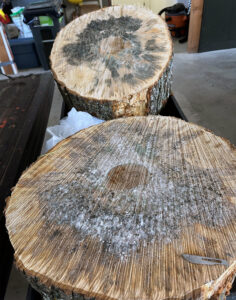
Sporulation of the fungus on logs within a few days of being left in a non-temperature-controlled environment. / Photo Credit: Wisconsin DNR
The impact of maple sapstreak is not as rapid as that of diseases such as oak wilt, and it will not cause mass mortality of sugar maple within a stand. Top-down decline, branch dieback that starts at the top of the tree, fewer leaves in the upper branches, and early fall color are symptoms commonly observed. Symptoms advance to the whole crown being affected; eventually, the trees can die. When trees are cut down the staining is evident in the cut ends of the logs. Typically, sapstreak affects a few trees here and there, and causes dieback and mortality over 1-5 years, rather than within a single growing season as oak wilt does.
Once identified, the diseased trees should be removed during regularly scheduled forest management practices. The disease is not a decay fungus, so the wood is still solid but it will have staining that may reduce the value of the log. To prevent sapstreak, sugar maple stands should not be harvested during spring and early summer, or caution should be used to avoid damaging the base of sugar maples, the root flare, or major roots, because the fungus can enter the trees on wounds that are in contact with soil.