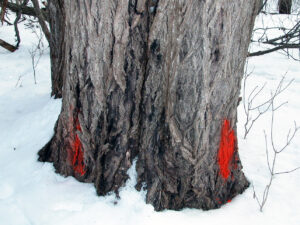
Black-stained spots indicate numerous butternut cankers near the base of this pair of trees. / Photo Credit: Wisconsin DNR
By Linda Williams, DNR Forest Health Specialist, Woodruff
Linda.Williams@wisconsin.gov or 920-360-0665
Butternut trees aren’t all that common in Wisconsin. Many people have never seen one, and those who do often call them “white walnut.”
In recent years, butternut trees have become even less common because the disease butternut canker (Ophiognomonia clavigignenti juglandacearum) continues to infect and kill the trees.
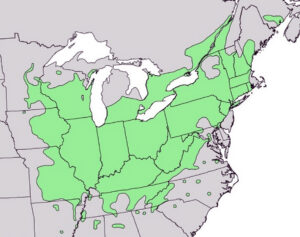
A map showing the native range of butternut trees in green. / Map Credit: Elbert Little, United States Forest Service
Severe infections can cause trees to decline and eventually die, although there are a few individual trees throughout the range of butternut that are resistant to the disease.
If you’re not sure if you can identify a butternut tree, check out this document from Purdue University with lots of pictures comparing butternuts with common hybrids.
Wisconsin has the distinction of being the first state to find butternut canker, in 1967. Wisconsin also has the world’s largest planting of butternut progeny to test resistance to the canker.
Symptoms of trees infected with butternut canker include dead and dying branches and decline in the canopy of the tree. Looking more closely at susceptible trees, you’ll see vertically elongated cankers, or dead spots, in the bark that will ooze black fluid, staining the edges of the cankered area black. These blackened cankers could form anywhere on the branches and trunk, including near the base of the tree.
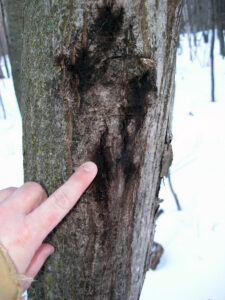
Black staining around multiple butternut cankers. / Photo Credit: Wisconsin DNR
Susceptible trees can have 50 or more cankers. All those dead spots prevent adequate movement of water and nutrients, and the tree declines and usually dies. Resistant trees may have no visible cankers, a minimal number of cankers, or very small cankers. This is because the tree can stop canker growth and heal over the dead areas.
Resistant trees should be identified and, if possible, preserved during forest management activities. Evaluate each butternut tree by looking at the amount of live crown and number and size of cankers.
Retain trees that have no visible cankers on the main stem and root flare if at least 50% of the tree’s crown remains alive. Or, if a tree has only a few cankers and more than 70% of the crown is alive, the tree may be a candidate for retention. More specific instructions for butternut tree evaluation can be found in the document Butternut – Strategies for Managing A Threatened Tree.
Resistant trees in Wisconsin can be reported to Wisconsin DNR forest geneticist Scott O’Donnell at Scottt.ODonnell@wisconsin.gov for inclusion in possible future genetic research. Additionally, you can report your tree in the TreeSnap app, which is used by researchers to compile reports of lingering trees that may be candidates for resistance breeding programs.
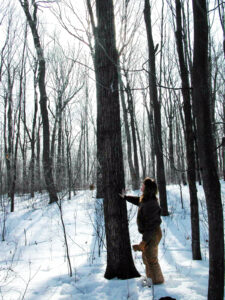
Evaluating butternut tree health. Healthy trees should be retained, if possible, during forest management activities. / Photo Credit: Wisconsin DNR
During forest management activities, create openings around resistant trees by removing neighboring trees. These openings allow seed from the resistant tree to have a chance to grow. Butternut seedlings do not tolerate shade well, so make sure the opening around a potentially resistant tree is large enough that lots of sun can reach the young seedlings — usually two to three tree lengths all the way around the resistant tree.
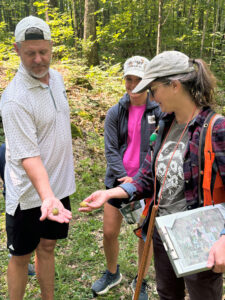
Collecting nuts from a healthy butternut tree to plant in nearby openings can be a fun family activity. / Photo Credit: Wisconsin DNR.