
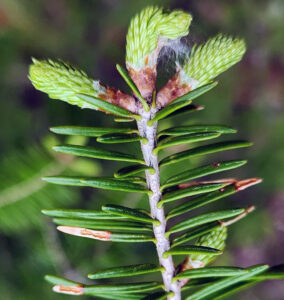
Young spruce budworm larvae begin feeding as buds break, causing the new growth to crook where feeding damage occurs. Webbing shown in the photo is also common. / Photo Credit: Wisconsin DNR
By Linda Williams, Forest Health Specialist, Woodruff
Linda.Williams@wisconsin.gov or 920-360-0665
The spruce budworm outbreak is continuing for yet another year in some areas of northern Wisconsin.
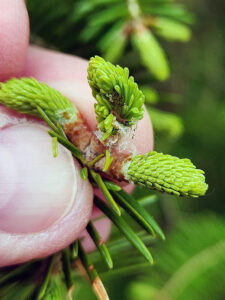
Pulling apart the webbing and examining new growth reveals a tiny, brown caterpillar with a black head, feeding within the expanding buds. / Photo Credit: Wisconsin DNR
During the third week of May, expanding buds on balsam fir trees were already showing damage from the tiny larvae. Spruce budworm overwinters as a tiny caterpillar that begins feeding as soon as buds begin to swell. Early feeding can cause expanding buds to curl slightly into a half-moon shape, and larvae may web together two or more buds so that they can feed safely within the webbing.
Budworm caterpillars continue to web needles together and continue feeding on needles as those needles expand. Older larvae continue webbing pieces of needles that will turn reddish-brown and remain on the tree into summer. Feeding is typically finished by mid-June, when caterpillars pupate. Moths emerge towards the end of June, mate and lay eggs, and the life cycle is completed for the year.
The spruce budworm fact sheet has more information on biology and management.
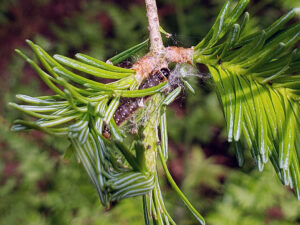
As caterpillars grow, they continue feeding on new needles as the needles expand further. / Photo Credit: Wisconsin DNR
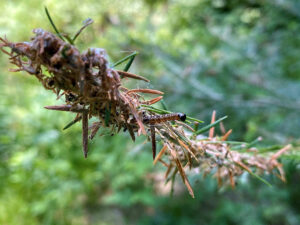
Spruce budworm caterpillars leave half-eaten needles, dead needles, and messy webbing as they feed. / Photo Credit: Wisconsin DNR