
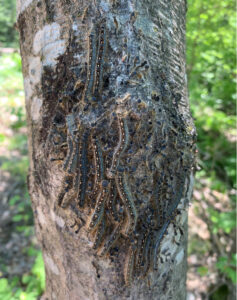
Forest tent caterpillar larvae displaying gregarious, clustering behavior on a tree stem. / Photo Credit: Wisconsin DNR
By Paul Cigan, DNR Forest Health Specialist, Hayward
dnr.wisconsin.gov/topic/foresthealth/staff, 715-416-4920
Populations of forest tent caterpillar (FTC) are likely to remain low throughout northern Wisconsin this growing season, continuing a record 23-year statewide trend.
Spring egg mass surveys showed a low presence of overwintering egg masses, suggesting that any defoliation this season is likely to be localized. Overwintering egg masses present on the twigs of deciduous twigs and branch tips are counted during surveys to forecast FTC population density and the associated risk of heavy defoliation going into spring leaf-out.
Localized defoliation was documented in northern Taylor County in 2025, and that same area could again see some defoliation this year. Regionally, however, aspen stands will benefit from a low FTC population phase — particularly those that sustained mortality and health decline from several consecutive years of drought and spongy moth defoliation in the first half of the decade.
In Wisconsin, FTC feeds each May and June on a wide variety of deciduous tree species including aspen, ash, oak, sugar maple, birch and basswood. During these low-population periods, including those over the last 22 years, FTC defoliation remains localized and light in intensity, usually going unobserved and unreported. It is common to see individual caterpillars on leaves or branches, or an occasional cluster of caterpillars on a tree stem.
Historically, populations undergo eruptive cycles every six to 16 years in the state, during which time they can explode within 1-2 growing seasons. During these outbreaks, defoliation can occur over more than several million acres in peak years and last 2-5 years. Tree mortality can occur in drought-stressed stands following consecutive years of defoliation, often after attack by secondary diseases and insect pests such as Armillaria root disease and bronze birch borer. Spring weather conditions that have been cooler and wetter than average cause reduced caterpillar population survival and growth by enhancing the activity of pathogenic fungi and slowing larval developmental rates.
Forest managers and forest landowners are advised to watch for and report defoliation for the remainder of this and coming years, as a significant population upswing is expected. FTC can be misidentified as other caterpillars, such as eastern tent caterpillar, fall webworm or spongy moth, so it’s important to correctly identify the insect in question.
Please report any suspected FTC defoliation to your regional forest health specialist and learn more about FTC identification and biology on the DNR Forest Health webpage.