
By Bill McNee, Forest Health Specialist, Oshkosh
Bill.McNee@wisconsin.gov
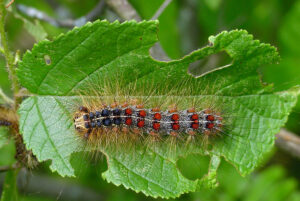
A spongy moth caterpillar feeds on a leaf. / Photo Credit: Wisconsin DNR
Property owners are encouraged to monitor their trees for spongy moth larvae and damage this summer to determine whether control measures are needed.
Property owners who have oak, birch, crabapple, aspen, willow and linden (basswood) trees should be particularly watchful because the caterpillars of this invasive insect prefer these species.
However, they will feed on many other kinds of trees and shrubs.
Population Status
Although overall spongy moth populations are currently low, it is possible that some locations will see a rapid population increase this summer if weather conditions continue to be warm and dry. Daily high temperatures in late May and early June reached the mid- to upper 80s, which were often 10-15 degrees above average. Population increases are probably more likely in areas that didn’t have a recent outbreak (temporary population explosion) over the last few years.
A population increase to noticeable or nuisance-level caterpillar numbers would be the likely degree of population increase in 2026. Widespread heavy defoliation is not expected, although heavy defoliation could occur on individual trees or small areas.
Research has shown that the rate of spongy moth caterpillar development reaches its maximum at 84 degrees. If weather conditions remain warm and dry in June, it is likely that parts of southern Wisconsin will have adult females present and laying eggs by early July.
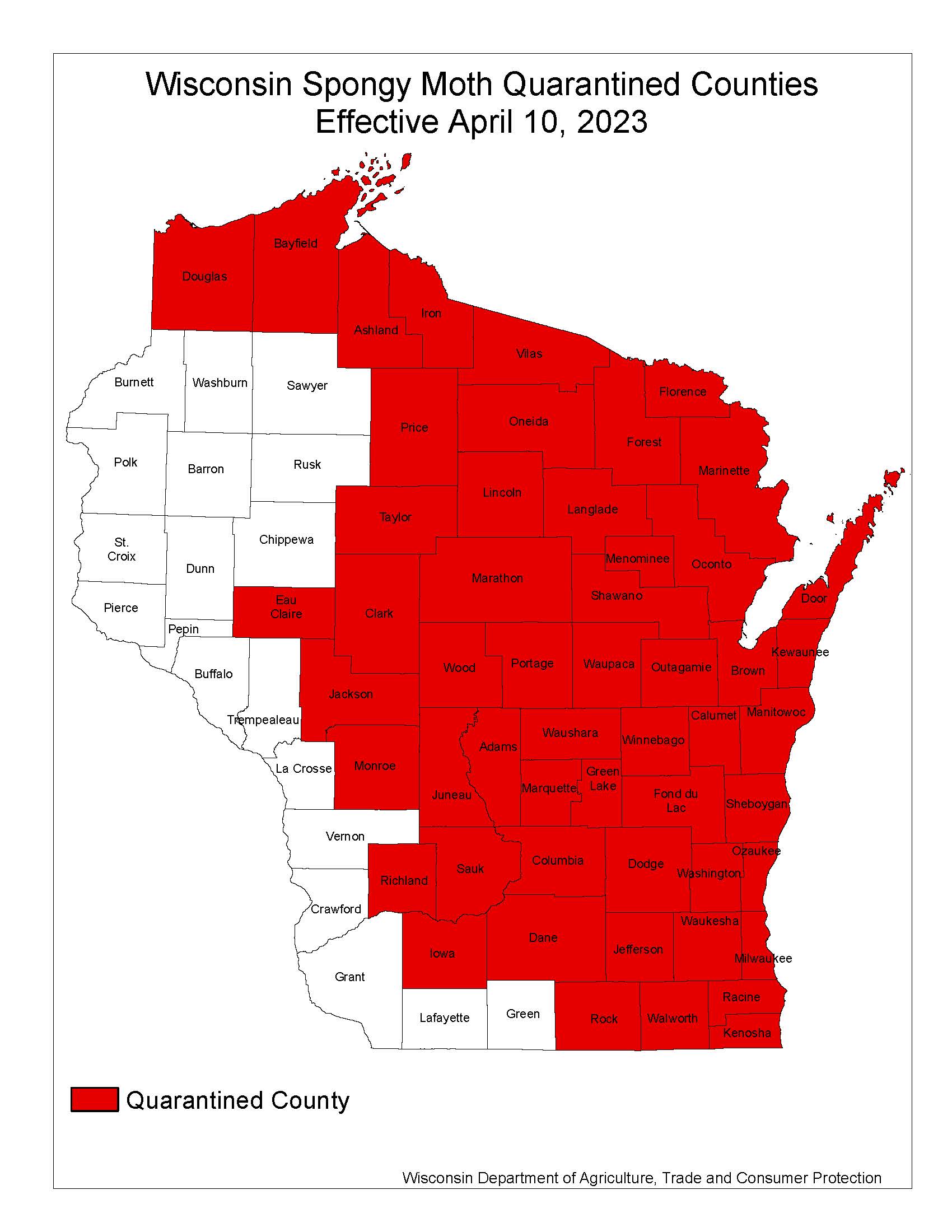
Spongy moth is considered generally established across most of Wisconsin, except the western third of the state. Rising spongy moth populations are most likely to be seen within parts of the quarantined area, but may be noticeable in parts of non-quarantined counties.
Management Options
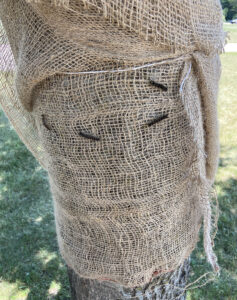
Spongy moth caterpillars are caught in a burlap collection band. / Photo Credit: Wisconsin DNR
At moderate populations, physical controls can reduce pest impacts and make insecticides unnecessary. Physical controls for larger caterpillars include crushing them, brushing them into soapy water to drown them, and putting up burlap collection bands to destroy caterpillars daily.
Insecticide treatments, including foliage sprays and soil and trunk injections, may be a suitable control option if large numbers of caterpillars are observed on high-value trees. A professional treatment is likely needed when there are high numbers on large trees.
Resources for finding a qualified pesticide applicator include the Wisconsin Arborist Association, the International Society of Arboriculture, the Tree Care Industry Association and a local phone book or online directory.
Monitor Trees For Decline And Mortality
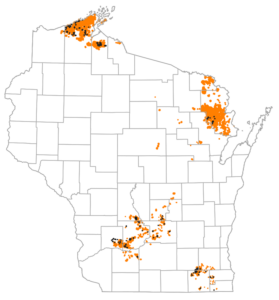
A map of Wisconsin counties, showing 2025 spongy moth tree defoliation (orange) and mortality (black). / Map Credit: Wisconsin DNR
Property owners are encouraged to monitor their trees, particularly oaks, for crown dieback, twolined chestnut borer infestation and mortality in trees that were stressed by drought and defoliation over the past few years. About 98 percent of Wisconsin was not in a droughty condition as of late May, and most trees have started the growing season with adequate soil moisture, so this will help to reduce the amount of new tree decline and mortality.
It is possible that tree mortality could still occur in previously defoliated areas, as these trees may remain alive in a weakened condition for up to three years before finally dying. DNR staff observed approximately 20,000 acres of heavy oak and aspen mortality during aerial surveys last summer. It is likely that additional mortality will be seen in 2026, primarily within the areas that were heavily defoliated in 2023 and 2024.
Consult a forester if significant tree decline or mortality is observed in forest stands, or if planning management activities in stands that were heavily defoliated over the last few years. These stands may still be experiencing a degree of residual stress from the period of drought and defoliation that largely ended in 2024, or from droughty conditions in 2025. Contact an arborist if yard trees are experiencing signs of decline.
Additional Recommendations
Property owners are encouraged to examine their trees and take action. Specifically:
- Visit the Spongy Moth Resource Center for management information. Options for June and July include physical controls and insecticide application.
- Watch this video showing how to use a burlap collection band to catch and kill spongy moth caterpillars.
- Insecticide treatments can be a suitable option for high-value host trees but are not practical for woodlots.
- Water yard trees weekly during dry periods to help reduce tree stress and aid a tree’s recovery from heavy defoliation, should this happen.
- Avoid touching the hairy caterpillars, as well as the moths and egg masses that will appear later in the summer. The hairs often cause a skin rash, welt or other irritation. Rubbing alcohol can help to remove the hairs and chemical irritants from skin that is exposed to the hairs.
- Wait to cut down any trees that are defoliated. Healthy hardwood trees usually produce a new set of leaves a few weeks after caterpillar defoliation.
- This fall, conduct egg mass surveys to predict the level of the 2027 population and help determine if active management is needed. A “Protect Your Trees From Spongy Moth” video is available online to assist property owners in conducting predictive egg mass surveys. Egg mass oiling or removal are options for the fall months.
Consult an arborist or forester for additional management recommendations.