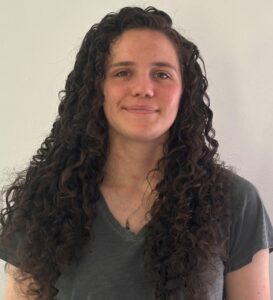
Katie Hill has been named the Wisconsin Department of Natural Resources Forest Health technician for West Central Wisconsin. / Photo Credit: Wisconsin DNR
By Art Kabelowsky, DNR Outreach and Communications, Fitchburg;
Arthur.Kabelowsky@wisconsin.gov or 608-335-0167
As a youngster, Katie Hill found her future outdoors.
Now, as she steps in as the Wisconsin Department of Natural Resources (DNR)’s Forest Health technician for West Central Wisconsin, she continues working to turn those early goals into reality.
“I’m extremely excited for this opportunity,” Hill said a week before stepping into her new role.
Hill will take over some of the duties of Tim Shively, who left the DNR in late May to accept a Forest Pathology faculty position at Michigan State University.
While she’s new to this role, Hill is not new to the DNR. She was hired in May 2025 as a Forest Regeneration Monitoring (FRM) technician, stationed in Eau Claire. FRM technicians visit public and private lands across all counties with at least 30 percent forest cover, to assess the regeneration of recent harvests throughout the state.
Hill’s introduction to the outdoors came early on, while growing up in the Bay Area of California. Still, it took a while for her to zero in on a specialty in forestry and forest health.
“I don’t know that I had a main focus on the forest growing up,” Hill said. “My Dad was a park ranger, and I enjoyed going to work with him. We would frequently leave the city and drive up into the mountains, and it always was something I looked forward to doing.”
When it came time to chart a college and potential career choice, Hill chose Willamette University in Salem, Oregon, to study environmental science. Eventually, she gravitated toward forestry. She’s currently finishing a Master of Science degree program in Forestry at Oregon State University in Corvallis.
“I’m working on my thesis presentation; I need to defend it,” Hill said. “It’s on emerald ash borer and fungal connections. I’ve been studying to see if emerald ash borer could be carrying fungal pathogens from tree to tree, the same way some bark beetles do.”
Much of her work at Oregon State involved pine and other conifer trees, which make up almost 99 percent of Oregon’s total timber volume. Things are a bit different in Wisconsin, Hill noted.
“It’s been a major learning curve,” she said. “There’s so much hardwood diversity here in Wisconsin versus Oregon. Such an abundance of diversity.
“Learning about the growth patterns, timber harvesting, some of those details, it’s definitely a different operation here,” Hill said. “The difference in forest types is another thing I noticed — in Oregon, different forest types are dependent on elevation. Here, you have the Driftless and glaciated areas, and other geographical differences.”
Hill said her work as an FRM tech “was a great way to get into what Wisconsin forests have to offer.”
She spent much of the month of May training with Shively, making the transition easier.
“He’s been great … taking me to see many different aspects of forestry here,” Hill said. “Different red pine stands, today we’ll be looking at oak for oak wilt, we found some Heterobasidion root disease fruiting bodies yesterday. He’s showing me a vast array of information.”
Hill is happy to head back outdoors during her free time, saying she loves to “camp, fish, forage for fungi and relax under tall trees.”
Hill can be contacted at Kathleen.Hill@wisconsin.gov or 608-772-6974.