
By Nathaniel Walton, Michigan State University Extension
Updated from an original article written by Diane Brown and Lori Imboden
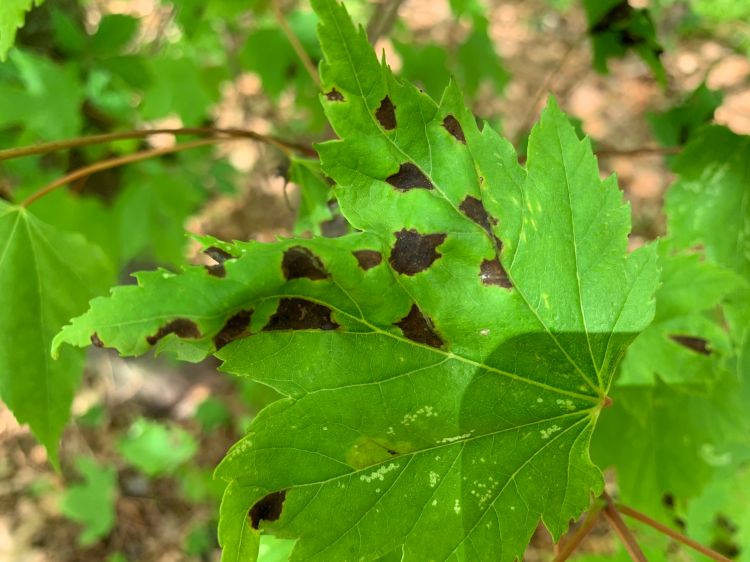
Irregularly shaped anthracnose lesions on a red maple (Acer rubrum) leaf. Photo by Rebecca Finneran, MSU Extension.
Each year, Michigan State University Extension receives questions from the public regarding spots on the leaves of their favorite maple trees. Both anthracnose and maple leaf blister can be the cause of late spring and early summer damage to leaves of these popular landscape trees.
Anthracnose is a common spring disease on maple trees common in the landscape including red (Acer rubrum), silver (Acer saccharinum), sugar (Acer saccharum) and Japanese (Acer palmatum) maples. Several different fungi can cause the symptoms we describe as anthracnose. These fungi overwinter in fallen leaf tissue and infected buds. Symptoms appear in years with cool, wet weather that supports fungal growth. Leaves of infected trees have dark, irregularly shaped damaged areas, or lesions, composed of dead tissue. The lesions grow between veins and on leaf margins.
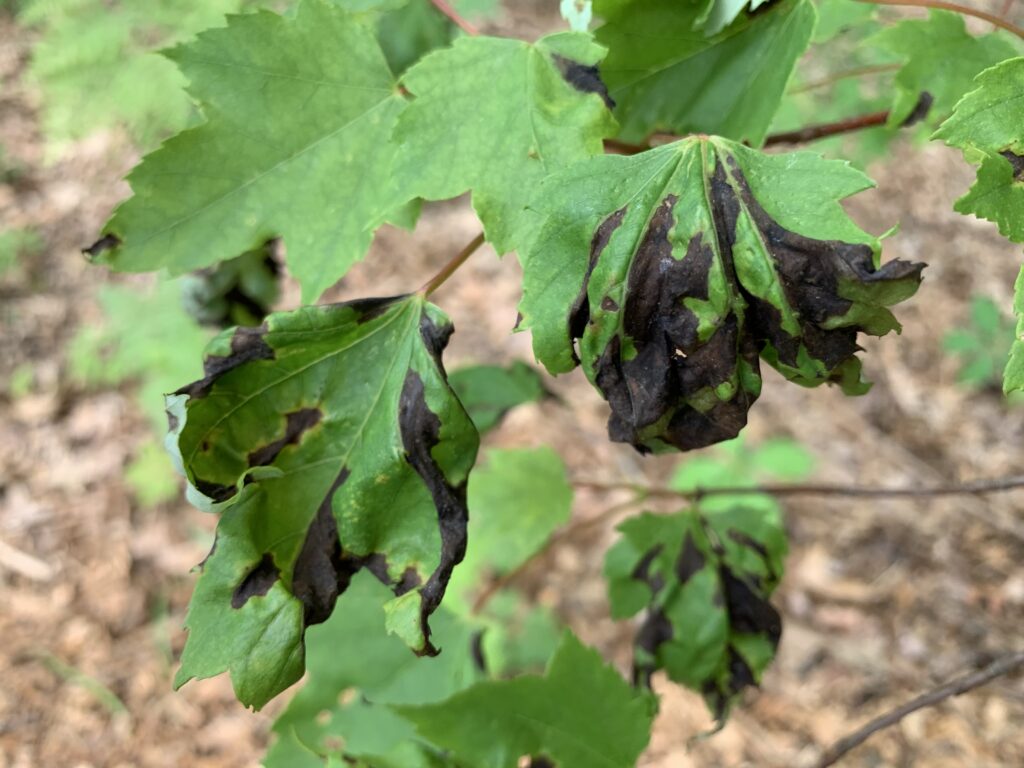
Leaves severely affected by anthracnose may be shed. Photo by Rebecca Finneran, MSU Extension.
Infections caused by anthracnose usually affect the lower branches and branches in the interior of the tree before progressing upwards. Severely affected leaves may be shed and replaced by a new set. As the tree leaves mature over the season, they become more tolerant of infection.
While the disease is not typically a threat to the health of an established tree, smart cultural practices can reduce the risk of serious damage to the tree and prevent further spread of the disease. Ensuring sufficient water (1 inch per week) will support the tree through the stress of disease and leaf regrowth. Maintaining sufficient spacing for airflow between trees creates an environment that is less favorable for fungal growth, and removing symptomatic leaves after they fall can help reduce the spread of the disease-causing fungi.
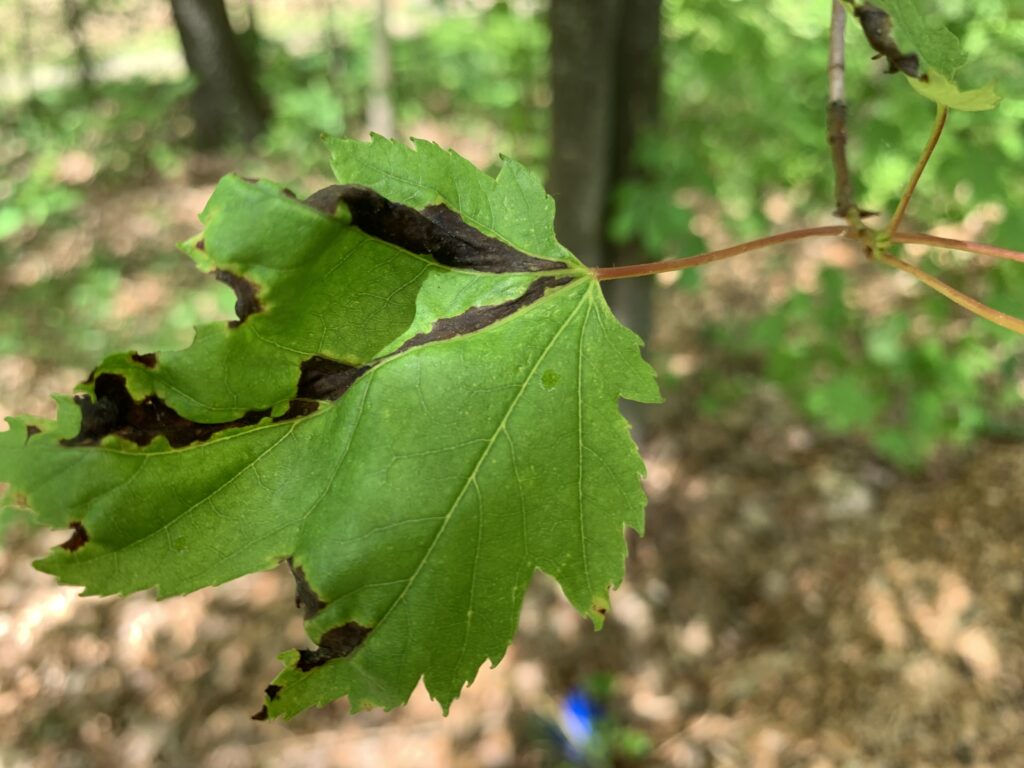
Anthracnose lesions grow between veins and on leaf margins of a red maple (Acer rubrum) leaf. Photo by Rebecca Finneran, MSU Extension.
Anthracnose may be a more serious concern in maple trees that are not well established or weakened due to other stressors. Such trees may benefit from protective fungicides early in spring, prior to infection. Products that contain chlorothalonil, chlorothalonil plus thiophanate-methyl, propiconazole or mancozeb can be used for disease control. Applications should be made in the spring at budbreak and be repeated twice at 10- to 14-day intervals, per label directions.
Maple leaf blister is a disease of maple leaves that displays symptoms somewhat similar to maple anthracnose. There are some differences. Compared with maple anthracnose, the spots are more rounded in shape and contain small, raised blisters. Lesions are a mix of lighter brown to black. The fungus that causes maple leaf blister overwinters in bud scales and attacks developing leaves early in spring. With the right weather conditions, the infection can spread rapidly and cover most of the leaves in the canopy.
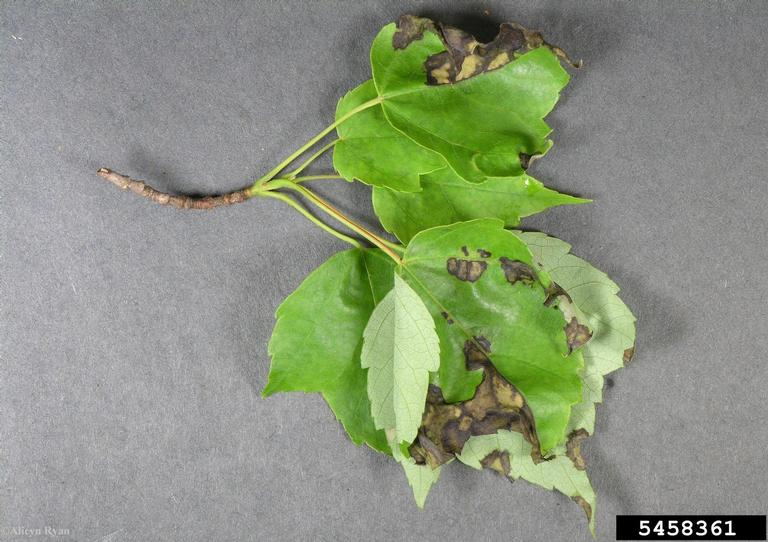
Leaf blister on red maple. Photo by Alicyn Ryan, University of Florida, Bugwood.org.
Like anthracnose, maple leaf blister is unlikely to threaten a healthy tree, and cultural practices described for anthracnose can reduce spread of the fungus and the risk of serious damage to the tree. Anthracnose and leaf blister can occur on a tree at the same time. The only way to be certain if a tree has one or the other, or both, is to send samples to a diagnostic laboratory and have it confirmed.