
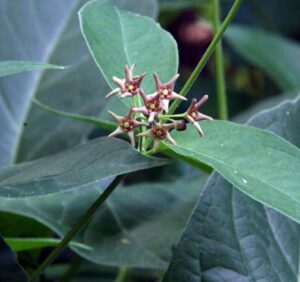
Pale swallow-wort flowers along the stem at the leaf axils. / Photo Credit: Chris Evans, University of Illinois, Bugwood.org
By Mackenzie Manicki, DNR Natural Resources Research Scientist
The Wisconsin Department of Natural Resources has confirmed that the state’s first populations of the invasive vine pale swallow-wort (Vincetoxicum rossicum) have been found.
The populations were first detected in Oconto and Shawano counties, within the outskirts of Krakow along the shared county line.
These are the first known populations in the state, making rapid response efforts critical in preventing the establishment of this species in Wisconsin.
The sites were originally reported by the Timberland Invasives Partnership (TIP) using an online invasive species reporting tool called the Early Detection and Distribution Mapping System (EDDMapS). These reports were then brought to the attention of the DNR. TIP is a nonprofit organization focused on controlling and raising awareness about invasive species in Langlade, Menominee, Oconto and Shawano counties.
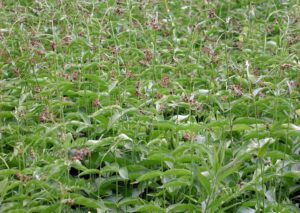
Pale swallow-wort infestation twining upward. / Photo Credit: Leslie J. Mehrhoff, University of Connecticut, Bugwood.org
Despite not having tendrils, the invasive vine twines and grows on top of surrounding vegetation, resulting in the displacement of native species in forests and grasslands. Both pale swallow-wort and its close relative, black swallow-wort (V. nigrum; also invasive), are within the milkweed family (Apocynacae) and can outcompete native milkweed. Monarch butterflies have been observed laying eggs on swallow-wort, but once they hatch, the caterpillars cannot survive on these non-native milkweed relatives. The DNR offers information about pale and black swallow-wort.
Due to these impacts, pale swallow-wort is classified as a prohibited invasive species in Wisconsin. Invasive species are not native and cause harm to Wisconsin’s environment, economy or pose threats to human health. To help prevent the introduction and spread of invasive species, the department established Wisconsin’s Invasive Species Rule (Chapter NR 40) in 2009 (last revised, 2015). Under the rule, it is unlawful to transport, transfer, introduce or possess prohibited species in Wisconsin.
The leaves of pale swallow-wort occur opposite of each other along the stem and have an oblong to oval shape with a pointed tip and smooth edges. They are light to dark green in color and can sometimes appear glossy. Slender seed pods, resembling those of milkweed plants, appear from mid- to late summer. The flowers are a key diagnostic feature and will help distinguish pale swallow-wort from black swallow-wort. For both plants, the flowers are star shaped with five petals and appear in clusters where the leaf connects to the stem (the axil). Pale swallow-wort flower petals are smooth on top, are longer and tapered and pinkish or light brown in color. Black swallow-wort petals are triangular, hairy on top and dark purple or blackish in color.
If you believe you have found pale swallow-wort, please report it to Invasive.Species@wisconsin.gov. At a minimum, please include the location and clear photos of the plant’s identifiable features. Other important details, such as population size and landownership are also encouraged. If preferred, you may also submit a report using the EDDMapS.
The department continues to work with TIP, landowners and additional partner organizations in the area to raise awareness and coordinate plant control efforts. This collaborative approach helps ensure additional populations can be found and controlled before this species can become established.