
By Elton Rogers, DNR Urban Forestry Coordinator
Elton.Rogers@wisconsin.gov or 414-294-8675
This is one of my least favorite questions to get as an urban forester/arborist; it’s right up there with “how old is my tree?” The reason I despise this question is not because it is a bad question, but rather it is a complex one. A question that often requires much more discussion than the person who asked it is looking for…
Of course, there is an easy way out. You can always give them the stock answer by identifying the species and/or cultivar, looking up that species on a myriad of different resources (i.e. Dirr, Missouri Botanical Garden, Virginia Tech Dendrology, etc.) and give them the projected tree height and crown width. But have you ever wondered where those projections come from? Are they accurate? Well, let’s find out.
For the first time ever, we have an Urban Forest Inventory and Analysis program (UFIA) and the first few years of data available. For more information on this program, check out the website, but long story short, we now have an extensive dataset of how big certain tree species are getting across all sorts of land uses in the urban environment. From this data, we pulled out the most common trees found in Wisconsin communities and the average tree heights and crown widths of mature specimens.
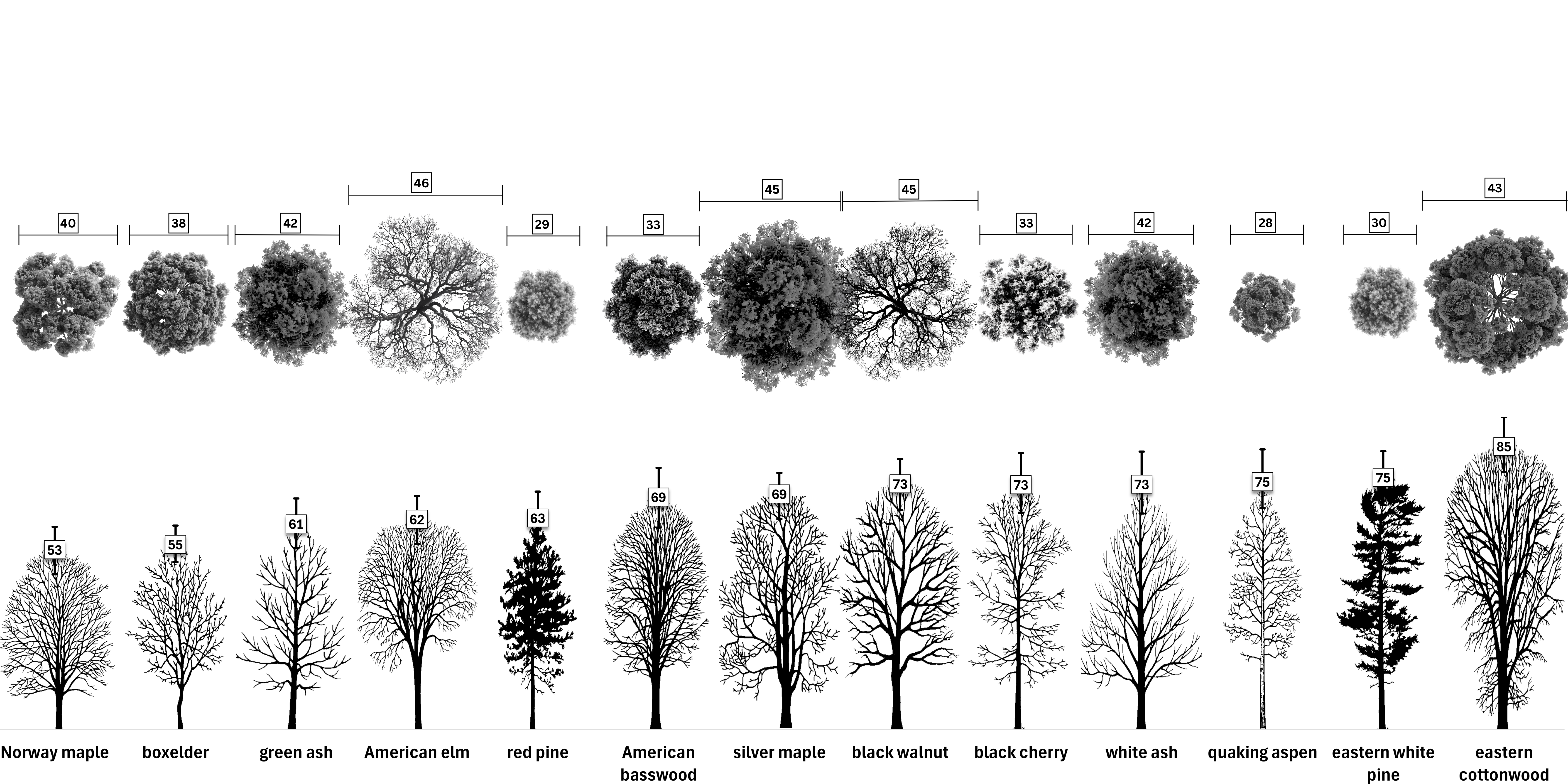
Figure 1: Tree size averages and ranges of the most commonly found trees in Wisconsin urban spaces. / Image Credit: Wisconsin DNR
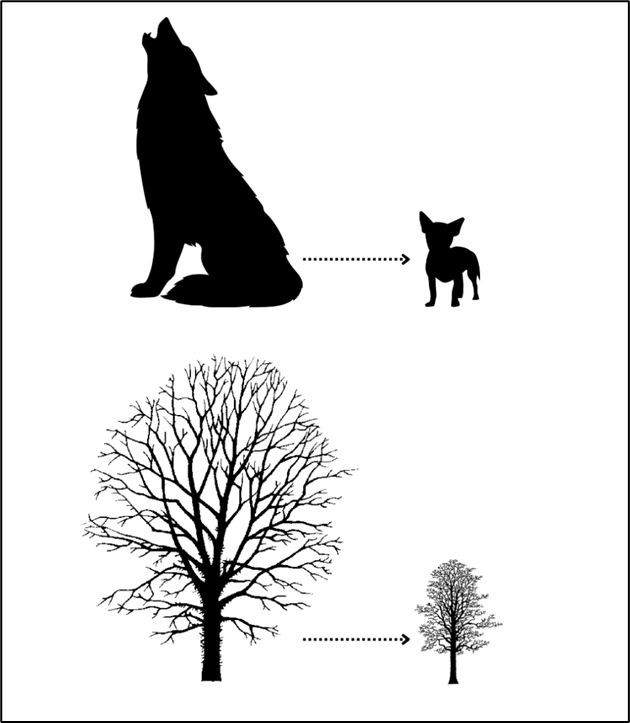
Some extreme examples of dwarfing. The bottom tree images represent a seed grown honey locust (left) that grows to 70 feet tall and 70 feet wide and the cultivar ‘Elegantissima,’ which gets only 20 feet tall and 15 feet wide. / Image Credit: Wisconsin DNR
Now, there are lots of factors that will influence mature tree size outside of just species. Some notable factors include available soil volume, sunlight exposure, cultural care and cultivation techniques. One of the more interesting concepts I have explored recently is the idea of mature tree size and cultivation. It’s become apparent that when a straight species of tree (ex. honey locust) is used to create cultivars, those cultivars, on average, are smaller than the straight species. Using honey locust as an example, it is estimated that, at maturity, you can expect a honey locust grown from seed to get roughly 70 feet tall and 70 feet wide. If you take all the various honey locust cultivars found in Wisconsin tree inventories (i.e. Skyline®, Street Keeper®, Sunburst®, etc.), they average out at a mature tree size of 40 feet tall and 40 feet wide. In some ways, we are doing the same thing to trees as we have done to the Canis genus; taking a 130-pound wolf to a 2-pound chihuahua.
All this being said, we continue to refine our understanding of trees and how they grow and interact with the urban environment. For many scenarios, underestimating or overestimating mature tree sizes by a few feet is not going to matter. However, we do want estimates to somewhat accurately reflect actual tree sizes in the urban landscape. As an example, many texts have black walnut estimated at a mature tree height of 75-100 feet and an equally large crown spread. The UFIA data, however, shows a size much closer to 65-80 feet in height and 40-50 feet in crown spread. We ultimately just want to give the best information and size estimates as possible to homeowners, municipalities, nonprofits and other entities to help ensure that they are planning and managing their trees as effectively as possible.