
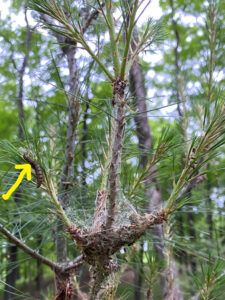
Messy webbing filled with frass (droppings) and pieces of needles are signs of pine false webworm feeding on this young white pine. The arrow points to a pine false webworm larvae. / Photo Credit: Wisconsin DNR
By Linda Williams, Forest Health Specialist, Woodruff;
Linda.Williams@wisconsin.gov, 920-360-0665
Pine false webworm (Acantholyda erythrocephala) is not a very common insect in Wisconsin, though it is present. They prefer to feed on white pine in Wisconsin, though reference materials say they will also feed on red pine, jack pine and Scotch pine.
Damage was reported as “minor” in the central part of the state from 1953 to 1961. Later, in 1995, 1997, 2002, 2004 and 2006, it was once again observed as a minor pest feeding on red or white pine in the central part of the state, particularly Portage, Waupaca and Waushara counties. In 2024 and again this year, a few scattered young white pine were observed being significantly defoliated in Oneida and Vilas counties.
Pine false webworm is not a native insect to North America. It was accidentally introduced into the United States in 1925. No widespread outbreaks have been reported in Wisconsin.
Adult webworms resemble wasps and emerge in the spring to mate and lay eggs on the needles of a nearby pine tree. They prefer younger trees, from 5 to 20 feet tall, although there are reports from Ontario of pine false webworm feeding on older, larger trees. Larvae feed on old needles, creating lots of webbing that traps bits of needles and lots of frass (insect droppings), leaving a very messy, defoliated tree.
Mature larvae drop and burrow into the ground, overwintering as a prepupae which will complete pupation in the spring prior to emerging as an adult.
By the time most people notice the defoliation caused by pine false webworm, the damage is done for the year and no control is necessary for that year.
Sawfly larvae are not true caterpillars, so Btk pesticide products do not work; a different pesticide is required. Check product instructions carefully.
It’s important to scout in the spring so you can spray when the larvae are young, as webbing will protect older caterpillars from pesticides.