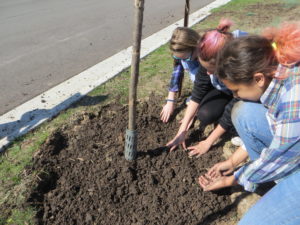
People from across the state celebrate trees

In 1872, J. Sterling Morton recognized the power of and need for trees. Morton helped set aside a special day for planting trees. After the success of the first Arbor Day that year, it became a legal holiday and now is celebrated across the world.

There is a lot to celebrate when it comes to trees, they shade us and reduce cooling costs, they help clean our air and water, they create a safe and inviting community, and they beautify our cities, streets and neighborhoods. Continue reading “People from across the state celebrate trees”

Trees clean the air and prevent respiratory illness

May is National Asthma and Allergy Awareness Month. Did you know trees help prevent asthma and other respiratory diseases? Trees filter particles out of the air we breathe, which decreases our risk of respiratory illnesses, including asthma. One study found that in 2010, trees removed 17.4 million tons of air pollution across the US, which prevented 850 human deaths and 670,000 cases of acute respiratory symptoms. Continue reading “Trees clean the air and prevent respiratory illness”

Urban tree identification tool available

By Dan Buckler, Urban Forestry Assessment Specialist

Many guides help you distinguish between a black and a northern red oak, or between a beech and a musclewood. But for many people just trying to identify a tree outside their door, these guides might not be appropriate. Some include too many trees from out-of-state, some focus on trees only found in rural areas, and some others are weighed down by detail.  Continue reading “Urban tree identification tool available”

New, customizable resource shows the value of trees

Money doesn’t grow on trees, or does it?

People know the many benefits that trees can provide – clean our air, beautify our communities, reduce stormwater runoff, and decrease noise pollution – but did you know trees also save you money?  With technology from i-Tree you can calculate how much your trees are saving you.  Now, with a new resource from the USDA Forest Service Urban Natural Resources Institute (UNRI), you can let others know exactly how much your trees are saving you. Continue reading “New, customizable resource shows the value of trees”

May 2, 2019 Wildfire Report

Wildfire Report for May 2, 2019

Widespread precipitation has kept wildfire activity low lately. In the past week, 63 wildfires burned 54 acres in DNR protection areas (approximately half the state); 35 homes and other buildings were threatened but saved with firefighter assistance and 3 buildings were destroyed.  Debris burning was the most common cause (30 fires); equipment was the second most common cause (17 fires). Other minor causes included power line, campfires, and ash disposal. As the vegetation dries out on the days we don’t receive rain, expect fire danger to increase, particularly in areas where standing dead grass and other dry vegetation remains.

If you choose to conduct outdoor burning, remember that a free annual burning permit is required to burn small piles of debris and to burn in a burn barrel in DNR protection areas. Burning permits are frequently suspended this time of year when fire danger increases. You must check the day’s burning restrictions every day you intend to burn by calling 1-888-WIS-BURN (947-2876) or by checking online at dnr.wi.gov, keyword ‘fire danger’.  Larger piles and daytime burning requires a special permit from a DNR Ranger. Piling your debris in a campfire pit does not make it okay to burn during the day.  If your property is outside a DNR protection area, check with local officials for burning restrictions.

Leaf and needle debris under decks can ignite and start the deck and house on fire.

Remove leaves and needles from your roof, around your foundation and under your deck to prevent ignition by a flying ember.

Firewise Tip: Homeowners are encouraged to make weekly checks around your home or cabin for windblown leaves and needles on your roof, around your foundation, and under decks and elevated porches; keep these areas clean. The debris that collects in these places could be easily ignited by flying embers produced during a wildfire.

Value-added Wood Manufacturing Industry Survey Results

By Scott Lyon, Forest Products Specialist

The value-added wood manufacturing industry (or secondary wood manufacturing industry) includes companies that use primary wood products such as lumber or veneer to produce higher value products, such as flooring, cabinets, millwork, furniture, sporting goods, doors, windows, roof trusses, wall panels, and other building materials. The industry includes more than 800 facilities, employs more than 20,000 workers, and generates a direct economic impact $3 billion in Wisconsin (WI DWD 2019; IMPLAN DATA 2017).

Continue reading “Value-added Wood Manufacturing Industry Survey Results”

Mass Timber University Grant Program

The announcement below has been reprinted with the written permission by the US Forest Service – Forest Products Laboratory and its original author, U.S. Endowment for Forestry and Communities.

The U.S. Endowment for Forestry and Communities (Endowment), in partnership with the United States Department of Agriculture’s Forest Service (USFS), announced the initiation of the Mass Timber University Grant Program (grant program) and related Request for Proposals (RFP) to promote the construction of mass timber buildings on institutions of higher learning campuses across the U.S.  The intent of the grant program is to inspire interest in and support for mass timber products among the architectural, developer and building communities as well as the public, by showcasing them in highly-visible projects on university campuses.

Continue reading “Mass Timber University Grant Program”

Upcoming forest products events

Hardwood Lumber Grading Course
Date: May 14- 16
Location: Grayling, MI

Sawing, Edging, and Trimming Class
Date: May 17
Location: Grayling, MI

Hardwood Lumber Grading Course
Date: June 3- 5
Location: Prairie du Chien, WI

Kiln Drying Short Course Drying Quality Lumber
Date: August 12- 15
Location: Antigo, WI

Local-Use Dimension Lumber Grading Workshop
Date: August 22
Location: DNR Service Center in Green Bay, WI

Great Lakes Timber Professionals Association Logging Expo
Date: September 5 -7
Location: UP State Fairgrounds – Escanaba, MI

Timber Product Output Project

By Alex Anderson, Forest Products Specialist

In April 2019, the Forest Products Services program mailed surveys to the majority of primary wood-using firms in Wisconsin. Historically, this survey was colloquially termed the “drain survey,” but it is now generally referred to as the Timber Product Output (TPO) survey. The survey captures information on Wisconsin’s forest products industries, including the total number of firms and employees in the sector, roundwood consumption, and the utilization of residues. Data collected during the survey remains completely confidential and is compiled only at the county and state levels.

The TPO survey is conducted for a variety of reasons. Firstly, the data allows for a direct comparison to previous years’ surveys, which grants us an opportunity to analyze the forest products industry’s performance over time. Additionally, the survey data paints a vivid picture of just how valuable the forest products industry is to the overall well-being of Wisconsin’s economy, including its central role in driving sustainable forest management in the state. The TPO results are also utilized in conjunction with Forest Inventory Analysis data to assist firms in making informed business decisions, such as forecasting resource availability or evaluating procurement strategies.

We hope to have the data compiled by end of 2019. Once the data is available, we will publicize it here.

My Wisconsin Woods Values Your Woodlands

YOUR WOODS can be a source of food for your family.
OR your favorite hunting ground.
OR even create a source of income!

Whatever you value most, your woods are your gateway to the outdoors. Whether you own several hundred acres or just enough to take a short walk, sustainably managing your woodland is important. The best part is you don’t have to do it alone. My Wisconsin Woods, a public, private partnership serving woodland owners across the state, has launched a comprehensive landowner portal to connect you with natural resource professionals, forestry events in your area, and free information and materials. Recently released is a video series for landowners who are curious about what forestry benefits might exist or have nagging concerns. This series was made possible through the generous support of the Ruffed Grouse Society and David Moore with production and content provided by the Department of Natural Resources, Aldo Leopold Foundation and Driftless Area Land Conservancy.

So let’s go exploring …