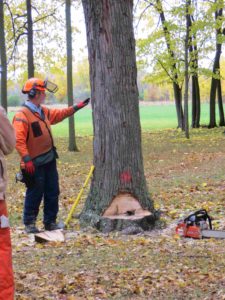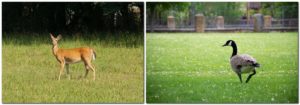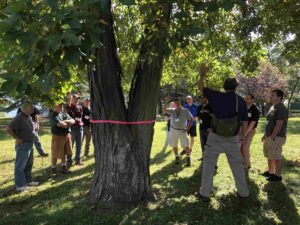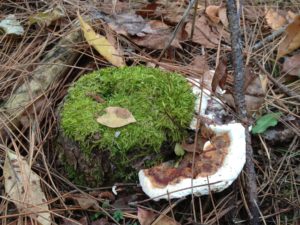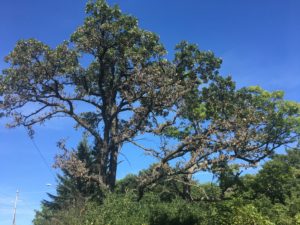
On the north side of Milwaukee is a park with a name more evocative of a medieval forest than one of the most densely populated parts of modern Wisconsin. Yet its history is as rich, its canopy as green and its deer as plentiful as any royal hunting ground. Havenwoods State Forest is Wisconsin’s only urban state forest and thus plays a critical role in connecting urban populations to nature. Continue reading “The continuous transformation of Havenwoods State Forest”
Native caterpillars not a major concern for trees
Mike Hillstrom, forest health specialist, Fitchburg, Michael.Hillstrom@wisconsin.gov, 608-513-7690
Eastern tent caterpillars (ETC) are hatching and beginning to feed on host trees, including cherry, apple and crabapple. Landowners and homeowners may notice the white silken tents forming in branch forks. Although they form unsightly tents, ETC is a native insect so management is not typically necessary. Even completely defoliated trees will put out new leaves within a few weeks.

A group of eastern tent caterpillars warm themselves on white silk tent before leaving to feed on black cherry leaves.
If landowners want to remove the tents the best time to do so is early morning or evening when the caterpillars are inside. Unless it is raining, eastern tent caterpillars leave their tents each morning to feed throughout the day before returning at night. Caterpillars can be removed either by hand if they are within reach or with a rake if they are high in the tree. They can then be killed by soaking them in soapy water or sealing them in a trash bag. Insecticides are rarely necessary but should penetrate inside the tent if used. Do not prune branches, burn tents or soak them with WD-40. These methods are more harmful to the tree than ETC defoliation and are not recommended.
For more information on eastern tent caterpillar, read this factsheet from UW-Madison Division of Extension.
Protect yourself from ticks and tickborne illnesses
Bill McNee, forest health specialist, Oshkosh, Bill.McNee@wisconsin.gov or 920-360-0942

Adult deer tick. Credit: Scott Bauer, USDA Agricultural Research Service, bugwood.org.
So far this spring we are off to a busy tick season, with many reports and photos being sent in to DNR staff. Ticks can be found year-round in Wisconsin but are most active from May to September. Some species, including the deer tick responsible for Lyme disease, carry infectious diseases that elevate them from mere nuisance to serious health threat. Lyme disease is most often spread by very small, immature ticks known as “nymphs.” Adult deer ticks can also transmit Lyme disease, but because they are larger, they are more likely to be discovered and removed compared to the tiny nymphs which can be as small as a chia or sesame seed.
Continue reading “Protect yourself from ticks and tickborne illnesses”
Needle and leaf diseases are back!
Mike Hillstrom, forest health specialist, Fitchburg, Michael.Hillstrom@wisconsin.gov, 608-513-7690
It’s nearly summer and the usual cast of disease characters are on the scene following wet spring conditions. Rhizosphaera needlecast and other needle diseases impacting spruce continue to be a major concern for landowners and homeowners. Diseases in hardwoods are also popping up. For more information on needle and leaf diseases affecting trees in Wisconsin and resources to learn more, click below to read full article.

Spruce trees impacted by Rhizosphaera needlecast.
Branch tips littering the ground under your trees?
Linda Williams, forest health specialist, Woodruff, Linda.Williams@wisconsin.gov, 920-360-0665
Have you been noticing branch tips scattered on the ground beneath spruce, fir or pine trees this spring? You may be seeing one of a few things – damage from small animals or breakage caused by the harsh winter we had. Fortunately, the damage from either is unlikely to do serious harm to your trees.

Spruce branch tips found on ground were clipped from tree by squirrels.
Continue reading “Branch tips littering the ground under your trees?”
Educational EAB DVDs available for order

Educational EAB DVDs.
Marguerite Rapp, communications and education/outreach specialist, Madison, Marguerite.Rapp@wisconsin.gov, 608-843-3506
The Forest Health Program has educational DVDs on the emerald ash borer (EAB) available for order. Produced in 2010 by the Wisconsin Cooperative EAB Program, the DVDs contain three videos to help viewers identify emerald ash borer, ash trees and signs of infestation. Each video is between 3-6 minutes in length.
If you would like free copies of this DVD for yourself or to share with partners and organizations in your community, please send an email to Marguerite.Rapp@wisconsin.gov that includes your name, mailing address and total number of copies needed. Please share this offer with anyone who may be interested.
Northwestern county forests trap for EAB
Paul Cigan, forest health specialist, Hayward, Paul.Cigan@wisconsin.gov, 715-416-4920

EAB purple prism trap in ash tree.
A number of county forestry partners in northwest Wisconsin are trapping for emerald ash borer (EAB) on their properties this year with technical assistance from the DNR forest health team. Potential captures of EAB may give officials a better understanding of the invasive beetle’s distribution in the region that can support forest management planning and public awareness. Partners conducting trapping include Bayfield, Douglas, Rusk, Sawyer counties and the Barron County Conservation District. Landowners and property managers are encouraged to report signs and symptoms of EAB activity to their regional forest health specialist.
Learn more about emerald ash borer and signs/symptoms of infestation at the DNR emerald ash borer page.
Another low year for forest tent caterpillar
Paul Cigan, forest health specialist, Hayward, Paul.Cigan@wisconsin.gov, 715-416-4920 and Linda Williams, forest health specialist, Woodruff, Linda.Williams@wisconsin.gov, 920-360-0665

Forest tent caterpillar larvae emerging from egg mass.
Forest tent caterpillar egg surveys conducted in northern counties indicate hardwood defoliation from this native insect will remain low in 2019, sustaining a 16-year trend. The last FTC outbreak affected northern Wisconsin from 1999 – 2002. Cooler and wetter than average spring weather may indirectly reduce caterpillar populations by enhancing the activity of pathogenic fungi. Please report any possible defoliation to your regional forest health specialist.
To learn more about this insect, visit the DNR forest tent caterpillar webpage.
Wildfire Report 5-16-19

Lower moisture levels in pines increase the possibility for torching pines.
A total of 51 wildfires burned in DNR Protection Areas over the past week, burning 86 acres. The majority of the fires were caused by debris burning, with several railroad and powerline fires. Four structures were threatened and all four were saved. One significant wildfire occurred in the Woodruff Area and burned approximately 40 acres before containment. Widespread rain is expected across the state into the weekend.
As starch and carbohydrate levels build up in our red and jack pine species, their moisture levels will drop significantly. Over the next week, we will be at the low point of this moisture level, and the possibility is highest for torching pines and surface fires transitioning to crown fire activity. There is also still plenty of dead grass and fallen leaves on the land that makes it easy for a wildfire to start and spread. Stay apprised of fire weather conditions by checking the DNR fire danger webpage each day after 11 a.m.: dnr.wi.gov, keyword “‘fire”.
Firewise Tip: Make sure your burn sites are completely out and not retaining heat before leaving the area!
Wildfire Alert
Fire danger is at High to Very High today, May 15 in several areas. The WI DNR is suspending burning permits for debris piles and broadcast burns in many counties due to forecasted winds, low humidity and dry vegetation. Please use caution outdoors with anything that could cause a spark including chainsaws, dragging trailer chains, and even hot exhaust systems from off-road vehicles. For the current fire restrictions, visit https://dnr.wi.gov/topic/ForestFire/restrictions.html