By Collin Buntrock, Forest Products Team Leader
The Forest Products Services program recently worked with the Technology Services Section in the Division of Forestry to develop an interactive mapping tool highlighting Wisconsin’s primary wood-using mills.
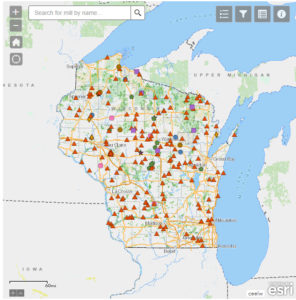
The new mill mapping tool highlights Wisconsin’s primary mills.
The goal of the mapping tool is to facilitate better marketing of forest products by connecting value-added industries with Wisconsin’s primary mills and by assisting forest managers and loggers with identifying markets for harvested timber. Mill data can be refined by county, species processed, products utilized, and products sold and then downloaded for later reference.
Wisconsin’s primary forest products industry consists of firms that manufacture logs and pulpwood into wood and paper products. Specific examples include sawmills, veneer plants, pulp mills and firewood processors, as well as companies that manufacture products such as composite panels (e.g. oriented strand board, particleboard), shavings, utility poles, wood pellets, and log buildings.
Mill data featured in this tool is collected by Forest Products Services staff as part of the USDA Timber Product Output survey. The FPS program will refine this dataset beginning in early 2019. It should be noted that a subset of mills opted-out of the mill dataset. Therefore, you may be aware of additional mills that are not included in the mapping tool.
If you know of a business that would like to be included in this mapping tool, please send an email to a staff member on the Forest Products Services team and include their contact information, species and products utilized, and products produced.

 “I have an opportunity to be a voice in the conversation.” As a new member of the Council on Forestry, Jordan Skiff, Fond du Lac public works director and Urban Forestry Council chair, will be an advocate for urban and community forestry, sharing its challenges and proclaiming its benefits. Skiff fills the urban forestry seat vacated by Dr. R. Bruce Allison in December 2016.
 Wisconsin Active Together starts 2019 by recognizing fourteen new communities from across the state for their efforts to promote active lifestyles and for their pledge to do more–because in addition to celebrating accomplishments, communities can make resolutions to foster health too! Where we live impacts our wellness and the newly named Wisconsin Active Together Communities, now reaching 1.4 million Wisconsinites across the state, know that even small changes in the landscape and in promoting physical activity can add up to creating lasting changes for everyone’s benefit. And your community can now also apply to be recognized in 2019 for its commitment to advancing strategies for safe places to walk, bike, and be active while getting connected to resources, training, and a peer network of experts.